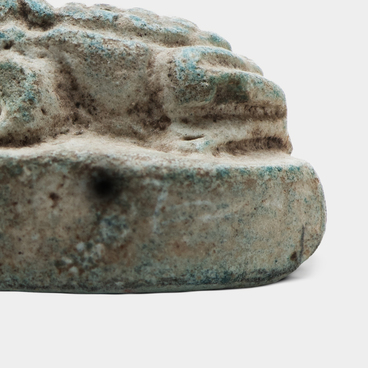
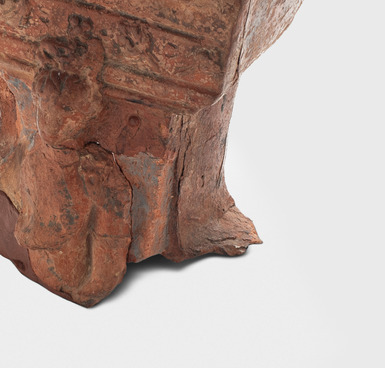
A variety of jewelry made from the so-called “Egyptian faience” were widely distributed among the people of the Northern Black Sea Region during the first centuries of the common era. This is an opaque material of a turquoise, purple, or yellow color. Although it is glass-like, it is completely different from glass — both ancient and especially modern.
The collection of the Tanais Archaeological Museum-Reserve features a round bead with the head of the child-god Horus depicted on it. It was discovered in 1973. Apparently, there was a loop for hanging at the top of the plaquette. The relief image of the god is depicted schematically, with a bead around his neck that resembles a necklace. Researchers refer to it as the “head of the child-god Horus” also known as Harpocrates. Such pendants were made in Egypt, most likely, in Naucratis workshops. Through ancient trading centers, they were transported to the barbarian tribes of the Crimean region and more remote parts of Eurasia. According to the beliefs of ancient people, the head of Horus provided protection against evil spirits and negative emotions and sometimes even helped cure severe illnesses. However, it is unlikely that the inhabitants of Tanais or their contemporaries in other parts of the Northern Black Sea Region fully understood the significance of these symbols. Most likely, the objects which had aesthetic value for the Bosporan Kingdom, were endowed with ideological meaning that was understandable to local residents. Faience figurines were included in small necklaces made of various beads and pendants, or were worn in leather pouches attached to belts along with other amulets.
The name “faience” originated from the Italian city of Faenza, where a special type of glaze based on kaolin clay was produced in the 15th and 16th centuries. Ancient faience did not contain a ceramic basis. In the literature on glassmaking, the term was used to refer to a material that appeared earlier than glass. It was opaque and was made from a mixture of silica (sand) and alkali (soda or ash), just like glass itself.