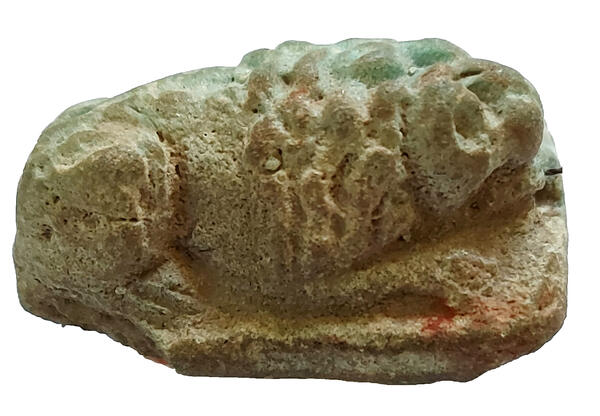
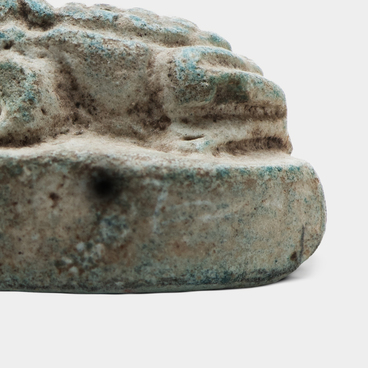
The exhibition of the Tanais Archaeological Museum-Reserve features a pendant — a lion on a plaque — that was discovered in Tanais in 1961. The plaquette has an almost rectangular shape and schematically depicts a lion with outstretched paws and a large head with round eyes. It is placed on a rectangular stand. The lion has tucked its front paws under its head. The body is straight. The stylized mane is represented by separated shields that protrude one from under the other. The mouth of the lion is open. The through hole runs along its body, painted in a grayish-turquoise color.
Beads and pendants made from the so-called “Egyptian faience” were a unique type of jewelry. They were widely distributed among the people of the Northern Black Sea Region in ancient times, particularly during the early centuries of the common era. These items were made from a glass-like material that often had a turquoise color, although they could also be yellow or purple. One of the distinguishing features of this material was its opaque quality, which set it apart from ordinary glass. Lion-shaped pendants were particularly popular in the Northern Black Sea Region and were often discovered in tombs, particularly in children’s graves. Similar to other “Egyptian faience” jewelry, they were likely made in Egypt and transported to the area via the Bosporus and Chersonesus. Lion pendants represented courage and bravery. Beads and pendants made of “Egyptian faience” played a significant role in the jewelry of the Northern Black Sea Region.
The Tanais necropolis features many pendants made of Egyptian faience. Lion-shaped pendants are some of the most popular products in the Northern Black Sea Region like other jewelry made of the same material, including screech beetles, herms, and anthropomorphic medallions. The peak of their popularity was in the 1st–2nd century CE. Later, they almost fell out of use. The exact reason for their use by the residents of Tanais and other settlements in the region remains unknown. They may have had religious or magical significance or were used as amulets to protect against evil forces.