#11
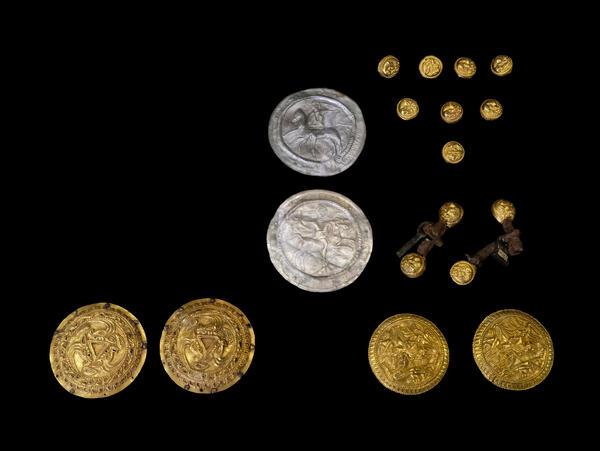
Phalera, Phalera, Phalera, Phalera, Bit shank
#12
#13
#14
Phalerae are items for decorating horse harnesses and distributing harness belts. This one was found in a hiding of a Sarmatian warrior’s burial mound. The phalerae are paired. They were found bent and rolled up since the Sarmatians had a custom to break certain things before lowering them into the graves. In addition to the phalerae, an iron sword, arrowheads, and a quiver hook were found in the burial mound.
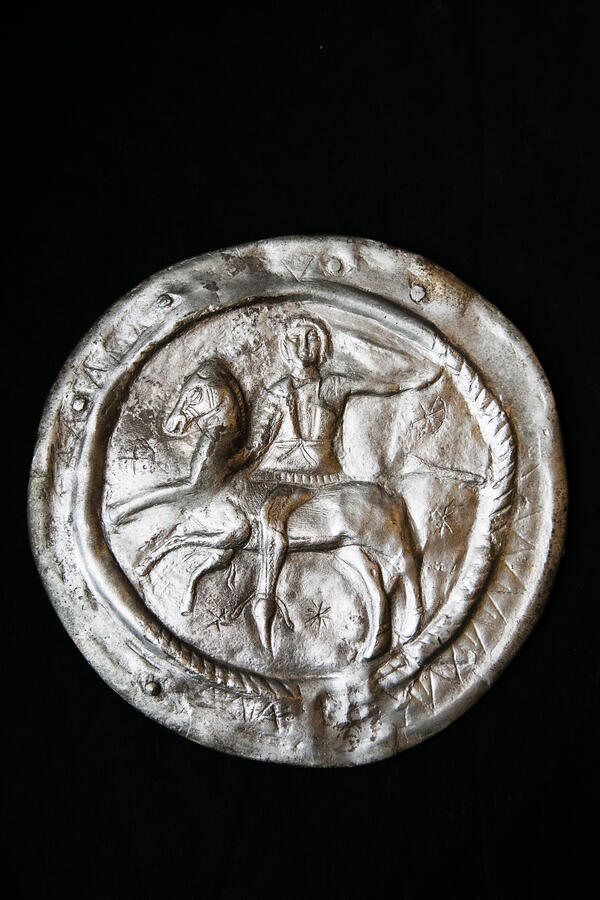
The phalera is decorated with a repoussé image of a horseman. To make the pattern, an ancient craftsman worked the item back side with an embossing die. After that, the image was engraved and embossed again outside. The front side of the phalera was gilded, which was revealed by experts during the restoration activities at the All-Union Central Research Institute of Conservation and Restoration.
The left hand of the rider is raised up and holds the spear, the right one is lowered. The rider is dressed in a shirt with a cutout; stripes on the shoulders are clearly visible, possibly they are shoulder pieces. The shirt hem is fringed with a ribbed strip ornament. The tight fit trousers end at the ankle, where you can see a strap or a foot loop. The rider’s neck is decorated with a torc. His posture is borrowed from Greek art where it emerged in the classical times and then was widely spread both in the Black Sea region and in Iran.
The horse has both front legs raised; there is no saddle and bit. The hogged mane is typical for war horses.
There are six solar symbols carved around the rider: three circled asterisks with beams and three ones without circles. Scientists suggest that it was the metal craftsman method to connotate a divine nature of the character.
All images are bordered with a bead of oblique incisions imitating a cord. There is a strip of zigzag ornament behind the bead. The bronze wire eyes are attached to the edges with silver rivets. Such phalerae were fastened with straps on the sides of horses.
This exhibit from the Astrakhan Museum Reserve collection was found by the Volga archaeological expedition from the Institute of Archeology of the USSR Academy of Sciences. The expedition worked at the construction site of the first stage of the Astrakhan-KalmYk rice irrigation system, in the vicinity of the dry bed of the KrivAya LUka creek of the Volga river in the ChernoYArsky District of the Astrakhan Region in 1974. The team was led by HErman FEdorov-DavYdov.
In 2005, the phalera and other finds were exhibited at the Astrakhan Steppe Treasures show at the National Museum of the Palazzo Venezia in Rome.
The phalera is decorated with a repoussé image of a horseman. To make the pattern, an ancient craftsman worked the item back side with an embossing die. After that, the image was engraved and embossed again outside. The front side of the phalera was gilded, which was revealed by experts during the restoration activities at the All-Union Central Research Institute of Conservation and Restoration.
The left hand of the rider is raised up and holds the spear, the right one is lowered. The rider is dressed in a shirt with a cutout; stripes on the shoulders are clearly visible, possibly they are shoulder pieces. The shirt hem is fringed with a ribbed strip ornament. The tight fit trousers end at the ankle, where you can see a strap or a foot loop. The rider’s neck is decorated with a torc. His posture is borrowed from Greek art where it emerged in the classical times and then was widely spread both in the Black Sea region and in Iran.
The horse has both front legs raised; there is no saddle and bit. The hogged mane is typical for war horses.
There are six solar symbols carved around the rider: three circled asterisks with beams and three ones without circles. Scientists suggest that it was the metal craftsman method to connotate a divine nature of the character.
All images are bordered with a bead of oblique incisions imitating a cord. There is a strip of zigzag ornament behind the bead. The bronze wire eyes are attached to the edges with silver rivets. Such phalerae were fastened with straps on the sides of horses.
This exhibit from the Astrakhan Museum Reserve collection was found by the Volga archaeological expedition from the Institute of Archeology of the USSR Academy of Sciences. The expedition worked at the construction site of the first stage of the Astrakhan-KalmYk rice irrigation system, in the vicinity of the dry bed of the KrivAya LUka creek of the Volga river in the ChernoYArsky District of the Astrakhan Region in 1974. The team was led by HErman FEdorov-DavYdov.
In 2005, the phalera and other finds were exhibited at the Astrakhan Steppe Treasures show at the National Museum of the Palazzo Venezia in Rome.
#27
Date: 1st century BC – 1st century AD
Technique: repoussé work
Dimensions: Height — 0,9 cm, diameter — 15,7 cm
Collection: Astrakhan State Joint Historical and Architectural Museum Reserve
Copyright: Astrakhan State Joint Historical and Architectural Museum Reserve
Goskatalog Number: 17112927
Technique: repoussé work
Dimensions: Height — 0,9 cm, diameter — 15,7 cm
Collection: Astrakhan State Joint Historical and Architectural Museum Reserve
Copyright: Astrakhan State Joint Historical and Architectural Museum Reserve
Goskatalog Number: 17112927
#15
Phalera
#16
#17
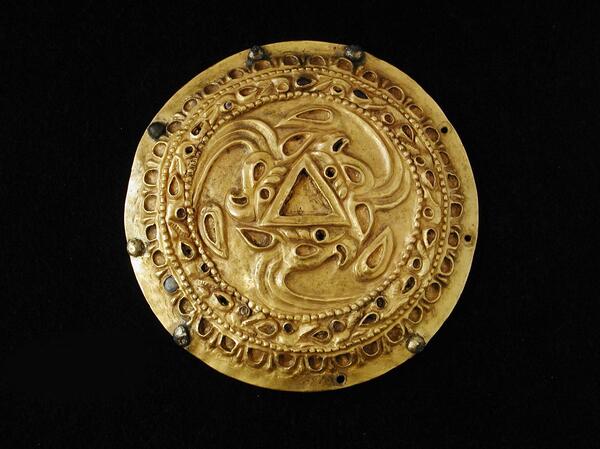
Phalerae are items for decorating horse harnesses and distributing harness belts.Our exhibit is a curved disk; there are triangular depressions surrounded by the heads of griffins in the middle, and stripes of pearl ornament around. The decor was crafted in a special way: first, an ancient craftsman pressed the ornament from the inside of the phalera, and then refined the pattern with an embossing die, chisel and punch (a tool for making dotted patterns).
The phalera is crafted in the Scythian-Sarmatian animal style: it is decorated with images of animals (in our case, they are fantastic griffins with the body of a lion and the head of an eagle), as well as with large inserts of precious stones or glass. The stones are placed in holders that are special sockets that were usually made apart and then soldered onto the base.
Researchers compare the Scythian-Sarmatian animal style with a certain language where the animal images serves to communicate ideas. Each animal had its own symbolical sacred meaning and ‘functions’. For example, the purpose of a rageful wild cat image was to be a powerful amulet for its owner. The griffin was both a predatory and winged creature, and, according to a legend, it connected all three zones of the universe (upper, middle, and lower worlds). Its image was associated with the idea of militancy and invincibility, the victory of a military state over the neighboring tribes.
The griffin images have not changed over the centuries. The classic one, a winged lion with the head of a cat or an eagle, became known around the beginning of the 1st millennium BC in the monuments of Ancient Iran and Greece. In the same era, griffin images appeared among the nomads of the Eurasian steppes. Often they decorated jewelry that ancient craftsmen produced for the Scythians and Sarmatians. The Scythian-Sarmatian version of a griffin, according to some researchers, is the head of a bird of prey with an animal’s ear.
The phalera was found in the course of archaeological activities at the ‘royal burial mound’ in 1984 by the team led by G.А. FEdorov-DavYdov, V.V. DvornichEnko and V.V. PlAkhova near the KOsika village of the EnotAevsky District of the Astrakhan Region.
In 2005, the phalera and other valuable finds were exhibited at the Astrakhan Steppe Treasures show at the National Museum of the Palazzo Venezia in Rome.
The phalera is crafted in the Scythian-Sarmatian animal style: it is decorated with images of animals (in our case, they are fantastic griffins with the body of a lion and the head of an eagle), as well as with large inserts of precious stones or glass. The stones are placed in holders that are special sockets that were usually made apart and then soldered onto the base.
Researchers compare the Scythian-Sarmatian animal style with a certain language where the animal images serves to communicate ideas. Each animal had its own symbolical sacred meaning and ‘functions’. For example, the purpose of a rageful wild cat image was to be a powerful amulet for its owner. The griffin was both a predatory and winged creature, and, according to a legend, it connected all three zones of the universe (upper, middle, and lower worlds). Its image was associated with the idea of militancy and invincibility, the victory of a military state over the neighboring tribes.
The griffin images have not changed over the centuries. The classic one, a winged lion with the head of a cat or an eagle, became known around the beginning of the 1st millennium BC in the monuments of Ancient Iran and Greece. In the same era, griffin images appeared among the nomads of the Eurasian steppes. Often they decorated jewelry that ancient craftsmen produced for the Scythians and Sarmatians. The Scythian-Sarmatian version of a griffin, according to some researchers, is the head of a bird of prey with an animal’s ear.
The phalera was found in the course of archaeological activities at the ‘royal burial mound’ in 1984 by the team led by G.А. FEdorov-DavYdov, V.V. DvornichEnko and V.V. PlAkhova near the KOsika village of the EnotAevsky District of the Astrakhan Region.
In 2005, the phalera and other valuable finds were exhibited at the Astrakhan Steppe Treasures show at the National Museum of the Palazzo Venezia in Rome.
#28
Date: 1st Century A.D.
Technique: embossing, repoussé work
Dimensions: Height — 1,6 cm, diameter — 13,7 cm
Collection: Astrakhan State Joint Historical and Architectural Museum Reserve
Copyright: Astrakhan State Joint Historical and Architectural Museum Reserve
Goskatalog Number: 17112919
Technique: embossing, repoussé work
Dimensions: Height — 1,6 cm, diameter — 13,7 cm
Collection: Astrakhan State Joint Historical and Architectural Museum Reserve
Copyright: Astrakhan State Joint Historical and Architectural Museum Reserve
Goskatalog Number: 17112919
#18
Phalera
#19

#20
Phalerae are items for decorating horse harnesses and distributing harness belts. This exhibit from our collection was created within the period from the 1st century BC to the 1st century AD. Most likely, it was crafted at the ancient sites of the East.
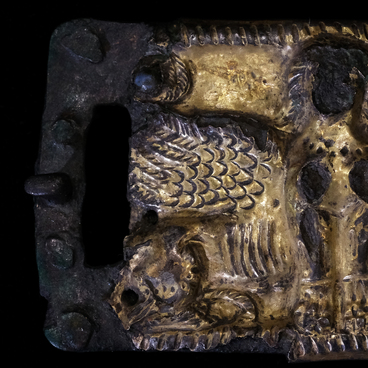
The round phalera is made on a bronze base with gold plating. Eyes made of forged bronze plate were attached to the base. The phalera is decorated with a repoussé zoomorphic ornament depicting a scene of a torment. It involves two panthers, a griffin (a fantastic animal with the body of a lion and the head of an eagle) and a fantastic animal with wings and horns depicted in the middle of the composition. Scientists have not yet come to a common conclusion what kind of animal it is. Valentin Shilov whose archaeological team found the phalera believed that it was a fantastic goat. Other scientists thought that it could be a lion griffin or a winged wolf. The so-called nosed wolf is one of the famous characters in the zoomorphic repertoire of the animal style of the Scythian era. Its images with horns and wings are not rare occurrences. Most likely, the Sarmatian animal style was enriched with the wolf-dragon image where the wolf united with the body of the Chinese hydra under the influence of the Chinese art of the Central Asia.
One of the phalera features is the decoration with a small number of inserts: an ancient craftsmab used coloured stones only to emphasize the eyes and ears of animals, and sometimes the nose (of the central figure) or the bridge of the nose (of the panther). As a rule, such inserts in the Scythian-Sarmatian style were used to decorate items quite abundantly by combining larger and smaller stones. For example, the large ones emphasized the strong muscles of animals, while the small ones were used for teeth, claws, ears, and bird feathers.
The phalera was found in 1964 on a mound near ZhUtovo station by the Astrakhan archaeological expedition arranged by Leningrad branch of the Institute of Archeology of the USSR Academy of Sciences and led by ValentIn ShIlov.
In 2005, the item and other valuable finds were exhibited at the Astrakhan Steppe Treasures show at the National Museum of the Palazzo Venezia in Rome. In 2008, it was presented at the Gold of the Sarmatians show at the State Historical Museum in Moscow.
The round phalera is made on a bronze base with gold plating. Eyes made of forged bronze plate were attached to the base. The phalera is decorated with a repoussé zoomorphic ornament depicting a scene of a torment. It involves two panthers, a griffin (a fantastic animal with the body of a lion and the head of an eagle) and a fantastic animal with wings and horns depicted in the middle of the composition. Scientists have not yet come to a common conclusion what kind of animal it is. Valentin Shilov whose archaeological team found the phalera believed that it was a fantastic goat. Other scientists thought that it could be a lion griffin or a winged wolf. The so-called nosed wolf is one of the famous characters in the zoomorphic repertoire of the animal style of the Scythian era. Its images with horns and wings are not rare occurrences. Most likely, the Sarmatian animal style was enriched with the wolf-dragon image where the wolf united with the body of the Chinese hydra under the influence of the Chinese art of the Central Asia.
One of the phalera features is the decoration with a small number of inserts: an ancient craftsmab used coloured stones only to emphasize the eyes and ears of animals, and sometimes the nose (of the central figure) or the bridge of the nose (of the panther). As a rule, such inserts in the Scythian-Sarmatian style were used to decorate items quite abundantly by combining larger and smaller stones. For example, the large ones emphasized the strong muscles of animals, while the small ones were used for teeth, claws, ears, and bird feathers.
The phalera was found in 1964 on a mound near ZhUtovo station by the Astrakhan archaeological expedition arranged by Leningrad branch of the Institute of Archeology of the USSR Academy of Sciences and led by ValentIn ShIlov.
In 2005, the item and other valuable finds were exhibited at the Astrakhan Steppe Treasures show at the National Museum of the Palazzo Venezia in Rome. In 2008, it was presented at the Gold of the Sarmatians show at the State Historical Museum in Moscow.
#29
Date: 1st century BC–1st Century A.D.
Technique: embossing, forging (basma — ?)
Dimensions: 2,5×11,5×11,5 cm
Collection: Astrakhan State Joint Historical and Architectural Museum Reserve
Copyright: Astrakhan State Joint Historical and Architectural Museum Reserve
Goskatalog Number: 17112907
Technique: embossing, forging (basma — ?)
Dimensions: 2,5×11,5×11,5 cm
Collection: Astrakhan State Joint Historical and Architectural Museum Reserve
Copyright: Astrakhan State Joint Historical and Architectural Museum Reserve
Goskatalog Number: 17112907
#21
Phalera
#22
#23
Phalerae are round discs for decorating horse harnesses and distributing harness belts. It covered the intersections of the belts. Most likely, the exhibit from our collection was crafted at the ancient sites of the East.
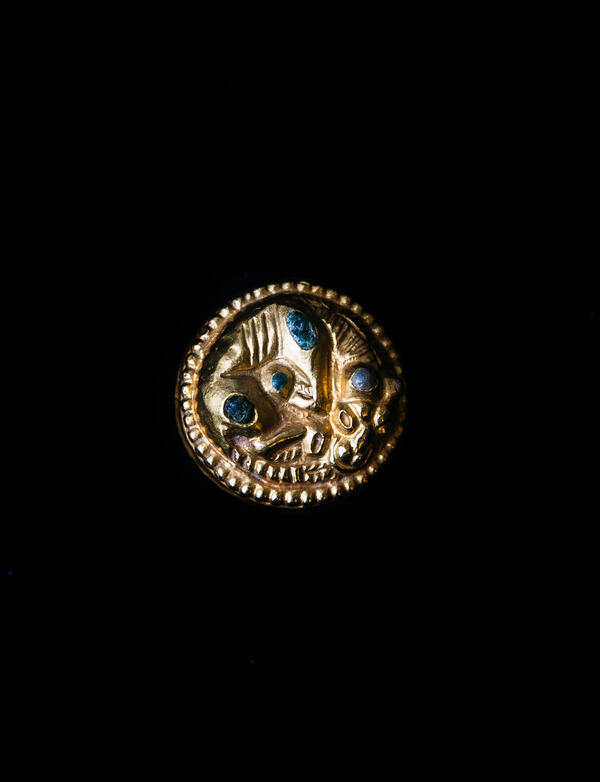
The phalera is made of bronze, while its edge is decorated with a gold plating glued to the base with a dark resinous substance. There is also an eye soldered to the base. A craftsman used a chisel to refine the smallest details of the ornament.
There is a panther curled up in a ball in the middle of the phalera. Its thigh, shoulder bone, ears, eyes and paw are decorated with inserts of blue, green, brown transparent glass and gray glass paste. The fur on the mane and ribs are marked with lines, and its tail ends with a fir tree-shaped tassel.
Totemism was widespread in the Sarmatian animal style: animals were indued with certain qualities and compared with people. The beast-predator personified the warrior and, respectively, was considered as the patron saint of military affairs. According to ancient legends, an amulet or even just an image of a totem animal inspired certain qualities in a person. For example, someone may be indued with strength, dexterity, or wisdom.
The static images of predatory animals are also presented in the Scythian-Sarmatian culture as an addition to dynamic scenes of torments. Certain animals personified various phenomena: peace, rest, sacrifice and even death. As for our phalera, the figure of a curled up animal depicted by an ancient author may symbolize the eternal movement of the universe, and the cyclical nature of life. There is a row of styled ‘pearls’ around the animal along the edge of the phalera. The pearls were made with a punch, a special tool that made it possible to apply a dotted pattern.
The phalera was found in 1964 on a mound near ZhUtovo station by the Astrakhan archaeological expedition arranged by Leningrad branch of the Institute of Archeology of the USSR Academy of Sciences and led by ValentIn ShIlov.
In 2005, the item and other valuable finds were exhibited at the Astrakhan Steppe Treasures show at the National Museum of the Palazzo Venezia in Rome. In 2008, it was presented at the Gold of the Sarmatians show at the State Historical Museum in Moscow.
The phalera is made of bronze, while its edge is decorated with a gold plating glued to the base with a dark resinous substance. There is also an eye soldered to the base. A craftsman used a chisel to refine the smallest details of the ornament.
There is a panther curled up in a ball in the middle of the phalera. Its thigh, shoulder bone, ears, eyes and paw are decorated with inserts of blue, green, brown transparent glass and gray glass paste. The fur on the mane and ribs are marked with lines, and its tail ends with a fir tree-shaped tassel.
Totemism was widespread in the Sarmatian animal style: animals were indued with certain qualities and compared with people. The beast-predator personified the warrior and, respectively, was considered as the patron saint of military affairs. According to ancient legends, an amulet or even just an image of a totem animal inspired certain qualities in a person. For example, someone may be indued with strength, dexterity, or wisdom.
The static images of predatory animals are also presented in the Scythian-Sarmatian culture as an addition to dynamic scenes of torments. Certain animals personified various phenomena: peace, rest, sacrifice and even death. As for our phalera, the figure of a curled up animal depicted by an ancient author may symbolize the eternal movement of the universe, and the cyclical nature of life. There is a row of styled ‘pearls’ around the animal along the edge of the phalera. The pearls were made with a punch, a special tool that made it possible to apply a dotted pattern.
The phalera was found in 1964 on a mound near ZhUtovo station by the Astrakhan archaeological expedition arranged by Leningrad branch of the Institute of Archeology of the USSR Academy of Sciences and led by ValentIn ShIlov.
In 2005, the item and other valuable finds were exhibited at the Astrakhan Steppe Treasures show at the National Museum of the Palazzo Venezia in Rome. In 2008, it was presented at the Gold of the Sarmatians show at the State Historical Museum in Moscow.
#30
Date: 1st century BC – 1st Century A.D.
Technique: embossing, forging (basma — ?)
Dimensions: Height — 1,5 cm, diameter — 3,6 cm
Collection: State budgetary institution of culture of the Astrakhan region ‘Astrakhan Museum-Reserve’
Copyright: State budgetary institution of culture of the Astrakhan region ‘Astrakhan Museum-Reserve’
Goskatalog Number: 17112926
Technique: embossing, forging (basma — ?)
Dimensions: Height — 1,5 cm, diameter — 3,6 cm
Collection: State budgetary institution of culture of the Astrakhan region ‘Astrakhan Museum-Reserve’
Copyright: State budgetary institution of culture of the Astrakhan region ‘Astrakhan Museum-Reserve’
Goskatalog Number: 17112926
#24
Bit shank
#25
#26
Bit shank is an element of an ancient bridle, harness for a riding horse. This set included a bit and a pair of bit shanks that were connected to each other in a certain way. Each bit shank consisted of a pair of vertical rods. It was attached perpendicularly to the end of the bit and so they were fixed in the mouth of the animal. When a rider drew the reins, the bit pressed on the horse’s gums: so the rider was able to control it.
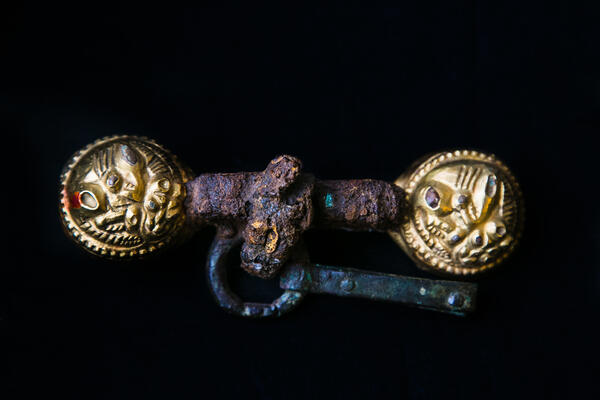
An ancient bit shank from our collection is hammered from a bar, the ends of which are flattened into round discs. Two eyes are welded in the middle of the bit shank — the outer ring of the bit was put on between them. The discs are decorated with gold phaleras. Phaleras is the name for appliques made of various metals (as a rule, gold, silver or bronze). Their cross-shaped fasteners connected the harness straps. The phaleras were often decorated with inserts of precious gems, geometric or floral ornaments, as well as zoomorphic drawings — images of animals.
The phaleras of our exhibit are decorated with images of a curled up panther. An ancient craftsman decorated the thigh, shoulder bone, ears, eyes and paws of the animal with inserts of blue, green and brown transparent glass, and also with gray glass paste. The hair on the mane and the ribs are drawn on metal, and the tail ends with a herringbone tassel.
It is difficult to say where the phaleras first appeared — similar finds were found in Ancient Greece, Egypt, in the Black Sea coastal area and Scythia. Later, their appearance changed a lot: archaeologists are of opinion that the parade harness of the Khazar horses was also decorated with phaleras.
The bit shank from our collection was found by archaeologists from the Astrakhan expedition of Leningrad branch of the Institute for the History of Material Culture of the USSR Academy of Sciences. The expedition was headed by Valentin Shilov. The excavations were carried out in 1964 on the mound near the Zhutovo station of the Oktyabrsky District (Volgograd Region).
In 2005, the bit shank was exhibited at the Astrakhan Steppe Treasures show at the National Museum of the Palazzo Venezia in Rome, and in 2008 at the Gold of the Sarmatians exhibition in the State Historical Museum (Moscow).
An ancient bit shank from our collection is hammered from a bar, the ends of which are flattened into round discs. Two eyes are welded in the middle of the bit shank — the outer ring of the bit was put on between them. The discs are decorated with gold phaleras. Phaleras is the name for appliques made of various metals (as a rule, gold, silver or bronze). Their cross-shaped fasteners connected the harness straps. The phaleras were often decorated with inserts of precious gems, geometric or floral ornaments, as well as zoomorphic drawings — images of animals.
The phaleras of our exhibit are decorated with images of a curled up panther. An ancient craftsman decorated the thigh, shoulder bone, ears, eyes and paws of the animal with inserts of blue, green and brown transparent glass, and also with gray glass paste. The hair on the mane and the ribs are drawn on metal, and the tail ends with a herringbone tassel.
It is difficult to say where the phaleras first appeared — similar finds were found in Ancient Greece, Egypt, in the Black Sea coastal area and Scythia. Later, their appearance changed a lot: archaeologists are of opinion that the parade harness of the Khazar horses was also decorated with phaleras.
The bit shank from our collection was found by archaeologists from the Astrakhan expedition of Leningrad branch of the Institute for the History of Material Culture of the USSR Academy of Sciences. The expedition was headed by Valentin Shilov. The excavations were carried out in 1964 on the mound near the Zhutovo station of the Oktyabrsky District (Volgograd Region).
In 2005, the bit shank was exhibited at the Astrakhan Steppe Treasures show at the National Museum of the Palazzo Venezia in Rome, and in 2008 at the Gold of the Sarmatians exhibition in the State Historical Museum (Moscow).
#31
Date: 1st century BC – 1st Century A.D.
Technique: embossing, forging, casting
Dimensions: Length — 13,3 cm, diameter — 3,6 cm
Collection: Precious metals
Copyright: State budgetary institution of culture of the Astrakhan region “Astrakhan Museum-Reserve”
Goskatalog Number: 17112902
Technique: embossing, forging, casting
Dimensions: Length — 13,3 cm, diameter — 3,6 cm
Collection: Precious metals
Copyright: State budgetary institution of culture of the Astrakhan region “Astrakhan Museum-Reserve”
Goskatalog Number: 17112902
read morehide
00:00
00:00
1x
1
 Point your smartphone camera to open in the app
Open in app
Share