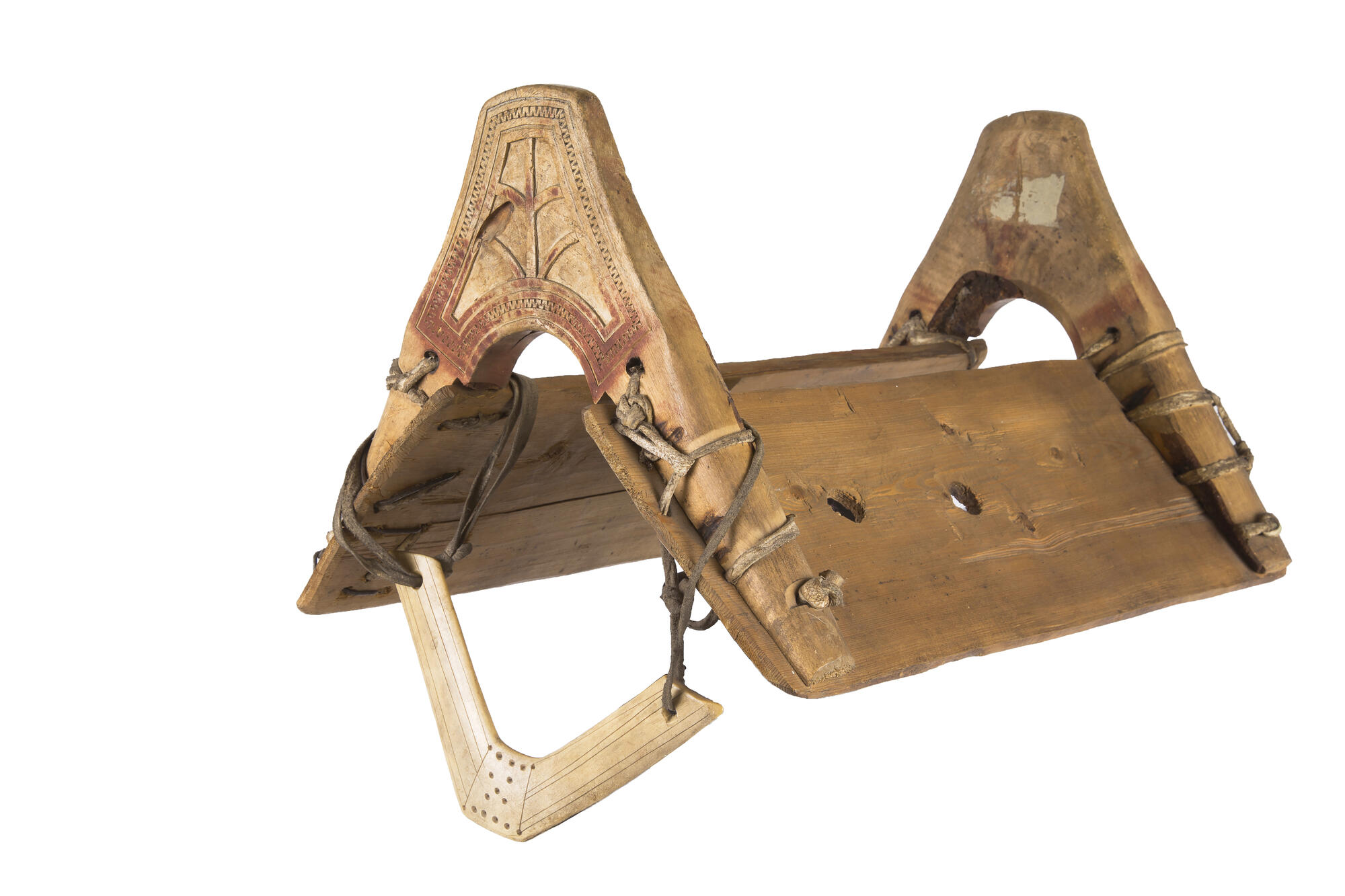


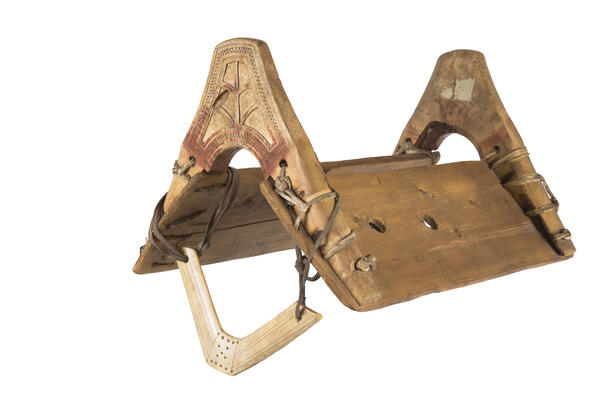
The Transbaikal Regional Museum of Local Lore houses several examples of Evenk pack saddles. These saddles were used for both riding and carrying heavy loads. The bags filled with possessions were tied on the sides.
The Evenks were a nomadic people. In summer, they rode reindeer. To keep better balance and reduce the load on the animal’s shoulders, riders used saddles. Their shape and decorations varied from region to region.
The main differences were in the pommel and cantle — the front and rear protruding areas of the saddle. Most Evenks made simple, rounded pommels and cantles without any ornaments. The Sym Evenks made these items pointed, and the Orochon tribes made high wooden ones and always decorated them with ornaments.
Some Evenk craftsmen connected the ends of the pommel and cantle with a square — a horizontal pole. Thus, a triangle was made, and by it a reindeer could be attached to the previous or the next one in the caravan.
The tree — the wooden base of the saddle — was partially or entirely lined with reindeer fur, and only the pommel and cantle were left open. The Evenks that lived on the banks of the Podkamennaya Tunguska and on the upper Lena replaced the saddle with a thick folded hide.
The reindeer harness — bridles, girths and belts — was made of moose hide. This material was coarse, dense and strong. It could withstand a heavy load and would not tear.
The pack saddle did not have stirrups on which the rider could rest his legs, thus it was tedious to ride this saddle. There was a special riding saddle that was used only by riders. There were variants for men, women, and children.
The pommel and cantle for these saddles were made of bone. The pommel was high and had a pointed top. The cantle with an oval top was lower.
Hide from the head of a moose or a deer covered the upper surface of the saddle. The pommel was left completely open, and the cantle’ top was bare, as well. Some Evenk tribes added wooden “shelves” to the sides of the saddle. To them, they tied “wings” — rounded planks or curved rods.
The rider mounted a reindeer by springing into the saddle, holding onto the low shelf with his right hand and onto the pommel of the saddle with his left hand. When the Evenks moved or crossed rivers, they used long canes with a hook to check the bottom and to balance the bags that had shifted.
The Evenks were a nomadic people. In summer, they rode reindeer. To keep better balance and reduce the load on the animal’s shoulders, riders used saddles. Their shape and decorations varied from region to region.
The main differences were in the pommel and cantle — the front and rear protruding areas of the saddle. Most Evenks made simple, rounded pommels and cantles without any ornaments. The Sym Evenks made these items pointed, and the Orochon tribes made high wooden ones and always decorated them with ornaments.
Some Evenk craftsmen connected the ends of the pommel and cantle with a square — a horizontal pole. Thus, a triangle was made, and by it a reindeer could be attached to the previous or the next one in the caravan.
The tree — the wooden base of the saddle — was partially or entirely lined with reindeer fur, and only the pommel and cantle were left open. The Evenks that lived on the banks of the Podkamennaya Tunguska and on the upper Lena replaced the saddle with a thick folded hide.
The reindeer harness — bridles, girths and belts — was made of moose hide. This material was coarse, dense and strong. It could withstand a heavy load and would not tear.
The pack saddle did not have stirrups on which the rider could rest his legs, thus it was tedious to ride this saddle. There was a special riding saddle that was used only by riders. There were variants for men, women, and children.
The pommel and cantle for these saddles were made of bone. The pommel was high and had a pointed top. The cantle with an oval top was lower.
Hide from the head of a moose or a deer covered the upper surface of the saddle. The pommel was left completely open, and the cantle’ top was bare, as well. Some Evenk tribes added wooden “shelves” to the sides of the saddle. To them, they tied “wings” — rounded planks or curved rods.
The rider mounted a reindeer by springing into the saddle, holding onto the low shelf with his right hand and onto the pommel of the saddle with his left hand. When the Evenks moved or crossed rivers, they used long canes with a hook to check the bottom and to balance the bags that had shifted.