The Solvychegodsk Museum of History and Art houses a unique item from the collection “Manuscripts and Early Printed Books”. This is an altar Gospel that was donated to the Solvychegodsk Boris and Gleb Monastery (which has not survived to this day) by Tsars Ivan V and Peter I and their sister Sophia who ruled as regent of Russia.
The monastery was supported by people from various social categories, ranks, and titles, including peasants, merchants, and clergymen. Its benefactors lived not only in Solvychegodsk and neighboring villages but also in other regions of Pomorye and faraway localities. Among the most famous donors were the families of Ioanniky Fyodorovich Stroganov, Ivan Ivanovich Bobrishchev-Pushkin, and Boyar Ivan Vasilyevich Godunov.
The co-rulers Ivan V and Peter I, together with their sister Sophia, made their contribution to the monastery in 1685, which is indicated by the inscriptions on the first 28 pages of the Gospel. The book itself was printed at the Synod Printing House in Moscow in 1681. This book is a work of typographical art. The text is written in Old Slavonic. The pages are decorated with engraved images of the Evangelists, headpieces, initials, vyaz calligraphy, patterns, decorative elements, and flowers in the margins. They were created using cinnabar and paint.
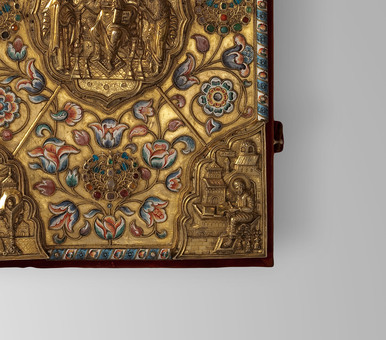
The gilded silver cover was made for the Gospel in 1737 upon the commission of Barons Alexander, Nikolay and Sergey Stroganov, sons of Grigory Dmitriyevich Stroganov, the last member of the family to live in Solvychegodsk. This is also evidenced by the inscriptions on the bottom margins.
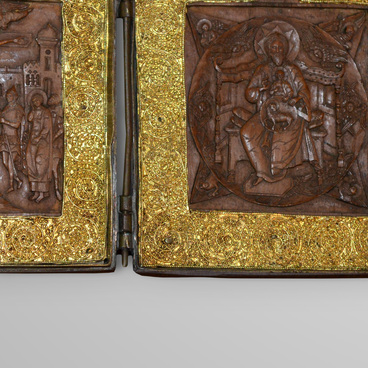
The décor of the Gospel is of great artistic value. The cover combines several types of techniques, including casting, chasing, filigree, enamel painting, finift, and cutting through. The front cover of the book has a smooth silver surface decorated with a floral pattern using the cloisonné enamel technique.
The binding is equipped with clasps that keep the book closed and protect the pages from deformation and mechanical damage. The clasps are made in the form of cast figures of the apostles Peter and Paul.
The upper and bottom
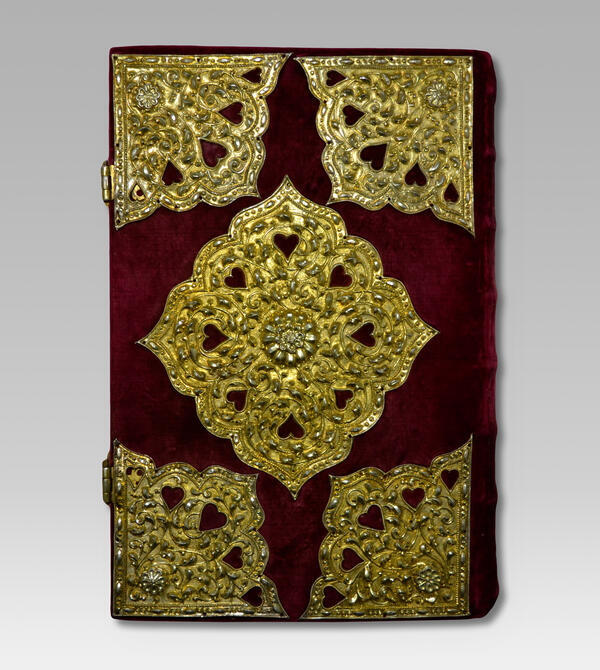
wooden covers are bound with dark red velvet. The bottom cover is decorated
with chased gilded overlays. The Gospel is well-preserved: apparently, the book
was treasured and used only on great feasts.