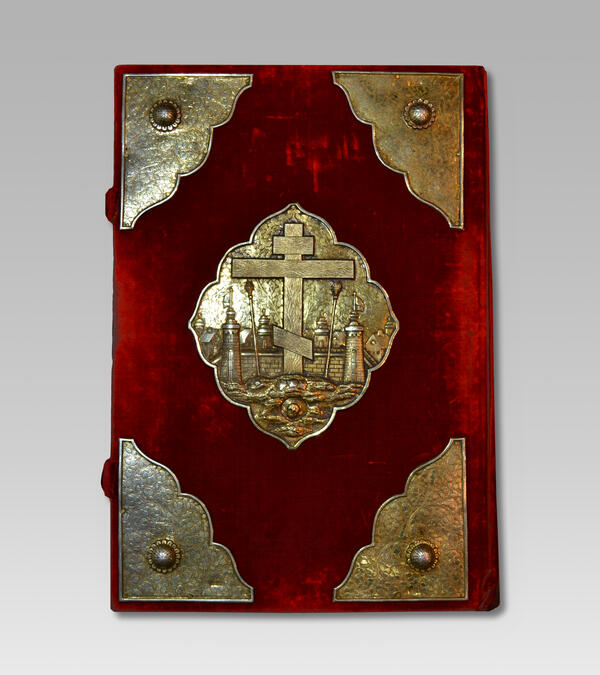
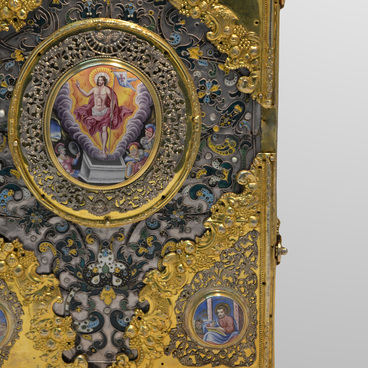
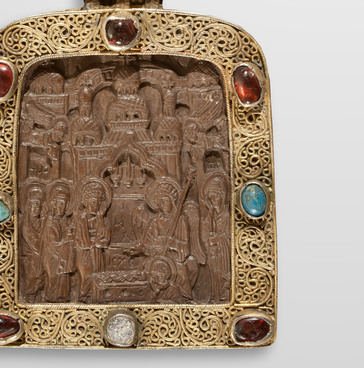
This altar Gospel originally belonged to the Spasoobydennaya Church in Solvychegodsk. The book was printed at the Synod Printing House in Moscow in 1760. The binding is made of wooden boards covered with red velvet and equipped with two clasps. The book is decorated with a silver cover which was made by Solvychegodsk craftsmen.
The front side of the cover features a smooth gilded silver sheet. It has four silver corner pieces with chased images of the Evangelists Mark, Luke, and Matthew against the background of buildings, as well as John and Prochorus against the background of rock mounds depicted using basic geometric shapes.
The central decorative plaque features a miniature icon with Christ Pantocrator enthroned and the Virgin Mary and John the Baptist standing in front of Him. Above Christ, there is the Holy Spirit in the form of a dove, and above all of Them is God the Father. The entire remaining surface of the front cover is decorated with lush tulip flowers in the filigree technique, pointed leaves and sprouts painted with enamel against a smooth gilded background.
Between the corner pieces along the entire edge of the front cover of the Gospel, there are narrow convex edge protectors decorated with patterns. They are painted with enamel. The clasps, the four corner pieces and the centerpiece, which are connected with the lower cover of the Gospel, were added later, in the 19th century.
Thanks to the Stroganov merchants, who organized silversmith’s shops in Solvychegodsk, skilled jewelers, including enamellers, worked there in the 16th and 17th centuries.
The distinctive style of
the Solvychegodsk art of enamel painting on a white background became
particularly prominent in the late 17th century. Although it was
influenced by Western European enamels, Russian artists used unique shading
techniques and created their own interpretation of fantastic flowers and
scenes, making their enamel-painted silver items significantly different from
Western European products. Solvychegodsk enameled items are distinguished by
their bright ornateness, rich and vibrant color palette, and artistic
techniques that make them resemble painted engravings or lubok prints.