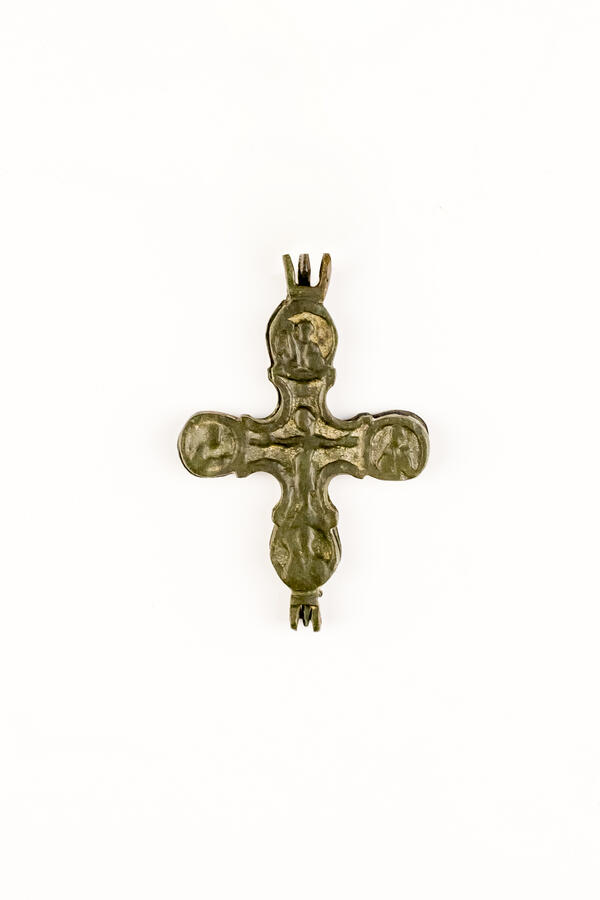
The museum houses an ancient cross-shaped encolpion. The term is translated from the ancient Greek language as “confidant”: it is a small hollow medallion. It was created with the help of the metal casting technique. Such products can be not only cruciform, but also rectangular or rounded.
In the Middle Ages, Christians put particles of a consecrated prosphora (liturgical bread) or the relics of saints inside encolpions. They were worn in the same way as pectoral crosses: on a braided rope or chain around the neck. The amulets were believed to protect from various misfortunes, especially on long journeys or hikes. Today, expensive encolpions are awarded to bishops when the latter are ordained. Encolpions can often be seen in icon painting: bishops — church hierarchs of the highest rank — are depicted wearing them.
There are special hinges at the ends of the vertical bar to help open and close the medallion. There are two loops on the front and one on the back. The hinges are very small, they are less than a centimeter long.
The craftsman decorated the encolpion with sacred symbols. On the obverse, he placed the saints in four side medallions with a crucifix in the center.
Initially, crucifixion was a type of execution. A person sentenced to death was nailed or tied with a rope to a wooden cross. Crucifixion was widespread in Babylonia, Ancient Greece, Palestine, Carthage and especially in Ancient Rome. There it became the main type of shameful execution: traitors, robbers, fugitive slaves and other especially dangerous criminals were sentenced to it.
According to the Gospel, after the inhabitants of the Roman province of Judea sentenced Christ to Crucifixion, He died on the Cross and then rose again. His Resurrection became a sign that the human race can be saved. So the instrument of execution ceased to frighten people and, on the contrary, turned into a symbol of salvation.
On the reverse side of the encolpion, the craftsman depicted the Virgin and Child on the throne. The side scenes possibly feature the Archangels Michael and Gabriel.
In the Middle Ages, Christians put particles of a consecrated prosphora (liturgical bread) or the relics of saints inside encolpions. They were worn in the same way as pectoral crosses: on a braided rope or chain around the neck. The amulets were believed to protect from various misfortunes, especially on long journeys or hikes. Today, expensive encolpions are awarded to bishops when the latter are ordained. Encolpions can often be seen in icon painting: bishops — church hierarchs of the highest rank — are depicted wearing them.
There are special hinges at the ends of the vertical bar to help open and close the medallion. There are two loops on the front and one on the back. The hinges are very small, they are less than a centimeter long.
The craftsman decorated the encolpion with sacred symbols. On the obverse, he placed the saints in four side medallions with a crucifix in the center.
Initially, crucifixion was a type of execution. A person sentenced to death was nailed or tied with a rope to a wooden cross. Crucifixion was widespread in Babylonia, Ancient Greece, Palestine, Carthage and especially in Ancient Rome. There it became the main type of shameful execution: traitors, robbers, fugitive slaves and other especially dangerous criminals were sentenced to it.
According to the Gospel, after the inhabitants of the Roman province of Judea sentenced Christ to Crucifixion, He died on the Cross and then rose again. His Resurrection became a sign that the human race can be saved. So the instrument of execution ceased to frighten people and, on the contrary, turned into a symbol of salvation.
On the reverse side of the encolpion, the craftsman depicted the Virgin and Child on the throne. The side scenes possibly feature the Archangels Michael and Gabriel.