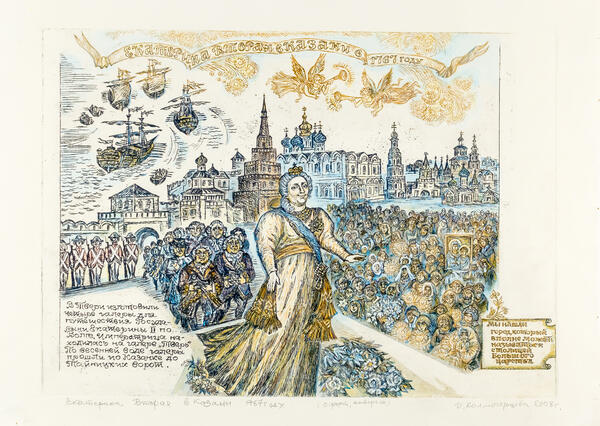
The People’s Artist of the Republic of Tatarstan Irina Kolmogortseva made this engraving in 2008. She dedicated it to a historical event that was important for the region: in 1767, Empress Catherine II went on a journey along the Volga and visited Kazan.
The Empress had been thinking about the trip for several months. She wanted to demonstrate herself to her subjects and see how her people lived along the banks of the mighty river. A whole flotilla of boats was prepared for the empress — it accommodated about two thousand people. Together with her, her favorite Count Grigory Orlov, his brother Alexei, Count Lev Naryshkin, Countess Praskovya Bruce and many other nobles set off on the road.
It was planned to depart from Tver, where the Empress and her retinue arrived by horse. The documents of the Russian State Archive of Ancient Acts say that 300 “road carriages” had been prepared. The procession was accompanied by a doctor and a pharmacist, as well as cooks, footmen, and gamekeepers with guns. Specially equipped carriages transported the clothes, screens, and appliances.
The Empress sailed from Tver on May 2. On the way, the monarch stopped for several days in large cities and monasteries, and 24 days later, her galley anchored near Kazan. The Empress with her retinue went to the pier, and at that moment “from the entire galley squadron and from the city, cannon fire was fired and the squadron was honored by playing the trumpets and the timpani, and the sailors and the numerous people on the shores exclaimed “hurray.”
At the pier, the empress was greeted by the most prominent citizens: Governor Alexander Kvashnin-Samarin, Prince Putyatin, “on the upper platform on the right side were the ladies, and on the left — the headquarters and chief officers, the local nobility and merchants.”
From the pier, the ruler went to the city. She rode in a carriage through the Taynitsky Gate and proceeded through the Kazan garrison built on both sides of the street to the Annunciation Cathedral, where she was greeted by the hierarchs of the church.
The next day after arriving in Kazan, on the feast day of the Life-Giving Trinity (it was May 27), Catherine II went to the cathedral church — there she was met by His Grace Veniamin. There the Empress listened to the Divine Liturgy and the Vespers.
As the “Camer-Furier Journal” recorded, along the entire path of Catherine II to the cathedral and back “near the triumphal gates, on both sides, there were Tatars and Cheremis [Mari people] with their wives and daughters, in all their smart dress.” On the same day, the empress welcomed the representatives of the Kazan and Sviyazhsk nobility, the Kazan governor and generals, officers of the Admiralty, and then went with her retinue to the Arsk field, where the festivities took place.
The Empress had been thinking about the trip for several months. She wanted to demonstrate herself to her subjects and see how her people lived along the banks of the mighty river. A whole flotilla of boats was prepared for the empress — it accommodated about two thousand people. Together with her, her favorite Count Grigory Orlov, his brother Alexei, Count Lev Naryshkin, Countess Praskovya Bruce and many other nobles set off on the road.
It was planned to depart from Tver, where the Empress and her retinue arrived by horse. The documents of the Russian State Archive of Ancient Acts say that 300 “road carriages” had been prepared. The procession was accompanied by a doctor and a pharmacist, as well as cooks, footmen, and gamekeepers with guns. Specially equipped carriages transported the clothes, screens, and appliances.
The Empress sailed from Tver on May 2. On the way, the monarch stopped for several days in large cities and monasteries, and 24 days later, her galley anchored near Kazan. The Empress with her retinue went to the pier, and at that moment “from the entire galley squadron and from the city, cannon fire was fired and the squadron was honored by playing the trumpets and the timpani, and the sailors and the numerous people on the shores exclaimed “hurray.”
At the pier, the empress was greeted by the most prominent citizens: Governor Alexander Kvashnin-Samarin, Prince Putyatin, “on the upper platform on the right side were the ladies, and on the left — the headquarters and chief officers, the local nobility and merchants.”
From the pier, the ruler went to the city. She rode in a carriage through the Taynitsky Gate and proceeded through the Kazan garrison built on both sides of the street to the Annunciation Cathedral, where she was greeted by the hierarchs of the church.
The next day after arriving in Kazan, on the feast day of the Life-Giving Trinity (it was May 27), Catherine II went to the cathedral church — there she was met by His Grace Veniamin. There the Empress listened to the Divine Liturgy and the Vespers.
As the “Camer-Furier Journal” recorded, along the entire path of Catherine II to the cathedral and back “near the triumphal gates, on both sides, there were Tatars and Cheremis [Mari people] with their wives and daughters, in all their smart dress.” On the same day, the empress welcomed the representatives of the Kazan and Sviyazhsk nobility, the Kazan governor and generals, officers of the Admiralty, and then went with her retinue to the Arsk field, where the festivities took place.