

#1
Shaft bow, Sleigh bell
#7
#8
#2
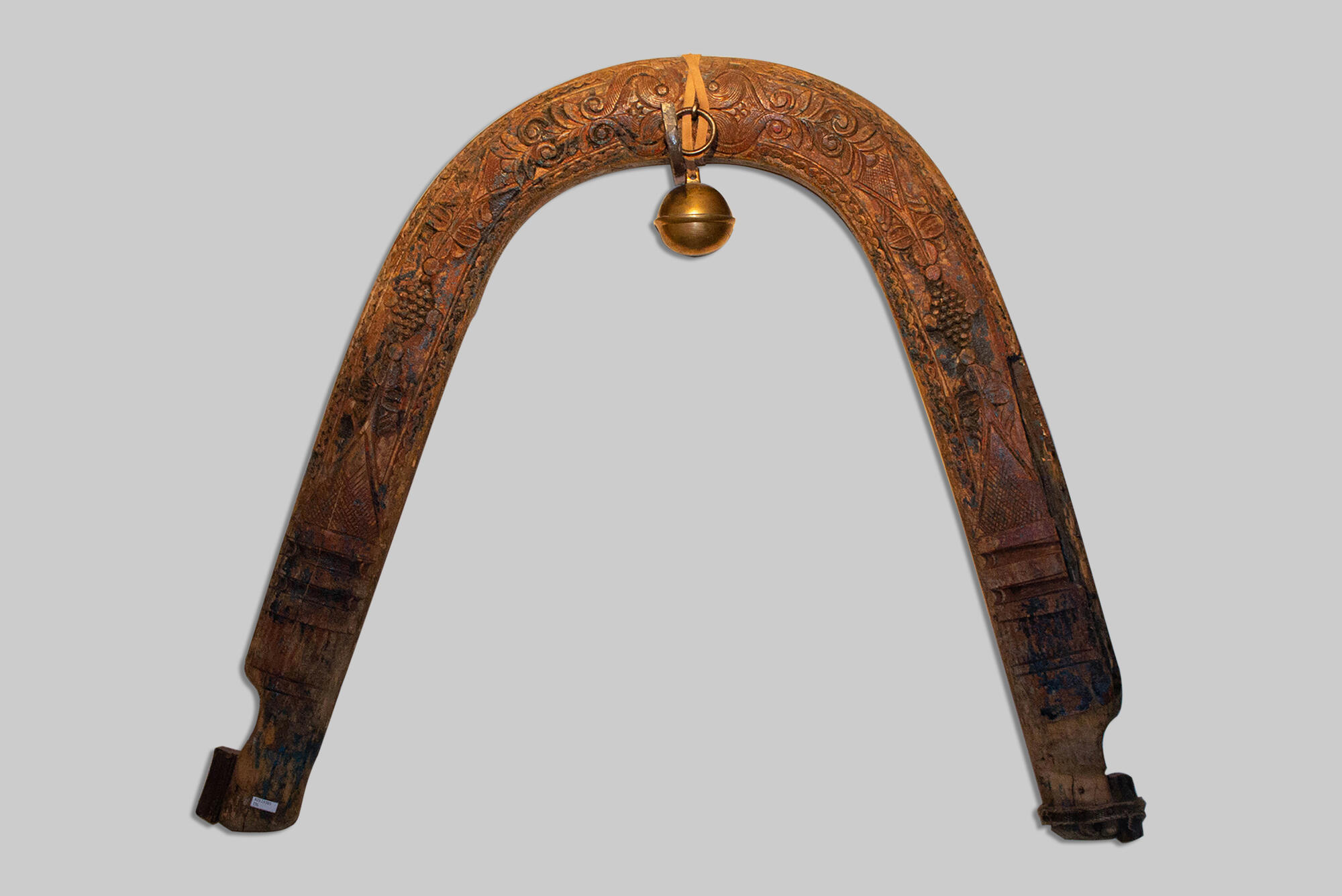
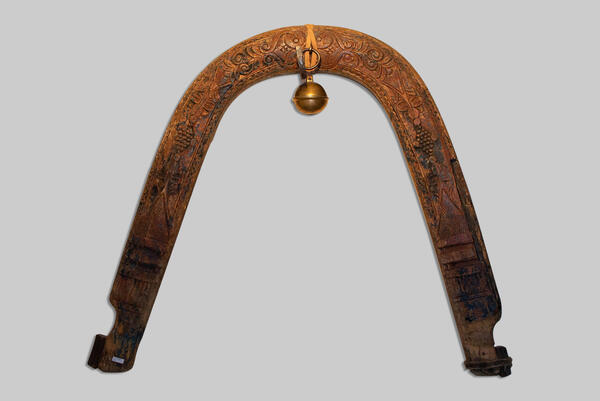
A Russian horse harness often had a shaft bow. This device was designed to facilitate the horse’s work. Firstly, the shaft bow made the whole design more rigid. When harnessed like this, the horse did not pull the cart, but pushed it, which helped it move. Secondly, the shaft bow together with other elements of the horse’s harness protected the horse from being hit by a clamp or shaft.
The size of the shaft bow was always customized depending on the size of the animal as well as the weight and dimensions of the carriage. There were one-horse shaft bows as well as shaft bows for troikas, a harness driving combination, using three horses. The shaft bow from the museum collection is intended for one horse. A shaft bow was custom-designed for each horse.
Firm wood, such as elm, oak and hazel, was used for the purpose. The timber had to be prepared early in spring before the trees stored too much sap. The shaft bow-to-be was treated with steam in a sauna or a special steam bath. It was then placed in a special bow machine and bent with the use of horsepower, while wedges were being driven along the bend. The article was then left to dry in a curved position for a few weeks. After that the blank could be processed. The shaft bow had to have slots for shafts. The shaft bow had to be ground. The master then could carve a pattern, like the one on the exhibit, and paint it.
For a long time, the researchers did not consider these decorations to be an important item of national culture. It was not until the 19th century that the interest in shaft bows as a work of art arose. In 1877 researcher Ivan Golyshev included illustrated articles on carved shaft bows in his publication ‘Monuments of ancient Russian wood carving in Vladimir Governorate’. That very same year archaeologist Vladimir Stasov posted an article called ‘The shaft bow and the gingerbread horse’. In the article Stasov poses questions regarding the time when the Russians started using the shaft bow, its decorative features, the symbolic meaning of the ornamentation patterns. He also marks the antiquity of ornamentation motifs of shaft bows and singles out rosettes: solar symbols, shamrocks, grapevines, the image of the earth in the shape of a triangular slide.
The size of the shaft bow was always customized depending on the size of the animal as well as the weight and dimensions of the carriage. There were one-horse shaft bows as well as shaft bows for troikas, a harness driving combination, using three horses. The shaft bow from the museum collection is intended for one horse. A shaft bow was custom-designed for each horse.
Firm wood, such as elm, oak and hazel, was used for the purpose. The timber had to be prepared early in spring before the trees stored too much sap. The shaft bow-to-be was treated with steam in a sauna or a special steam bath. It was then placed in a special bow machine and bent with the use of horsepower, while wedges were being driven along the bend. The article was then left to dry in a curved position for a few weeks. After that the blank could be processed. The shaft bow had to have slots for shafts. The shaft bow had to be ground. The master then could carve a pattern, like the one on the exhibit, and paint it.
For a long time, the researchers did not consider these decorations to be an important item of national culture. It was not until the 19th century that the interest in shaft bows as a work of art arose. In 1877 researcher Ivan Golyshev included illustrated articles on carved shaft bows in his publication ‘Monuments of ancient Russian wood carving in Vladimir Governorate’. That very same year archaeologist Vladimir Stasov posted an article called ‘The shaft bow and the gingerbread horse’. In the article Stasov poses questions regarding the time when the Russians started using the shaft bow, its decorative features, the symbolic meaning of the ornamentation patterns. He also marks the antiquity of ornamentation motifs of shaft bows and singles out rosettes: solar symbols, shamrocks, grapevines, the image of the earth in the shape of a triangular slide.
#3
Full name: Shaft bow with plant ornamentation
Author: unknown
Date: early 20th century
Place: Russia
Technique: wood, leather, carving, bending, coloring
Dimensions: 76×90×6 cm
Collection: The United Museum of the Urals Writers, Yekaterinburg
Copyright: The United Museum of the Urals Writers
Author: unknown
Date: early 20th century
Place: Russia
Technique: wood, leather, carving, bending, coloring
Dimensions: 76×90×6 cm
Collection: The United Museum of the Urals Writers, Yekaterinburg
Copyright: The United Museum of the Urals Writers
#9
Sleigh bell
#10
#5
In the 18th century, bells were used by mail coachmen as a special signaling device. Their purpose was to warn the custodian of the post station in advance about the approaching carriage so he would prepare replacement horses. The sound of the bell could be heard for a distance of over two kilometers.
However, common people could also use bells, which confused the post station officials. As a result of numerous complaints from the post office, the Senate issued a special decree on December 18, 1836, which stated the following: ‘The use of bells by all those who ride their own or rented horses shall be banned’.
That said, the ringing was still necessary during rides. First, it notified pedestrians of the oncoming carriage, and second, it was an indispensable road companion. It had to do with the cultural tradition: ancient Slavs used bells as a good luck charm, sewing them to clothes. The normal bell was soon substituted with a sleigh, bell which proved to be a good alternative for common people.
During excavations in NOvgorod, sleigh bells were found in all cultural layers between the 10th and 16th centuries. The sleigh bell was often used as buttons in Russian national costumes; this tradition existed until the early 20th century. However, in Russia, sleigh bells became most widespread after the ban on regular bells on shaft bows. Typically, the biggest sleigh bell was hung in the middle of the shaft bow, above the horse’s head. Smaller sleigh bells could be hung along the shaft bow, on shafts, bridles, or breechings. Rich and noble people decorated the horse tacks with silver sleigh bells.
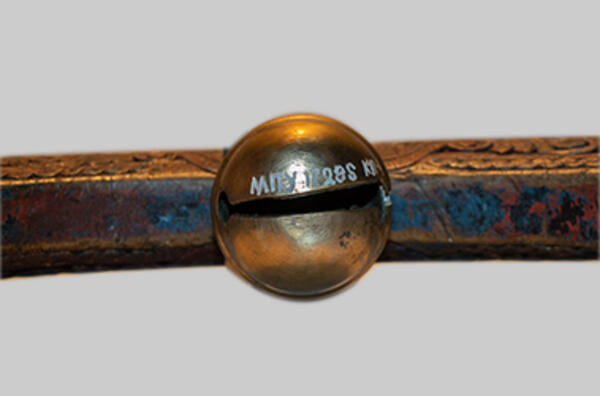
A sleigh bell is a metal hollow sphere with a slit, inside of which a metal solid ball moves freely. When shaking the ball hits the walls of the sphere thus producing a sound. Such sleigh bells have a duller and less lasting sound than regular bells, but they make sounds regardless of the position. With regard to the manufacturing technique, they can be stamped, cast or forged. Hemispheres of copper sleigh bells were welded with tin, iron sleigh bells were welded with copper. Some sleigh bells are seamless, rimmed, and ridged.
However, common people could also use bells, which confused the post station officials. As a result of numerous complaints from the post office, the Senate issued a special decree on December 18, 1836, which stated the following: ‘The use of bells by all those who ride their own or rented horses shall be banned’.
That said, the ringing was still necessary during rides. First, it notified pedestrians of the oncoming carriage, and second, it was an indispensable road companion. It had to do with the cultural tradition: ancient Slavs used bells as a good luck charm, sewing them to clothes. The normal bell was soon substituted with a sleigh, bell which proved to be a good alternative for common people.
During excavations in NOvgorod, sleigh bells were found in all cultural layers between the 10th and 16th centuries. The sleigh bell was often used as buttons in Russian national costumes; this tradition existed until the early 20th century. However, in Russia, sleigh bells became most widespread after the ban on regular bells on shaft bows. Typically, the biggest sleigh bell was hung in the middle of the shaft bow, above the horse’s head. Smaller sleigh bells could be hung along the shaft bow, on shafts, bridles, or breechings. Rich and noble people decorated the horse tacks with silver sleigh bells.
A sleigh bell is a metal hollow sphere with a slit, inside of which a metal solid ball moves freely. When shaking the ball hits the walls of the sphere thus producing a sound. Such sleigh bells have a duller and less lasting sound than regular bells, but they make sounds regardless of the position. With regard to the manufacturing technique, they can be stamped, cast or forged. Hemispheres of copper sleigh bells were welded with tin, iron sleigh bells were welded with copper. Some sleigh bells are seamless, rimmed, and ridged.
#6
Full name: Sleigh bell attached to the harness
Author: unknown
Date: first half of the 20th century
Technique: bronze, casting, welding
Place: unknown
Dimensions: 8×7,9×7,9 cm
Copyright: United Museum of the Ural Writers
Collection: United Museum of the Ural Writers, Yekaterinburg
Author: unknown
Date: first half of the 20th century
Technique: bronze, casting, welding
Place: unknown
Dimensions: 8×7,9×7,9 cm
Copyright: United Museum of the Ural Writers
Collection: United Museum of the Ural Writers, Yekaterinburg
read morehide
00:00
00:00
1x
1
 Point your smartphone camera to open in the app
Open in app
Share