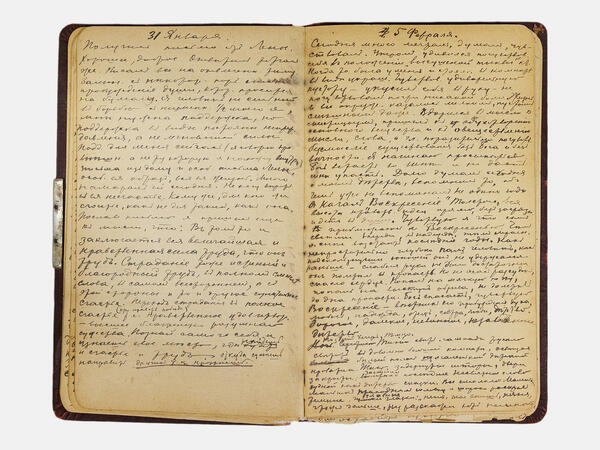
At the bottom, there is an autograph, presumably of Alexander Verkhovsky. The notes include quotes by famous writers, as well as the owner’s philosophical musings, “A human being is an animal that has always thought ‘I am a king, and I am a slave.’ It is a maxim that seems self-contradictory at first sight”; “There is a terrible racial struggle coming onto the scene.”
The use of diaries as a means of self-expression can be traced back to the 10th century. Initially, diaries were texts of various genres, mostly travelogs and autobiographical notes. Diaries as memoirs that reveal the owner’s personality appeared during the time of the Reformation and Counter-Reformation when religion was increasingly imposing introspection and self-discipline. The first known Russian diaries date back to the late 17th century.
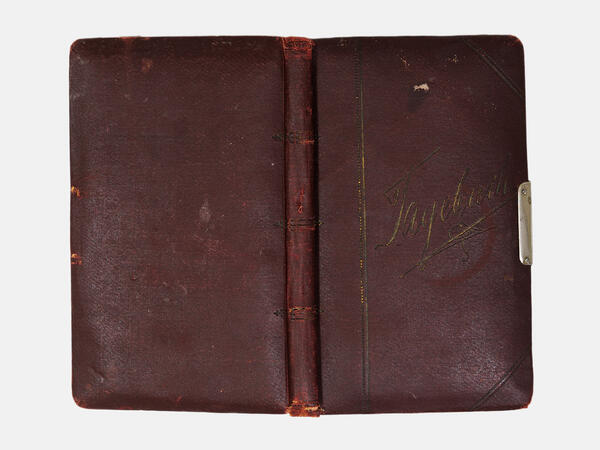
The style of European diaries was inspired by books. The title page was decorated with vignettes, the name, autograph, title, and date. Sometimes entries began with book-style titles such as “Chapter I”, and the pages were numbered.
Anton Chekhov also kept a diary, in particular,
during his trip to Sakhalin Island. The writer said that it was “all rather
fragmented or unfinished”, and according to others accounts, lost on the way,
that the Sakhalin diaries were not published separately. However, some notes
have survived which were not included in the book “Sakhalin Island”,