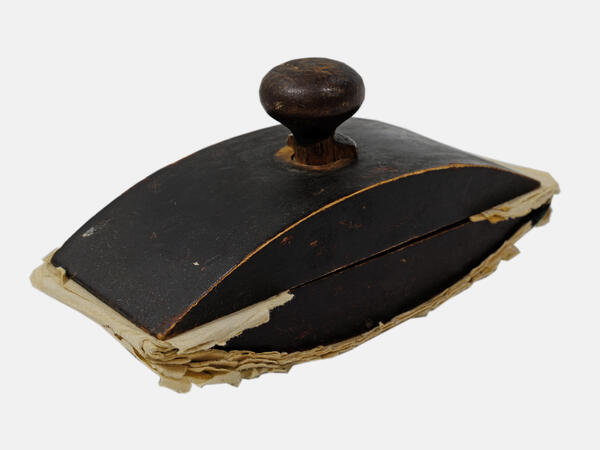
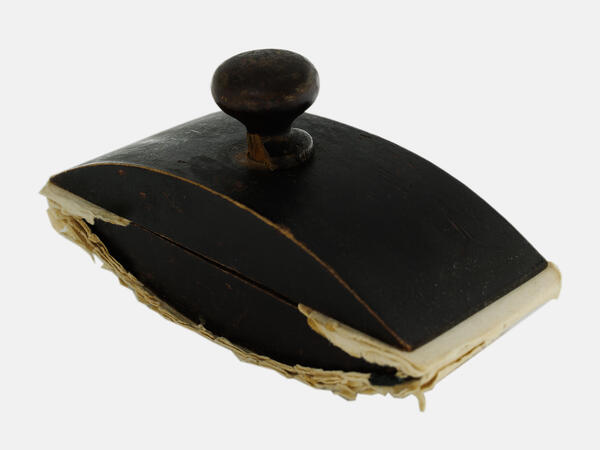
It is believed that this paperweight belonged to the family of Anton Chekhov’s nephew Sergey between the 1930s and the 1960s. It is made of wood and consists of two parts held together by a handle. The lower part of the item has blotting paper stretched in several layers.
In the 19th century, there were two types of paperweights: one was used for fixing papers on the table and looked like a heavy marble block, while the other helped to absorb superficial ink from paper. Both were essential elements of a writing set or an inkstand that could be found on every writing desk.
The inkstand also served as a piece of interior décor. It was made of expensive stones and decorated with gilding or amber. The upper part of a writing set usually had an inkwell with a hinged lid flanked by metal stands and holders for fountain pens and other writing tools.
The Russian word for “a paperweight” — “presse-papiers” — was borrowed from French and means “to press” and “a paper”. The word “presse-bouvard” meaning “a rocker blotter” also came from French: “boire” means “to drink”, in this case, to absorb ink. Rocker blotters were made of different kinds of wood, including mahogany, ebony, Karelian birch, walnut, alder, oak, ash, sycamore, and cypress, as well as brass, silver, marble, and eventually plastic. The top of the blotter was crowned with decorative elements made of ornamental stones, metal, ivory, or glass.
The lower wooden block had a convex shape so that it could be easily rolled over the paper. At the bottom, it was lined with cloth or felt, with blotting paper stretched over it. Blotting paper appeared in the second half of the 19th century and was also called filter, bibulous, or absorbent paper. It was unglued, minimally pressed paper made of pure cellulose. The absorption of ink involved a capillary action phenomenon because blotting paper had many small pores on its surface. Rocker blotters helped accelerate the drying of ink and protected manuscripts from stains.
Souvenir blotters were luxurious, often decorated with painting, pyrography, carving, and inlay. The surfaces were milled, polished, and engraved with inscriptions. Nowadays, a paperweight is an interesting collector’s item.