Font
Color
Graphics
Изображение точки

To see AR mode in action:

1. Install ARTEFACT app for iOS or Android;

2. Find the exhibition «Permanent Exhibition of the Zlatoust Museum»

3. Push the «Augmented reality» button and point your phone's camera at the exhibit;

Скрыть точки интересаПоказать точки интереса
Показать в высоком качестве

Diploma, Rogatina, Broadswords, Saber

0
Open in app
#6
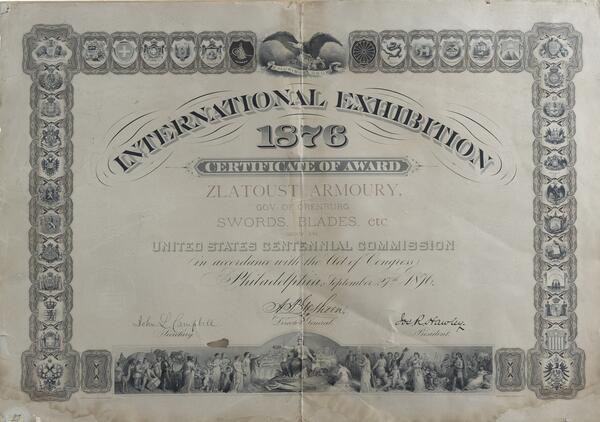
Diploma of the World’s Fair in Philadelphia
#8
The first major World’s Fair outside of Europe was held in Philadelphia in 1876. It was dedicated to the centenary of the United States and was named “The International Exhibition of Arts, Manufactures, and Products of the Soil and Mine”.

The exhibition was held in a park in Philadelphia and occupied an area of 17 hectares. Russian factories and mines prepared a variety of exhibits for this event. The Zlatoust Arms Factory presented bladed weapons: sabers, damascened blades, yatagans, hunting knives, and daggers made of cast and Damascus steel. Decorated weapons sold well, despite their expensiveness. Only a small number of products returned to the factory.

For the high quality of bladed weapons, the expert committee of the International Industrial Exhibition of 1876 awarded the Zlatoust Arms Factory a silver medal, which corresponded to a second-degree diploma. It was printed on a cardboard sheet. The text is enclosed in an ornamental frame, which features the coats of arms of all countries participating in the International Industrial Exhibition, including Russia.

At the top of the frame is an image of a bald eagle — the national bird symbol of the United States of America. In the lower part, a multi-figured allegorical composition was used, which had Columbia in the center, wearing classical draped clothes and sitting on a throne. The image of Columbia, which used to represent the United States, was largely superseded by the Statue of Liberty, which was erected at the mouth of the Hudson River in 1886.

The text of the diploma is composed in English. The inscriptions confirm the participation of the Zlatoust Arms Factory in the World’s Fair. Under the text at the bottom left, there is a relief imprint of a round seal that was used to certify the diplomas of the World’s Fair.

The document was signed by General Manager of the Exhibition Alfred T. Goshorn, Secretary John L. Campbell, and Joseph R. Hawley — President of the United States Centennial Commission, which planned and ran the event.
#1
Name: Diploma of the World’s Fair in Philadelphia
№: 18345535
Date of creation: 1876
Place of creation: the USA
Technique: paper, letterpress printing
Dimensions: 43×62 cm
#10
Rogatina (hunting spear)
#11
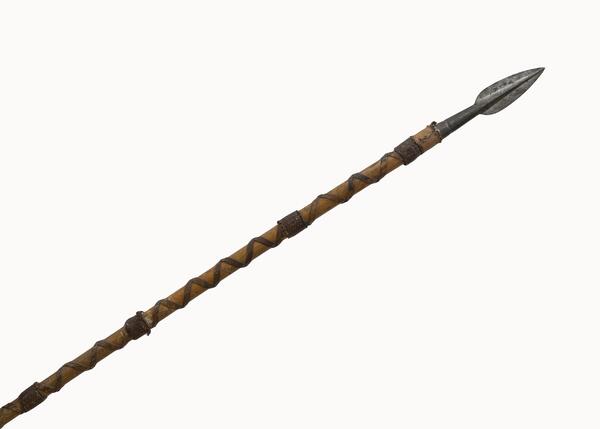
The collection of the Zlatoust City Museum of Local Lore contains a hunting spear known in Russian as “rogatina”, which, in fact, is a sort of heavy spear. It was made by the craftsmen of the Zlatoust Arms Factory in the 19th century and is an example of a classic weapon for Russian hunting. A hunter with such a weapon was referred to in Russian as “rogatnik”, or “rogatennik”.

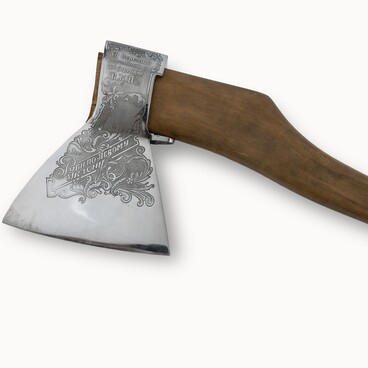
The striking steel tip was called “rozhon”. This led to a Russian saying “lezt na rozhon” (look for a fight, head for trouble). When forging the tip, the craftsman made four faces — two narrow and two wide ones. The tip ends with a conical bushing (“tuleya”) with a hole for the shaft. It was secured with two screws. The front side of the tuleya was decorated with an etched ornamented factory mark “Zlatoust Arms Factory 1887”.

In the manufacture of the spear, a wooden shaft (“iskepische”) was used. It was lacquered and bound in an ancient style with a fringed leather cord, which was firmly fixed with steel rivets at a specific interval. Five woven leather clutches were installed over the cord to fix the hunter’s hands. Traditionally, the shaft was made approximately equal to a person’s height.

With such a spear, hunters would go for a large and dangerous animal: a bear, a wild ox or a wild boar, since it was designed to inflict a wide and deep wound. When struck, it was usually held with both hands, but that was not done to make the strike heavier; on the contrary, the strike was to be of a rather moderate force. The technique was used to ensure a secure grip, so as not to release the shaft and to keep the beast at bay, and then rest the end of the shaft on the ground.
#12
And the man was quick-witted,
He assaulted the bear,
He put her on the rogatina
Above the navel, but below the liver.

And the bear did fall down on the ground…
“The Tale of a Bear”, 1830, Alexander Sergeyevich Pushkin
#13
Such hunting weapons were made on orders in limited quantities at the Zlatoust Arms Factory. The spears were in common use by hunters right until the late 19th — early 20th century.
#2
Name: Rogatina (hunting spear)
Date of creation: 1887
Place of creation: Zlatoust, the Russian Empire
Technique: wood, leather, metal, hammering, planishing
Dimensions: 30×6,5 cm
#14
Naval broadsword
#15
Zlatoust bladed weapons had great combat qualities and were known far beyond Russia. Foreign craftsmen were invited for the manufacture of bladed weapons to be established, however, local workers began to manage on their own later. The factory had seven departments including those in charge of steel production and manufacture of blades, knives, hilts, and decorated weapons.

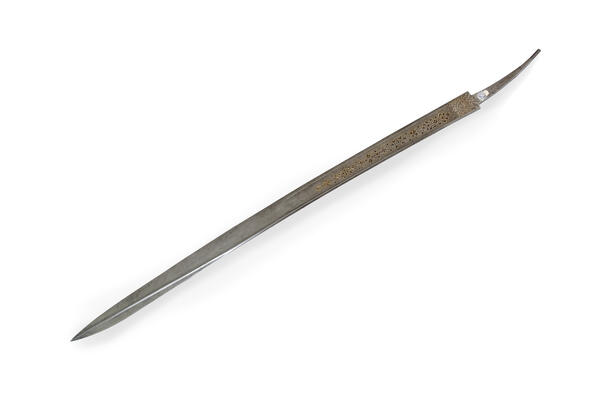
The permanent exhibition of the Zlatoust Museum of Local Lore has two naval boarding broadswords. The displayed item is an 1854 model blade. It was decorated with a very rare technique — openwork cutting. It was used exclusively at the weapons factory in Zlatoust.

The blade was made of Damascus steel in the second half of the 19th century. In fact, this Damascus steel is an artificial (or welded) bulat steel according to the classification proposed by Pavel Petrovich Anosov (1799, Saint Petersburg — 1851, Omsk). He was an outstanding Russian metallurgical scientist, a major organizer of the mining industry, and a researcher of the nature of the Southern Urals.

After graduating from the Saint Petersburg Mining Cadet Corps, Pavel Anosov worked in the Zlatoust Mining District from 1817 to 1847. Anosov’s most significant achievement in metallurgy was finding a new method for producing high-quality steels. He obtained various bulat steel patterns in Zlatoust in the 1840s and identified the way they depend on the properties of the metal.

The blade is decorated with a 27-centimeter-long pattern of diamond-shaped through holes. The edges of the holes are gilded. On the right side, a double-headed eagle, the coat of arms of the Russian Empire, is enclosed in the ornament.

This exhibit has no hilt. This means that the craftsmen actually made two specimens. One was finished and sent to a private customer. As for this one, it was intended for the collection of the arsenal of the Zlatoust Arms Factory. For the sake of economy, such blades were made with no hilts or scabbards. Similar cut-through blades were very rare, and the patterns on them were unique.
#3
Name: Naval broadsword
№: 16816881 
Date of creation: 1881
Place of creation: Zlatoust, the Russian Empire
Technique: steel (welded bulat steel), hammering, cutting, etching, gilding
#16
Naval broadsword
#17
By the beginning of the 19th century, the government of the Russian Empire faced the challenge of building a blade weapons factory. The Russian army and navy required a huge amount of blade weapons and firearms, and Emperor Alexander I approved the idea of creating a special weapons factory. The Zlatoust Ironworks was chosen as the site for the construction of the factory.

In 1873, the Zlatoust Arms Factory received an order to make 27 naval broadswords for officers who had taken part in the voyage of the frigate Svetlana. For the first time, the ship was talked about in June 1856, when a contract agreement was signed between the Naval Ministry of the Russian Empire and the French shipyard “Collas at Comp”. The contract stipulated the construction of a frigate and a corvette.

The cost of building the frigate was estimated at 2,800,000 francs, which was approximately equal to 705,000 silver rubles. On October 13, 1856, the official ceremony of laying the keel of the ship took place. In February of the following year, the installation of the iron framework was almost completed. On May 3, 1858, the frigate was launched.

French craftsmen used the wood of oak, teak, mahogany, and pine to build the hull of the frigate. Emperor Alexander II personally approved the name for the ship — “Svetlana”. In the period from 1871 to 1873, the ship made a round-the-world trip. The son of Emperor Alexander II, 21-year-old captain-lieutenant of the Guards naval crew, Grand Duke Alexei Alexandrovich took part in the long voyage.

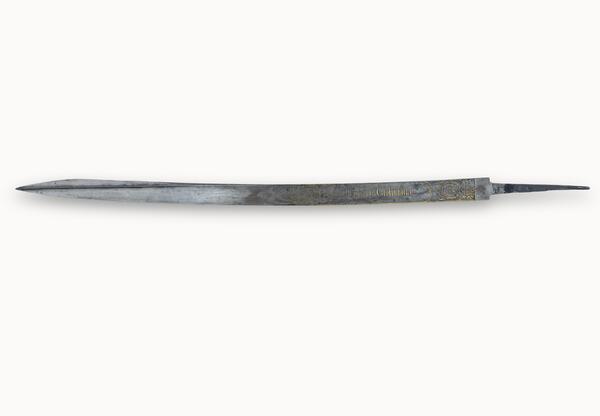
In memory of the campaign, he ordered naval broadswords of the 1858 model for officers of the frigate at the Zlatoust Arms Factory. The order was entrusted to the best etching and gilding craftsmen of the Zlatoust Arms Factory — Mikhail Stepanovich Petukhov and Alexander Petrovich Agarkov. Etched and gilded inscriptions “Frigate Svetlana” and “From H.R.H. Alexei Alexandrovich” were put on the blade in ornamental frames.

On the tang and shank of the blade, one can see the stamps of the craftsmen who participated in the manufacture of the sword. The blade was transferred to the museum fund in 1960 from the Chelyabinsk Regional Museum of Local Lore.
#4
Name: Naval broadsword
Date of creation: 1873
Place of creation: Zlatoust, the Russian Empire
Technique: steel, etching, gilding, etching on varnish with a needle
Dimensions: 89 cm
#18
Saber of the Preobrazhensky Regiment officer
#19
Over the first two decades, the craftsmen of the Zlatoust Arms Factory manufactured and delivered 230,212 units of weapons to the troops. The consistent output was due to the fact that throughout almost the entire 19th century, changes in the blade weapons of the Russian troops were not fundamental, though frequent. All varieties had their analogs in France or Prussia.

In the 1870s, Major General Alexander Pavlovich Gorlov, who was a military agent at the embassy in London, reported to the Minister of War on the models of blade weapons that were the best in his opinion, and, accordingly, proposed to significantly improve weapons for the Russian cavalry. In essence, his proposals came down to the adoption of a single model of a saber for all cavalry units, excluding the cuirassiers.

After the manufacture of prototypes, discussions and modifications, a special commission decided to adopt two types of cavalry sword — those for dragoon and Cossack units with a single blade. At the same time, the commission approved the new broadsword. The main production facilities were established at the Zlatoust Arms Factory. Compared to previous rearmaments, the introduction of a system of new weapons in 1881 amounted to the scale of a true reform.

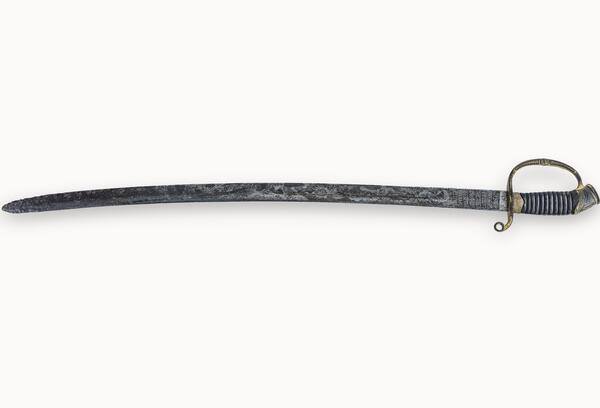
The history section of the Zlatoust City Museum of Local Lore has a dragoon officer’s saber of 1881/1909. The blade is of non-conventional design; it is almost straight, with one groove near the butt. The hilt has a single bow. The guard bears traces of gilding. The blade is decorated with an etched ornament in the style of embroidery of dress uniforms of the Preobrazhensky Life-Guards Regiment officers and features the text of the first verse of the Preobrazhensky Regiment march. Both the blade and the hilt feature the monogram of Emperor Alexander III.

The Preobrazhensky Life-Guards Regiment of the Russian Imperial Guard was one of the oldest and most famous Life-Guards regiments. It was created back in 1691 by Peter the Great. The regiment participated in all major battles of the 18th and 19th centuries.

On December 12, 2012, in his message to the Federal Assembly, Russian President Vladimir Vladimirovich Putin announced the need to reestablish the Preobrazhensky and Semyonovsky regiments. Since April 9, 2013, the 154th Separate Commandant’s Regiment has been named Preobrazhensky after its legendary predecessor.
#5
Name: Saber of the Preobrazhensky Regiment officer
Date of creation: 1910-1916
Place of creation: Zlatoust, the Russian Empire
Technique: steel, gilding, etching
Dimensions: 93,5×3,2 cm
#9
read morehide
00:00
00:00
1x

Diploma, Rogatina, Broadswords, Saber

0
Point your smartphone camera to open in the app
Share
VkontakteOdnoklassnikiTelegram
Share on my website
Copy linkCopied
Copy
Open in app
To see AR mode in action:
  1. Install ARTEFACT app for 
  2. iOS or Android;
  3. Find and download the «Paintings in Details» exhibition
  4. Push the «Augmented reality» button and point your phone's camera at the painting;
  5. Watch what happens on your phone screen whilst you flip through the pictures.
 
We use Cookies
Cookies on the Artefact Website. We use cookies to ensure that we give you the best experience on our website. If you continue without changing your settings, we'll assume that you are happy to receive all cookies on the Artefact website. However, if you would like to, you can change your cookie settings at any time.
Learn more about useHide
Content is available only in Russian

X

Нашли опечатку?...

%title%%type%