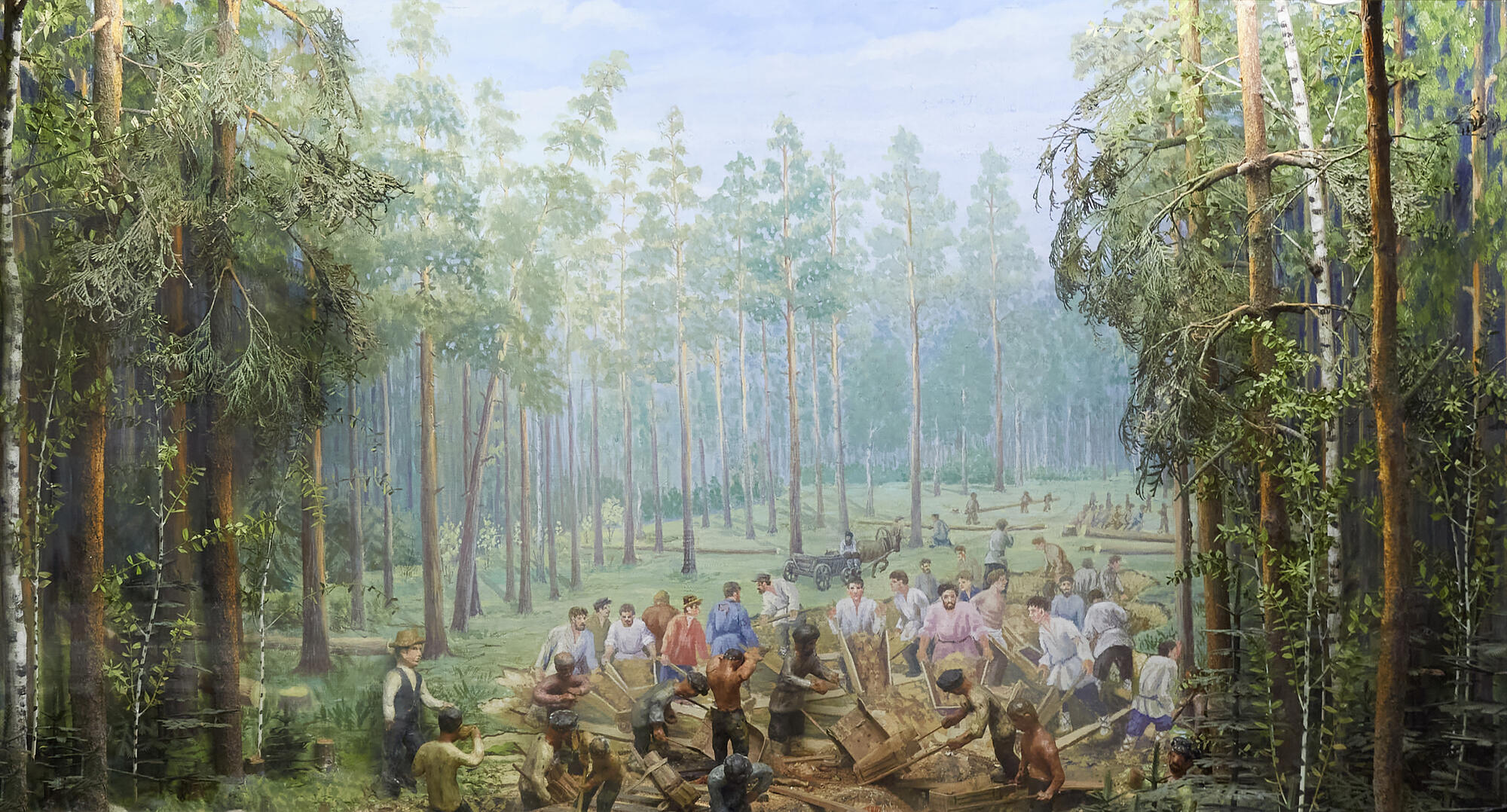


The diorama “Building the Moscow-Nizhny Novgorod Railway”, created by the artists Ivan Nikolayevich Prikhodko and Pyotr Nikolayevich Prikhodko, is a detailed story of how hard the builders worked on bringing the railway about.
The construction of the Nizhny Novgorod (now Gorky) railroad began in the spring of 1858. The workers were mainly serfs, and there were about 17,000 of them at the beginning. The road was laid through dense forests and crossed many peat bogs. All work was carried out manually using wooden shovels with iron overlaps, wheelbarrows with runways and horse-drawn rakes for transporting soil over long distances. The first single-track line to Vladimir was opened on June 14, 1861, and on August 1, 1862, the first train arrived in Nizhny Novgorod. This day is considered the date of foundation of the Moscow-Nizhny Novgorod Railway. 34 million rubles were spent on the construction in total.
The construction of the railway caused an intense struggle between the Bogorodsk, Zuyevo and Nikolsk merchants, who debated whether the road should pass through Bogorodsk, Zuyevo or Orekhovo. In the end, the Morozov merchants from Nikolsk, who owned local weaving factories, won. The Morozovs bribed the builders so that the railway track passed through Orekhovo first. There was a total of 26 stations. There were Moscow-Nizhegorodskaya, Kuskovo, Obiralovka, Vasilyevo (later renamed Kudinovo, now Elektrougli) and Stepanovo (now Fryazevo).
Curiously enough, the famous Russian poet Alexander
Pushkin was one of the most active participants in discussions about railways,
along with scientists and engineers. He ardently supported the need to build
railways in Russia, elaborating on this topic on the pages of the Sovremennik
magazine. In a letter to Prince Vladimir Odoyevsky, Pushkin expressed an
interesting thought about the construction of the first railway,