The Igbi festival is celebrated in the Tsez (Dido) village of Shaitli, Tsuntinsky district of the Republic of Dagestan. It has no analogue in the ritual culture of the North Caucasian peoples. Locals believe that on this day, for the first time since winter, the sun rays reach the slopes of Mount Khora, which indicates the oncoming of spring.
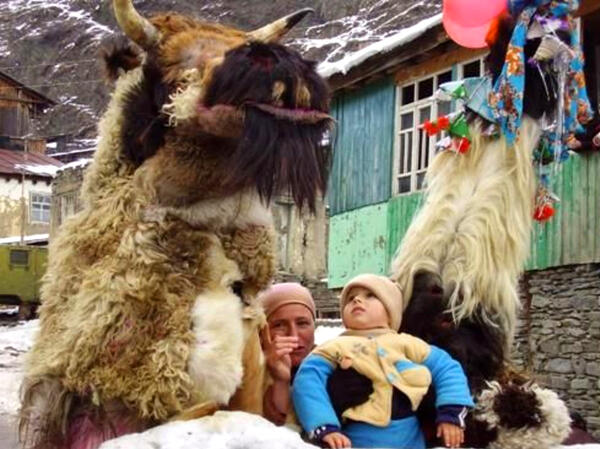
The name of the holiday is associated with the main ritual dish — igbi (bagels). Boys and young men from the age of 10 to 25 years take part in the festival. Eight to six weeks before the festival, they begin to sew carnival costumes, make masks of wolves (the wolves are called botsi), masks of forest people, shaitan, skeleton and others. The central figure of the celebration is Kvidili (Khvidili).
A week before the festival, 3 or 4 youths disguised as wolves appear in the village. They remind fellow villagers to start preparing for the festival.
After this, women begin to bake igbi: there should be a lot of them. On the festival day, in the morning, the boys gather in groups and go around the village, collecting igbi. The wolves-botsi do the same. They string their bagels on a long pole called giri.
While igbi collectors are walking around the village, villagers are meeting in the godekan square. The botsi also come there. Then, from the side of Mount Khora, Kvidili enters the village. By noon, the festival enters its final phase. All the participants gather in the godekan (center of the village) around Kvidili and drag him to the bridge, where the elder botsi imitates his killing. This serves as a signal for the end of the festival.
The name of the holiday is associated with the main ritual dish — igbi (bagels). Boys and young men from the age of 10 to 25 years take part in the festival. Eight to six weeks before the festival, they begin to sew carnival costumes, make masks of wolves (the wolves are called botsi), masks of forest people, shaitan, skeleton and others. The central figure of the celebration is Kvidili (Khvidili).
A week before the festival, 3 or 4 youths disguised as wolves appear in the village. They remind fellow villagers to start preparing for the festival.
After this, women begin to bake igbi: there should be a lot of them. On the festival day, in the morning, the boys gather in groups and go around the village, collecting igbi. The wolves-botsi do the same. They string their bagels on a long pole called giri.
While igbi collectors are walking around the village, villagers are meeting in the godekan square. The botsi also come there. Then, from the side of Mount Khora, Kvidili enters the village. By noon, the festival enters its final phase. All the participants gather in the godekan (center of the village) around Kvidili and drag him to the bridge, where the elder botsi imitates his killing. This serves as a signal for the end of the festival.