Sea-hunting played an important role in the economic activity of the Nivkh people of the Amur region. Hunting seals and beluga whales provided them with plenty of meat and fat. The season began when the bays were free of ice.
Experienced Nivkh people could distinguish the breed of the seal by the shape of its head and its ways. They said that the sea lion, also known as Steller’s northern sea lion, had a blunt head, while those of other seals were pointed. When tracking a sea animal, hunters skillfully lured them with shouts, special guttural sounds, or by banging their oars against the boat.
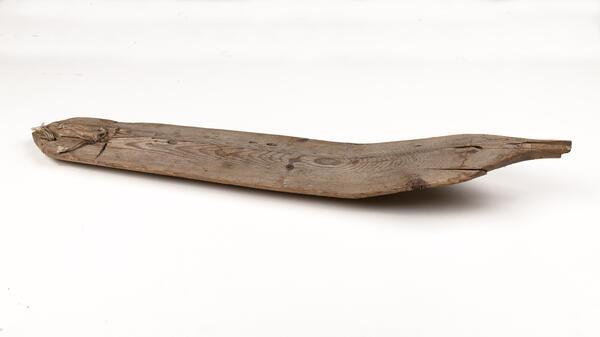
When hunting in the summer, Nivkhs used a floating spear, which consisted of four parts: a handle, a lykh (lakh) guidance device, such as this exhibit, an iron tip, and a long thin strap.
The total length of the handle was approximately 35 meters. It was made up of four or five sticks, each of which had to be approximately seven meters long, flexible and flat. The sticks were joined together and fastened with thin straps. A guidance device was attached to the end of the handle.
The construction was very complex: a small flat keel ran along the underside, the upper side was smooth, slightly sloping on both sides of the center. On the upper rear part, non-through interconnecting holes and a hollow were carved. A well-fitted end of the shaft of the spear was put into it and fastened with waterproof eagle feathers. Only the outer part of the feather was used for this purpose, as the inner part, facing the eagle’s body, was fragile.
A spur of birch was made to fix the iron tip, it was fitted in a slit on a guidance device made of spruce. The iron tip, unlike the arrow, had one more point — a protrusion. A properly made guidance device floated on water and did not sink.
When the lakh approached
the seal, the tip was pushed forward and thrust into the prey. The leather
strap prevented the animal from swimming away or sinking. Hunting a sea animal
required strength and agility, good eye and the ability to wait for a long time
for the prey.