Traditionally, a Nanai bride wore several robes during her wedding ceremony. According to tradition, the number of robes should not be less than four. The sike upper robe was richly decorated with protective decorative patterns.
A Nanai bride wore a bib under her sike. In everyday life, Nanai women also wore such a piece of clothing over their pants, covering their knees. It was worn by all women before marriage, and after that only by those in wealthy families.
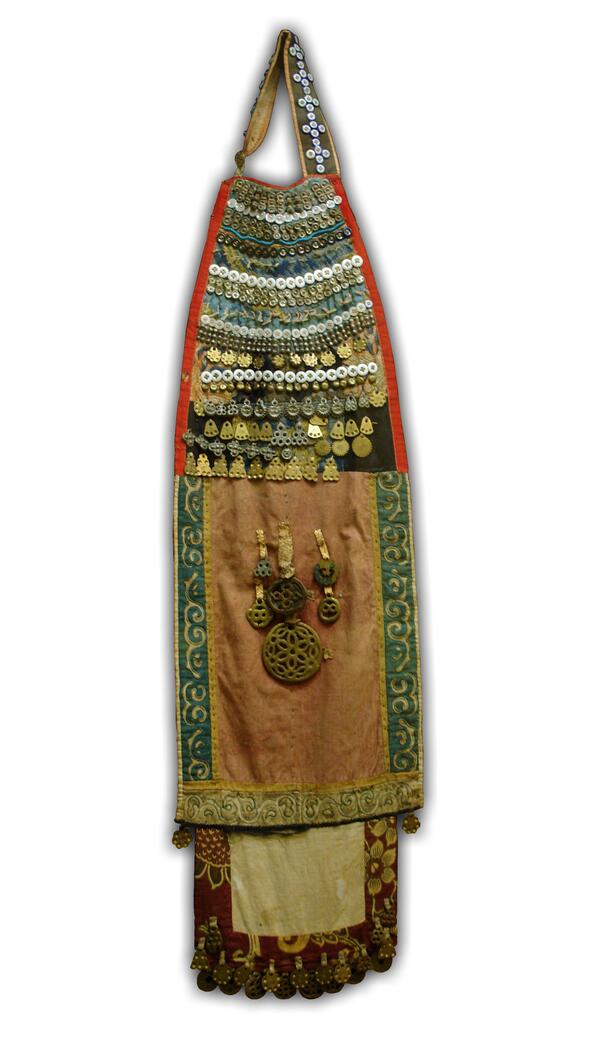
There were two types of bibs: Amur and Tungusic. The latter prevailed among the Nanai people of the Lower Amur. The Tungusic type, the one to which the bib on display belongs, was called lelu. It suggested an open robe. According to the custom, the upper robe of the bride was exactly like that.
Compositionally, the bib is divided into three tiers: the upper one is made of black fabric with colored buttons, the middle one is sewn from three vertical strips with stitched bronze pendants, coins, shells and medallions with images of a bear and hieroglyphs. The lower tier is made of black fabric with stitched metal pendants. This design echoes the three-level division of the world tree and the universe as a whole: the Heavenly World — the abode of the supreme deities, the Earthly Space — the world of people and the Underworld — the world of the souls of the dead.
Women’s wedding bibs were sewn from silk or cotton fabric with lining. They were richly decorated with beads, buttons, copper pendants, plaques of various shapes. In the lower part of the bib, bronze metal pendants or cowrie shells were sewn on suede straps. The ringing of metal pendants at every movement of the bride testified to the presence of these items in the costume. Thus, the bride could not only be seen, but also heard. The metallic ringing also scared away evil spirits.
The bride’s parents tried to provide their daughter with clothes for many years. Sometimes they gave her 15, 20 and even 30 robes, as well as shoes, hats, undergarments, bedding, and all kinds of utensils made of wood, birch bark, wicker, and porcelain.
The mother often gave
her daughter silk robes and other clothes, precious jewelry from her dowry,
which, as a rule, was used only during the wedding, and then lay unused for
years. This is how old things were passed from mother to daughter, and often
from grandmothers to granddaughters.