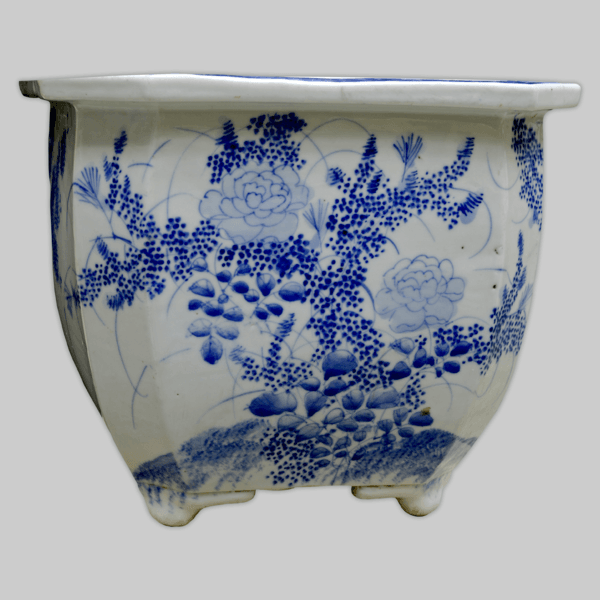
The flower pot is a white porcelain vase with an octagonal cylindrical body, wide bent side and three curly legs at the base. The vase is decorated with blue underglaze painting in the form of a floral ornament with peonies and twigs.
Peony in China is revered as the ‘king of flowers’. He embodies a noble character, grandeur and well-being. It is a symbol of abundance, honor. This is one of the few flowers that symbolizes the arrival of spring. It is planted in parks and is depicted on the one-yuan coin. The delicate scent of peonies attracts insects and butterflies, so you can often find the image of a butterfly flying around a peony, which has become one of the most used images in Chinese art.
Porcelain is ceramics of a very thin layer; even with a light blow with a wooden stick, you can hear a high, clear sound, indicating high quality. The culture and art of China cannot be imagined without porcelain items, and the history of the creation of porcelain products that delighted the world is an endless striving for perfection, the pinnacle of the decorative and applied art of the Celestial Empire.
The Chinese themselves named the porcelain with a double hieroglyph, part of which means ‘tiles’, emphasizing its belonging to baked clay. The discovery of porcelain was the result of a long way of improving ceramics. The main center for the manufacture of items from Chinese porcelain was the city of Jingdezhen. It is there that there are deposits of clay of a special quality with high plasticity and whiteness. Scientists claim that the craftsmen managed to get as close as possible to the manufacture of thin-walled ceramics already in the 1st century AD. Archaeologists have found ‘vessels for the soul’ intended for the wandering of the souls of the dead, dating back to this period.
From the 16th century, porcelain began to be decorated with overglaze painting. The skill reached its peak during the reign of the first emperors of the Qing dynasty, but by the end of the 17th century this art form began to gradually lose its significance due to endless wars.
When painting porcelain, two methods are used: overglaze and underglaze painting. In the second method, paints are applied to unglazed porcelain, after which it is fired at a sufficiently high temperature — about 850 degrees. After that, the product is covered with glaze and fired again, but at a higher temperature — 1350 degrees.
The flower pot was purchased by the Amur Regional Museum of Local Lore in 1995 from a resident of the city of Blagoveshchensk I.G. Matvienko.
Peony in China is revered as the ‘king of flowers’. He embodies a noble character, grandeur and well-being. It is a symbol of abundance, honor. This is one of the few flowers that symbolizes the arrival of spring. It is planted in parks and is depicted on the one-yuan coin. The delicate scent of peonies attracts insects and butterflies, so you can often find the image of a butterfly flying around a peony, which has become one of the most used images in Chinese art.
Porcelain is ceramics of a very thin layer; even with a light blow with a wooden stick, you can hear a high, clear sound, indicating high quality. The culture and art of China cannot be imagined without porcelain items, and the history of the creation of porcelain products that delighted the world is an endless striving for perfection, the pinnacle of the decorative and applied art of the Celestial Empire.
The Chinese themselves named the porcelain with a double hieroglyph, part of which means ‘tiles’, emphasizing its belonging to baked clay. The discovery of porcelain was the result of a long way of improving ceramics. The main center for the manufacture of items from Chinese porcelain was the city of Jingdezhen. It is there that there are deposits of clay of a special quality with high plasticity and whiteness. Scientists claim that the craftsmen managed to get as close as possible to the manufacture of thin-walled ceramics already in the 1st century AD. Archaeologists have found ‘vessels for the soul’ intended for the wandering of the souls of the dead, dating back to this period.
From the 16th century, porcelain began to be decorated with overglaze painting. The skill reached its peak during the reign of the first emperors of the Qing dynasty, but by the end of the 17th century this art form began to gradually lose its significance due to endless wars.
When painting porcelain, two methods are used: overglaze and underglaze painting. In the second method, paints are applied to unglazed porcelain, after which it is fired at a sufficiently high temperature — about 850 degrees. After that, the product is covered with glaze and fired again, but at a higher temperature — 1350 degrees.
The flower pot was purchased by the Amur Regional Museum of Local Lore in 1995 from a resident of the city of Blagoveshchensk I.G. Matvienko.