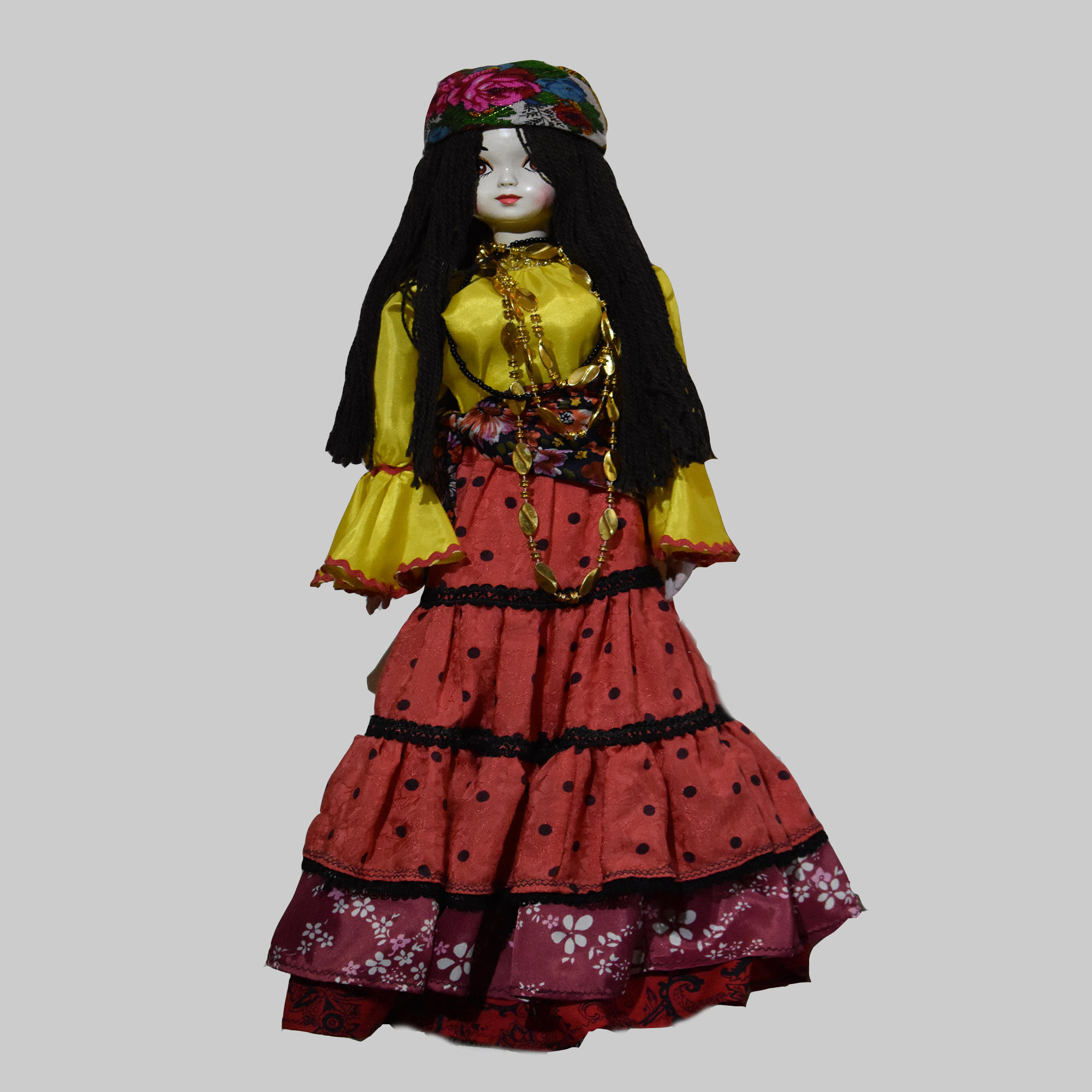


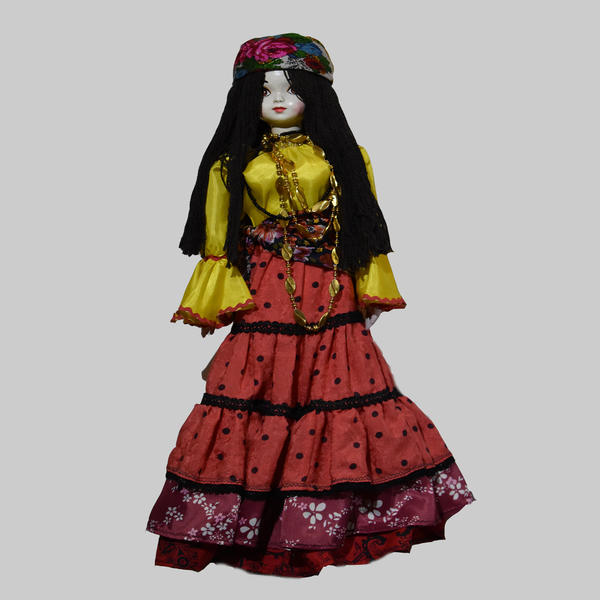
The Gypsies have inhabited the Boguchar district for a long time, some of them still live in the village of Zaliman. The Romani women’s folk costume in this area looked approximately similar to what the doll is wearing: a wide three-tier red skirt with black polka dots and a black ribbon trim, a yellow satin shirt with belt-shaped sleeves decorated with red ribbon, and a white colorful headscarf. And gypsy women have, of course, always loved flashy large jewelry- beads, earrings and bracelets.
The legend has it that gypsies are the descendants of lower caste Indians, so they have always liked - in spite of their poverty - to dress in an expensive and flamboyant style. The cut of their clothes was influenced by different cultures, but the elements of ancient Indian style can be seen in gypsy outfits to this day, according to researchers. This is especially true of women’s dresses that have retained their distinctive cultural character.
The main element of the gypsy costume is a floor length skirt. The woman’s legs must be completely covered – the Roma consider the lower half of the woman’s body ‘bad’ and ‘unclean’, so it is necessary to hide it. And you can wear everything you want at the top: any shirts and blouses. Low necklines and open shoulders are not frowned upon, they are not considered vulgar. It is the other way round - this way of demonstrating the female nature is considered beautiful and aesthetic.
Married women cover their heads with a triangular scarf, which is called diklo. It is first twisted at the ends and then tied on the back of the head. Their festive kerchiefs are decorated with fringe, embroidered with beads and bedazzlers.
Massive gold jewelry is an integral part of a gypsy woman image. The Europeans usually invest their wealth in the house and everyday life, while the Gypsy nomads have always worn all the gold on themselves.
A shawl made of wool or silk complements the outfit. The variety of the color schemes in their outfits is amazing. Gypsies prefer bright, vibrant colors featuring rich ornaments. Bachelorettes are not allowed to wear yellow clothes, however, and you will never see black monochrome wardrobe items on gypsies.
Typical costume elements for men are bright silk or satin shirts, vests and Turkish-style trousers.
Little Roma children are wrapped in soft fabrics; women often carry them in a sling on the chest or the back. Older children wear loose dresses and Turkish-style trousers. Nowadays, you can often come across Roma children wearing clothes we are used to. On holidays, girls dress up in long skirts, and boys put on beautiful shirts.