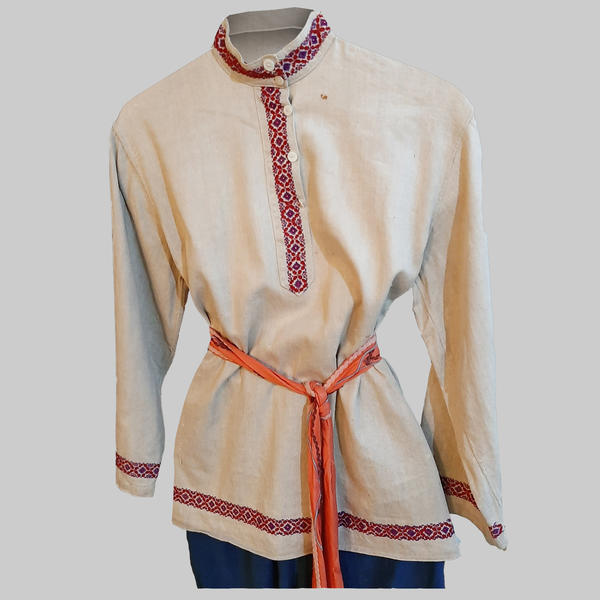
In the Voronezh Province, men wore several types of shirts: tunic-shaped shirts with beveled sides; articles with straight poliks (shoulder inserts) connected along the weft or with a yoke. Tunic-like shirts were not the same, a few styles were used.
Articles with straight sides were made from a whole cloth body folded along the weft, with the hole for the head cut at the fold. To this piece of cloth, sleeves and small pieces, which formed the shirt sides, were connected. Between them and the sleeves, rectangular gores were placed. Usually, they were made from fabric of other color, preferably red.
Garments were made with a special lining from thick linen – podopleka. It was placed in the upper part of the article.
Women made shirts from homespun cloth woven from linen or hemp. In most cases, the articles were white, sometimes a rare variety of red or blue shades could be found. In every region, they were decorated in accordance with the tradition formed in many years. For the most part, they decorated the hem, the lower part of the sleeves, more seldom – shoulders.
Articles with straight sides were made from a whole cloth body folded along the weft, with the hole for the head cut at the fold. To this piece of cloth, sleeves and small pieces, which formed the shirt sides, were connected. Between them and the sleeves, rectangular gores were placed. Usually, they were made from fabric of other color, preferably red.
Garments were made with a special lining from thick linen – podopleka. It was placed in the upper part of the article.
Especially elaborately wedding and festal shirts for young men were decorated. Beautifully ornamented articles were not only part of festive attire, but also played the role of a key element in the ritual costume worn at the time of hay making and harvesting. At that time, their usual labor became a real feast for peasants. It was easier to work in a linen shirt: in the heat, such cloth perfectly absorbs sweat.
The shirt cut was maximally simple, this loose, not hampering movements garment consisted exclusively of rectangular pieces of cloth. For wearer’s comfort, gores were placed in the armpits.
Sleeves were always long, quite often, they even covered the owner’s fingers. Frequently, the sleeves were also very full. Then, they had to be held up. It was done with special bracelets placed on the wrists.
Usually, shirts were made long. Men’s articles could reach down to the knees and they were worn loose. Women’s garments were even longer and could reach down to the ground.
Shirts were traditionally decorated with rich embroidery. It made clothes more beautiful, but its main task was to protect the shirt owner from the evil spirit and bad spell. Embroidered patterns were placed along the hem, on the collar and wristbands. Also, they often decorated the front part of the article.
Peasants had quite many shirts. The most beautiful, ritual ones were only used a couple of times a year.