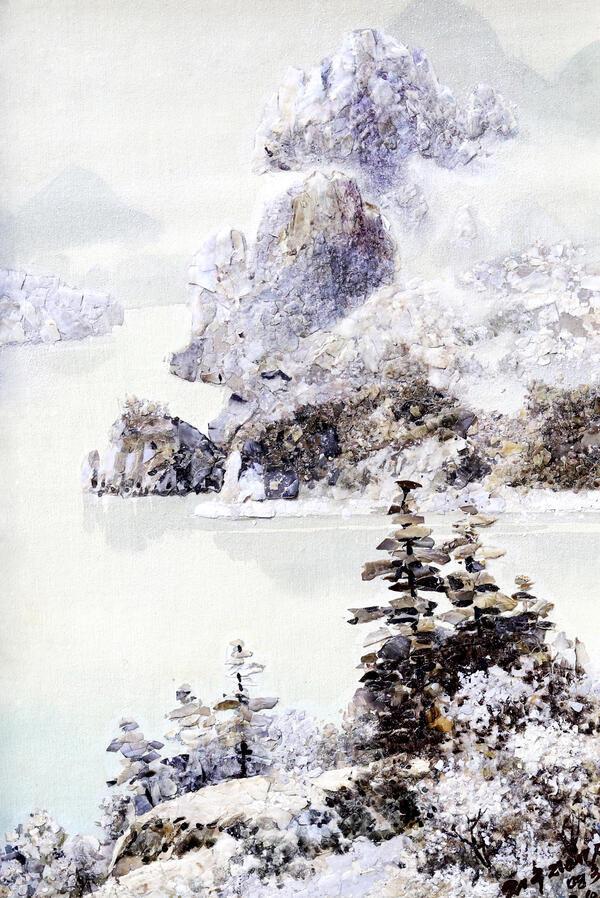
A landscape is depicted on a gray background using applique technique. In the foreground is a small snow-covered hill with shrubs and trees. Behind it is a winding mountain river, to the right and left of which there are rocks, hills with dark reflections in still water. A gray sky is in the background. The panel is framed with a dark brown wooden frame.
Mother-of-pearl paintings are a type of applied art which roots go far back in time. When making such paintings, the inlay method was used. It attracted attention not only due to the brilliance of the image, but also draw the eye with its style.
Such paintings were created by the masters of Asian countries located next to the ocean or rivers. A large amount of mother-of-pearl contributed to the development of folk craft, craftsmen honed their skills for years and came up with new ways of depicting. A rich color range, a special technique of cutting mother-of-pearl, incredible scrupulousness in the selection of shells and jewelry work — all this made it possible to create real works of art of rare beauty. By combining yellow, pink, red, blue and lilac mother-of-pearl, the artists created works that had no equal.
Mother-of-pearl is the inner layer of the shells. This is a German name that comes from two words: perl — pearl and mutter — mother. A substance of extraordinary beauty accumulates inside the shells of certain types of mollusks. Mother-of-pearl is classified as a semi-precious stone, but jewelers value it quite highly. Since ancient times, it has been used to decorate furniture and interior items, caskets and fans have been inlaid with it.
The Korean inlay technique used for mother-of-pearl decoration is divided into two types: jureumjil (filling) and kkeuneumjil (cutting). Usually, the first type is used when creating plots where floral patterns and birds appear. At the beginning of the 20th century, a band saw appeared, which made it possible to make decor even smaller in thickness.
The second method is much older and appeared during the Goryeo dynasty. When working, craftsmen use sharp metal tools. With their help, thin strips of ‘sangsa’ are cut. When a sufficient amount has been obtained from the blanks, the master begins to lay them out on the surface of the canvas, thereby forming a figure or image. Koreans compare this process to silk embroidery, since the master needs to be as concentrated as possible.
The ‘Paektu Mountain’ panel was purchased by the Amur Regional Museum of Local Lore in 1989 from Park Zon Sen, a representative of the trading company ‘Vneshtorg Rynrada’.
Mother-of-pearl paintings are a type of applied art which roots go far back in time. When making such paintings, the inlay method was used. It attracted attention not only due to the brilliance of the image, but also draw the eye with its style.
Such paintings were created by the masters of Asian countries located next to the ocean or rivers. A large amount of mother-of-pearl contributed to the development of folk craft, craftsmen honed their skills for years and came up with new ways of depicting. A rich color range, a special technique of cutting mother-of-pearl, incredible scrupulousness in the selection of shells and jewelry work — all this made it possible to create real works of art of rare beauty. By combining yellow, pink, red, blue and lilac mother-of-pearl, the artists created works that had no equal.
Mother-of-pearl is the inner layer of the shells. This is a German name that comes from two words: perl — pearl and mutter — mother. A substance of extraordinary beauty accumulates inside the shells of certain types of mollusks. Mother-of-pearl is classified as a semi-precious stone, but jewelers value it quite highly. Since ancient times, it has been used to decorate furniture and interior items, caskets and fans have been inlaid with it.
The Korean inlay technique used for mother-of-pearl decoration is divided into two types: jureumjil (filling) and kkeuneumjil (cutting). Usually, the first type is used when creating plots where floral patterns and birds appear. At the beginning of the 20th century, a band saw appeared, which made it possible to make decor even smaller in thickness.
The second method is much older and appeared during the Goryeo dynasty. When working, craftsmen use sharp metal tools. With their help, thin strips of ‘sangsa’ are cut. When a sufficient amount has been obtained from the blanks, the master begins to lay them out on the surface of the canvas, thereby forming a figure or image. Koreans compare this process to silk embroidery, since the master needs to be as concentrated as possible.
The ‘Paektu Mountain’ panel was purchased by the Amur Regional Museum of Local Lore in 1989 from Park Zon Sen, a representative of the trading company ‘Vneshtorg Rynrada’.