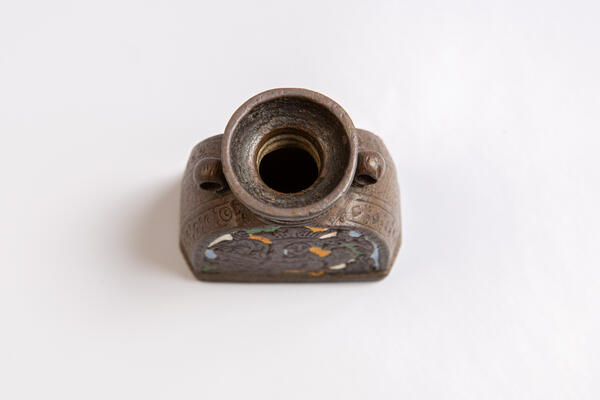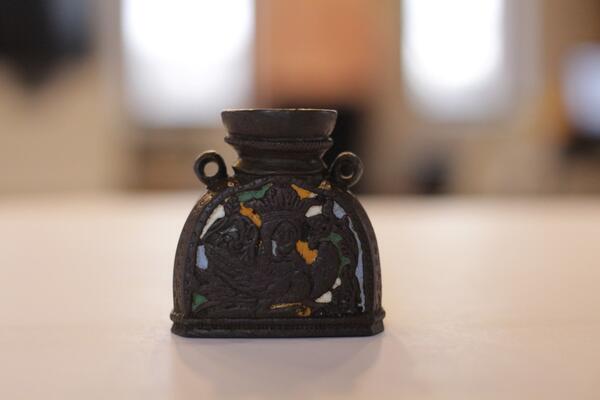
The metal inkwell with enamel decor from the museum’s collection belongs to the common type of suspended inkwells. Using the two suspension loops in the upper part, the owner could hang this item on a ribbon or chain. This greatly expanded the number of ways the inkwell could be used.
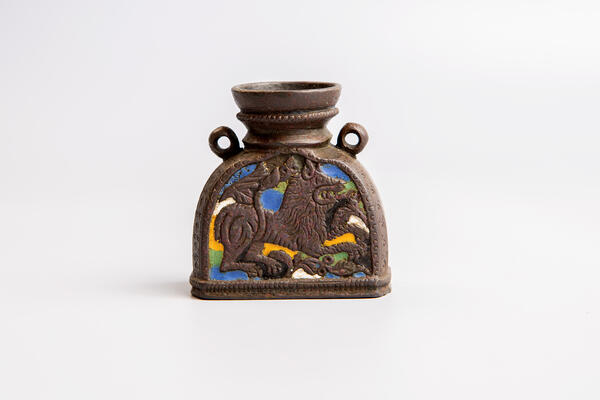
When making the inkwell, the artisan used a rare decorative technique —champlevé enamel. The front side of the object is decorated with a three-dimensional cast figure of a lion. A profile image of the king of beasts is not typical of the 17th-century. According to some researchers, when depicting lions, Russian artisans were inspired by foreign printed books, which came to Russia at that time in large quantities.
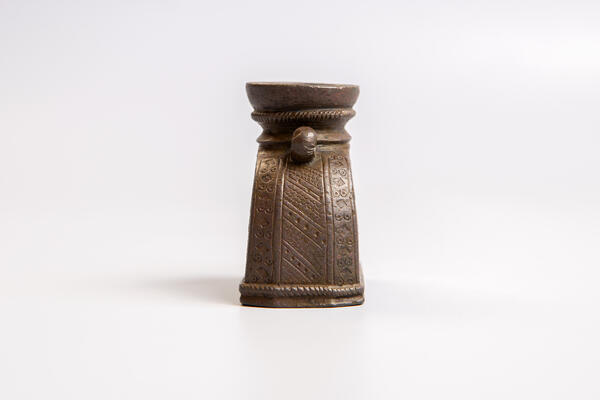
The pattern of the lion’s fur is emphasized by chiseling and is extremely expressive. The side surfaces of the inkwell are engraved. In addition to the large figure of a lion, the surface features images of plant shoots. This pattern fills the free fragments of the background, complements the figure of a lion and harmonizes the composition as a whole.
Bright shades of dark blue, green, yellow and white enamel contrast with each other. The peculiarity of this item is that the enamel was applied in spots of various shades on a single background. Clear borders of color spots are replaced by a subtle gradient. This multicolored background is fully in line with the style of the 17th century.
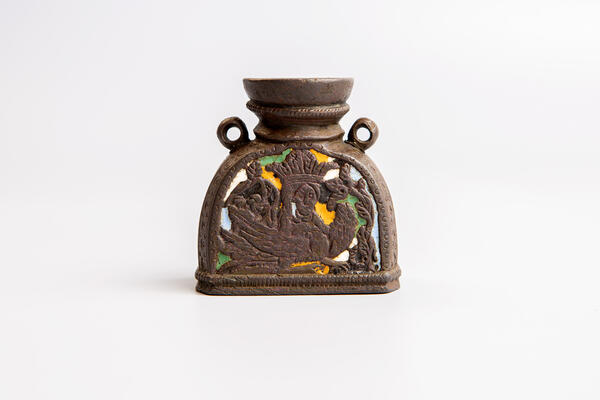
Sirin is depicted on the other side of the inkwell. It was a character of ancient Russian legends — a bird of paradise with a maiden’s head. People believed that she sings prophetic songs, visits an apple orchard on the Apple Feast of the Savior in the morning, is sad and cries, and after that she is replaced by another mythical bird — Alkonost. This couple was painted in 1896 by Viktor Mikhailovich Vasnetsov. The image of Sirin with a small crown was used to create a carved stone panel for the Moscow metro station Perovo.
In Russian arts and crafts, inkwells were made not only from metal, but also from clay, although ceramic samples have not been so well preserved. Inkwells are the most vivid attributes of literacy and education of the urban population of the 16th and 17th centuries.
When making the inkwell, the artisan used a rare decorative technique —champlevé enamel. The front side of the object is decorated with a three-dimensional cast figure of a lion. A profile image of the king of beasts is not typical of the 17th-century. According to some researchers, when depicting lions, Russian artisans were inspired by foreign printed books, which came to Russia at that time in large quantities.
The pattern of the lion’s fur is emphasized by chiseling and is extremely expressive. The side surfaces of the inkwell are engraved. In addition to the large figure of a lion, the surface features images of plant shoots. This pattern fills the free fragments of the background, complements the figure of a lion and harmonizes the composition as a whole.
Bright shades of dark blue, green, yellow and white enamel contrast with each other. The peculiarity of this item is that the enamel was applied in spots of various shades on a single background. Clear borders of color spots are replaced by a subtle gradient. This multicolored background is fully in line with the style of the 17th century.
Sirin is depicted on the other side of the inkwell. It was a character of ancient Russian legends — a bird of paradise with a maiden’s head. People believed that she sings prophetic songs, visits an apple orchard on the Apple Feast of the Savior in the morning, is sad and cries, and after that she is replaced by another mythical bird — Alkonost. This couple was painted in 1896 by Viktor Mikhailovich Vasnetsov. The image of Sirin with a small crown was used to create a carved stone panel for the Moscow metro station Perovo.
In Russian arts and crafts, inkwells were made not only from metal, but also from clay, although ceramic samples have not been so well preserved. Inkwells are the most vivid attributes of literacy and education of the urban population of the 16th and 17th centuries.