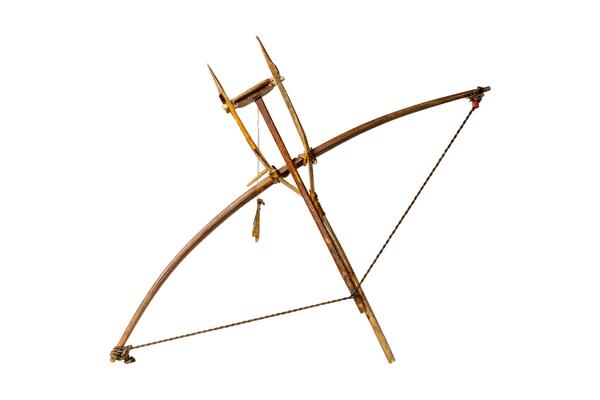
A trap used by Siberian hunters for hunting fur-bearing animals was called a cherkan. It consisted of a handle, a crossbar, and a bow with a bowstring. The hunters fixed a wooden T-shaped crutch instead of an arrow in special grooves. A bow for a cherkan was made of dried larch or bird cherry wood. It was cocked by a hammer. A stotozhok, also known as a special board that activates the mechanism of a trap, was attached to it with a cord. The animal had to touch it for a trap to work. An eatable bait was placed in the center of a trap. The animal touched a trap, knocked down a stotozhok, a trigger lowered a bowstring, and a crutch pressed an animal to a crossbar so that it could not get out.
Cherkans were the most popular portable traps in Siberia in the middle of the 20th century. They could be made of any available materials. Cherkans were set higher than ordinary traps. That is why they were less often covered with snow in winter, and the hunters could easily find them. However, such traps also had their downside: it was inconvenient to carry them because they could not be folded or disassembled.
Cherkans were used to catch animals for their furs. This craft was one of the most important in Siberia since the 11th century. The indigenous people paid a tribute to Novgorodians with fur skins. In the 16th century, valuable sable furs became one of the reasons why Ataman Yermak’s detachments went to Siberia. Their leader died, but many sables, beaver, and fox fur skins were sent to Moscow. After it, the fur trade with the rest of Russia was built. The skins were firstly sent to Tobolsk. They were sorted and evaluated there and then, they were sent to Moscow. Only after that, they were sent to other cities.
More suitable and modern traps almost completely replaced the cherkans from the hunting arsenal in the second half of the 20th century. But, sometimes wooden traps were still used. They were intended for animals with a keen sense of smell, who avoided steel traps.
Cherkans are still being produced nowadays, but they are made industrially. The multi-turn springs are used instead of a bow. Anyway, the principle of work is still the same.
Cherkans were the most popular portable traps in Siberia in the middle of the 20th century. They could be made of any available materials. Cherkans were set higher than ordinary traps. That is why they were less often covered with snow in winter, and the hunters could easily find them. However, such traps also had their downside: it was inconvenient to carry them because they could not be folded or disassembled.
Cherkans were used to catch animals for their furs. This craft was one of the most important in Siberia since the 11th century. The indigenous people paid a tribute to Novgorodians with fur skins. In the 16th century, valuable sable furs became one of the reasons why Ataman Yermak’s detachments went to Siberia. Their leader died, but many sables, beaver, and fox fur skins were sent to Moscow. After it, the fur trade with the rest of Russia was built. The skins were firstly sent to Tobolsk. They were sorted and evaluated there and then, they were sent to Moscow. Only after that, they were sent to other cities.
More suitable and modern traps almost completely replaced the cherkans from the hunting arsenal in the second half of the 20th century. But, sometimes wooden traps were still used. They were intended for animals with a keen sense of smell, who avoided steel traps.
Cherkans are still being produced nowadays, but they are made industrially. The multi-turn springs are used instead of a bow. Anyway, the principle of work is still the same.