A back band is an element of festive reindeer harness made of a wide leather strap covered with multicolored cloth. It was tied transversely on the deer’s back.
A festive back band was used on various Sami holidays, primarily religious ones. The Russian Sami adopted the Orthodox Christianity as early as the 16th century, but many pre-Christian traditions and rituals have been preserved for centuries, some of which are still prevalent among the Sami people today.
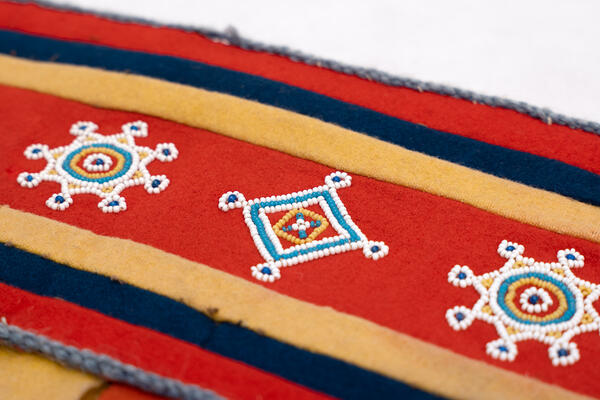
The front side of the back band, presented in the Murmansk Museum of Local History, is sewn from narrow strips of red, blue, and yellow cloth, with red cloth in the center. A fringe of rectangular strips of cloth of different colors is sewn to the edges on three sides.
The red color is the favorite one of the Sami people. It served as protection, and thus it was a color that guaranteed life. Any color in Sami had a symbolic meaning: blue symbolized the sky, yellow — the sun, white — snow, blue — water, green — leaves and grass.
In the center, a characteristic Sami decorative pattern is embroidered with beads on a red cloth. White, blue and yellow are the three main colors of beads that are used in the pattern. There are tertiary colors, but black beads are never used, as the black color symbolizes death.
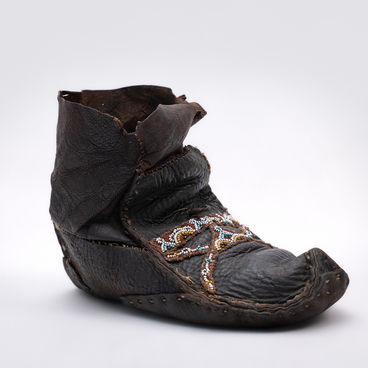
The Sami people pattern differs from all others in its content. It is striking in its varied execution, which is closely related to the Sami ideas of nature. The surface of the sea, for example, is depicted by a blue wavy beaded line. And a simple loop represents a man in a malitsa.
Sami embroidery can be attributed with certainty to a very popular geometric group: it features triangles, zigzags, straight and wavy lines, rhombuses, squares, circles, rosettes, semicircles, and crosses. A characteristic feature of the pattern is a loop, which tops most of the angles. The decorative pattern on the back band, presented in the Murmansk Museum of Local History, has such loops on geometric figures.
The works of the craftswomen in the early days
certainly bore the stamp of paganism. The design of the embroidery always
included the sign of the clan. Each pattern in ancient times had its own
meaning related to the family, the area where the craftswoman lived, a story
about her native home.