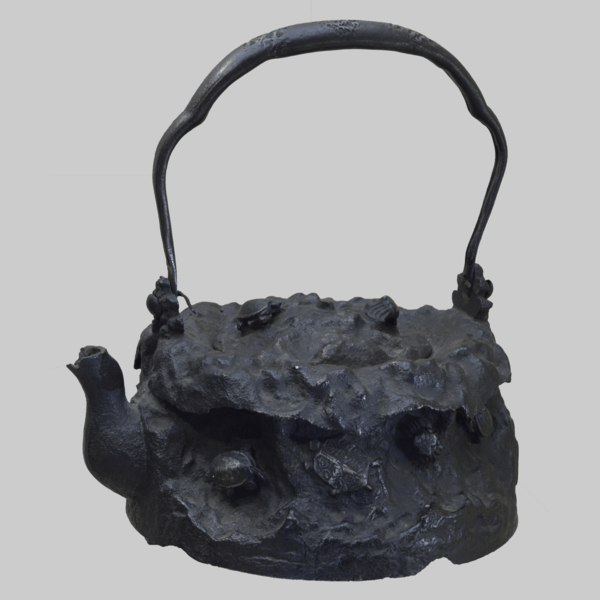
The teapot was purchased by employees of the Amur Regional Museum of Local Lore in 1952 for 50 rubles from a resident of the city of Blagoveshchensk A.I. Syupov — foreman of the boat ‘Researcher’. He, in turn, acquired it in the Chinese city of Jiamusi, where the Chinese explained that it was a ‘teapot of happiness’ cast in 1650.
The teapot is made in the shape of a turtle. Its outer walls are split-level, with an overhanging wavy rim decorated with a floral pattern. On the walls there are volume relief images of turtles and crab. The spout of the teapot is short and curved. In the upper part there is a high arched handle with three hieroglyphs, which is attached to the ‘ears’ of the body, made in the form of flowers.
The teapot is the most important element in the tea culture of Asian countries. The very first teapots were made of porous red clay, which was mined near the city of Yixing. The structure of this clay allowed oxygen to saturate the tea, it became more aromatic with each next brew.
In the 8th century AD, tea leaves were rolled by hand, dried, and then ground into powder. Then salt was added to it and placed in boiling water to get a thick mixture. It was called tea. After a while, the brewing procedure changed. Hot water was added to the tea powder, and the whole mixture was whipped until foam appeared. This method of making tea was first used in Japan in the 9th century. The Japanese treated the making of teapots like creating works of art, painting their surfaces with beautiful scenes.
The traditional brewing method became popular during the Ming Dynasty in 1368-1644. The leaves were poured with boiling water, and people used sealed dishes to brew the drink. Since the tea was used in small quantities and only freshly brewed, the teapots were also small. It often happened that each family member had his own. Even the very first teapots had a lid to maintain the temperature of the brewed tea.
At the turn of the 16th-17th centuries, the Japanese invented cast-iron kettles and called them tetsubins, which are popular to this day. Traditionally, tetsubin is heated over a burning coal. In the Japanese art of the tea ceremony, there is a special portable brazier on which the teapot is heated. Tetsubin is often elaborately decorated on the outside with embossed patterns. Perhaps the Chinese adopted this invention from the Japanese.
The teapot is the most important element in the tea culture of Asian countries. The very first teapots were made of porous red clay, which was mined near the city of Yixing. The structure of this clay allowed oxygen to saturate the tea, it became more aromatic with each next brew.
In the 8th century AD, tea leaves were rolled by hand, dried, and then ground into powder. Then salt was added to it and placed in boiling water to get a thick mixture. It was called tea. After a while, the brewing procedure changed. Hot water was added to the tea powder, and the whole mixture was whipped until foam appeared. This method of making tea was first used in Japan in the 9th century. The Japanese treated the making of teapots like creating works of art, painting their surfaces with beautiful scenes.
The traditional brewing method became popular during the Ming Dynasty in 1368-1644. The leaves were poured with boiling water, and people used sealed dishes to brew the drink. Since the tea was used in small quantities and only freshly brewed, the teapots were also small. It often happened that each family member had his own. Even the very first teapots had a lid to maintain the temperature of the brewed tea.
At the turn of the 16th-17th centuries, the Japanese invented cast-iron kettles and called them tetsubins, which are popular to this day. Traditionally, tetsubin is heated over a burning coal. In the Japanese art of the tea ceremony, there is a special portable brazier on which the teapot is heated. Tetsubin is often elaborately decorated on the outside with embossed patterns. Perhaps the Chinese adopted this invention from the Japanese.