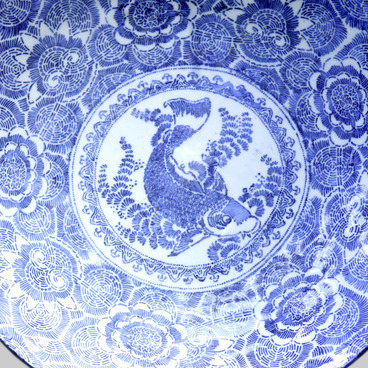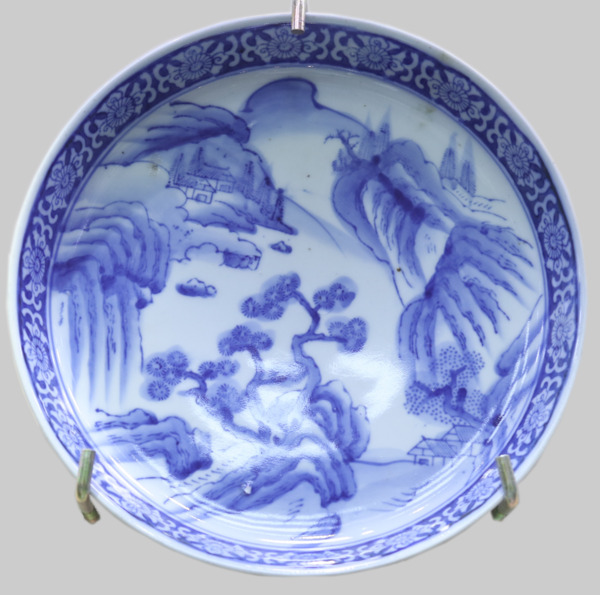
Among the exhibits that came to the museum in the first half of the 20th century is a dish with an ornament. It is painted with blue and white tones in underglaze style. It is a round dish with a high edge and a ring stem. Along the edge, from the inside and outside, the dish is decorated with floral designs. A landscape with houses, trees, clouds and mountains can be seen at the bottom.
While porcelain production in Korea and China began as early as the 1st millennium AD, in Japan, porcelain was only imported until the 17th century, when its own production began. The products of the Chinese workshops in Jingdezhen were actively exported by the East India companies. Prior to that, the export of porcelain to Europe was exclusively carried out by Korean ceramic masters, who discovered deposits of white kaolin clay on the island of Kyushu. The East India Companies were shut down by the economic decline caused by the Chinese civil war at the end of the Ming dynasty.
Japanese porcelain began to compete successfully with Chinese in the 17th century, when the Dutch established a sales office in Nagasaki. Then Japanese porcelain interested European traders as well. The Dutch Delft ceramists copied not only Chinese works, but also the blue and white products of the masters of Arita, an urban district on the island of Kyushu. The same name was given to porcelain, which was produced in the area using thousands of ovens. Also, this porcelain was sometimes called Imari, in honor of the port city, which was one of the few centers of trade open to foreign ships. All masters brought their works there and sold them.
Porcelain items made in the styles of Arita, Imari and Kutani have much in common: in the 18th century, their production was around one city. Then, by the middle of the 19th century, they begin to acquire their characteristic features. Red enamel appeared in Imari’s products, and more green color was added to Kutani’s painting.
The absence of splendor and pomp in Japanese porcelain painting is its main difference from Chinese and Korean. The works of Japanese masters stand out for their graceful, laconic, rather restrained images of nature, and this makes them even more attractive — with their simplicity. Modern Japanese porcelain and ceramics are still a distinctive art that is unique to Japan. They are filled with a philosophical detachment from the ado of everyday life and admiration for the true beauty of nature.
While porcelain production in Korea and China began as early as the 1st millennium AD, in Japan, porcelain was only imported until the 17th century, when its own production began. The products of the Chinese workshops in Jingdezhen were actively exported by the East India companies. Prior to that, the export of porcelain to Europe was exclusively carried out by Korean ceramic masters, who discovered deposits of white kaolin clay on the island of Kyushu. The East India Companies were shut down by the economic decline caused by the Chinese civil war at the end of the Ming dynasty.
Japanese porcelain began to compete successfully with Chinese in the 17th century, when the Dutch established a sales office in Nagasaki. Then Japanese porcelain interested European traders as well. The Dutch Delft ceramists copied not only Chinese works, but also the blue and white products of the masters of Arita, an urban district on the island of Kyushu. The same name was given to porcelain, which was produced in the area using thousands of ovens. Also, this porcelain was sometimes called Imari, in honor of the port city, which was one of the few centers of trade open to foreign ships. All masters brought their works there and sold them.
Porcelain items made in the styles of Arita, Imari and Kutani have much in common: in the 18th century, their production was around one city. Then, by the middle of the 19th century, they begin to acquire their characteristic features. Red enamel appeared in Imari’s products, and more green color was added to Kutani’s painting.
The absence of splendor and pomp in Japanese porcelain painting is its main difference from Chinese and Korean. The works of Japanese masters stand out for their graceful, laconic, rather restrained images of nature, and this makes them even more attractive — with their simplicity. Modern Japanese porcelain and ceramics are still a distinctive art that is unique to Japan. They are filled with a philosophical detachment from the ado of everyday life and admiration for the true beauty of nature.