Artist Zhao-Guo-Yi was born in Hailun. He graduated from the Faculty of Fine Arts of the Pedagogical Institute and is a member of the Hailongjiang Association of Artists.
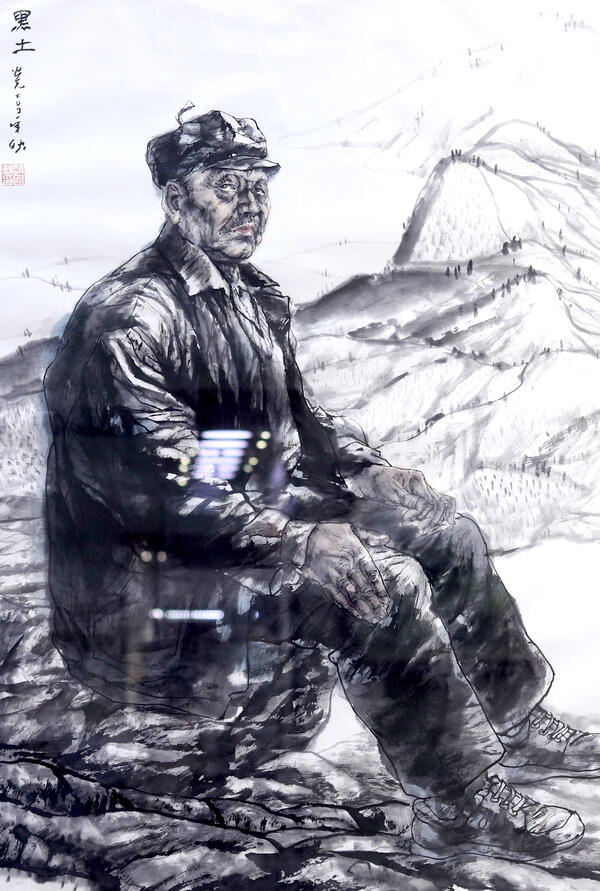
The painting depicts an elderly Chinese man sitting on a stone against the background of a rocky area, turned a quarter to the right. He is dressed in workwear — a jacket, trousers, a cap on his head. The worn hands lying on the knees and the wrinkled face are clearly visible. The look is calm, a little stern. In the background are the outlines of mountains covered with rare vegetation. The scroll is decorated in a passe-partout made of light gray fabric with floral ornaments. Above, vertically left, there is an inscription in hieroglyphs and the artist’s red seal.
Traditional Chinese painting is a monochrome portrayal as well as drawing with lines. It is noteworthy that during their work the craftsmen do not make preliminary sketches. The distinctive features of this painting are laconicism, expressive and rhythmic contours. Another characteristic feature is the flat design and the absence of chiaroscuro. The main genres that can be found among Chinese artists are the traditional depiction of mountains or wells, painted birds and flowers, and portraits.
“Xieyi” and " gongbi " are the traditional styles into which Chinese painting is divided. The fine brush technique, or gongbi, is based on the realism and high detail of the subject. The master pays special attention to even the smallest details, painting an exquisite picture. In this style, without expression, figured compositions, landscapes, and narrative plots were created. Such works were popular with the imperial family, who collected gongbi scrolls.
However, ‘The Chinese’ painting is made in a different style — " xieyi ‘. This direction assumes a free manner of performance, it is called the style of philosophers and poets. It is emotionally close to European impressionism. Here, external similarity fades into the background, and the main role is played by the master’s own vision, his state of mind and how he perceives the object itself. Starting work, the master is guided by his mood in a flash, playing a hunch. The picture is painted quickly, and making a copy is extremely difficult. The xieyi style has no clear lines, there is no detailed elaboration of anything. Here you can find loose and wide brush strokes. Such paintings are painted in ink in black and white and do not look as bright and ‘fancy’ as works in the gongbi style, but you can see more genuine emotions in them.
The painting was donated to the Amur Regional Museum of Local Lore named after G.S. Novikov-Daursky by the artist Zhao-Guo-Yi himself after his personal exhibition in October 2001.
The painting depicts an elderly Chinese man sitting on a stone against the background of a rocky area, turned a quarter to the right. He is dressed in workwear — a jacket, trousers, a cap on his head. The worn hands lying on the knees and the wrinkled face are clearly visible. The look is calm, a little stern. In the background are the outlines of mountains covered with rare vegetation. The scroll is decorated in a passe-partout made of light gray fabric with floral ornaments. Above, vertically left, there is an inscription in hieroglyphs and the artist’s red seal.
Traditional Chinese painting is a monochrome portrayal as well as drawing with lines. It is noteworthy that during their work the craftsmen do not make preliminary sketches. The distinctive features of this painting are laconicism, expressive and rhythmic contours. Another characteristic feature is the flat design and the absence of chiaroscuro. The main genres that can be found among Chinese artists are the traditional depiction of mountains or wells, painted birds and flowers, and portraits.
“Xieyi” and " gongbi " are the traditional styles into which Chinese painting is divided. The fine brush technique, or gongbi, is based on the realism and high detail of the subject. The master pays special attention to even the smallest details, painting an exquisite picture. In this style, without expression, figured compositions, landscapes, and narrative plots were created. Such works were popular with the imperial family, who collected gongbi scrolls.
However, ‘The Chinese’ painting is made in a different style — " xieyi ‘. This direction assumes a free manner of performance, it is called the style of philosophers and poets. It is emotionally close to European impressionism. Here, external similarity fades into the background, and the main role is played by the master’s own vision, his state of mind and how he perceives the object itself. Starting work, the master is guided by his mood in a flash, playing a hunch. The picture is painted quickly, and making a copy is extremely difficult. The xieyi style has no clear lines, there is no detailed elaboration of anything. Here you can find loose and wide brush strokes. Such paintings are painted in ink in black and white and do not look as bright and ‘fancy’ as works in the gongbi style, but you can see more genuine emotions in them.
The painting was donated to the Amur Regional Museum of Local Lore named after G.S. Novikov-Daursky by the artist Zhao-Guo-Yi himself after his personal exhibition in October 2001.