It was China that gave the world the tradition of tea drinking. Therefore, the Chinese are very successful in the art of making items for the tea ceremony.
For centuries, Chinese teaware has been distinguished by a variety of shapes, designed in accordance with traditions, and rich décor. Due to its external expressiveness, it is endowed not only with practical, but also with artistic significance and even philosophical meaning, since household utensils created by the hands of artisans of Tianxia (China) are often considered true works of applied art.
In the daily life of the Chinese, tea has a special meaning, and tea drinking is a ceremony in which it is important to observe a certain sequence of rituals in the process of brewing tea. The main purpose of the tea ceremony is to reveal the aroma and taste of the drink as fully as possible. A prerequisite for the ceremony is a calm state of mind. Ornate tea utensils, small exquisite dishes, and calm quiet music contribute to creating a special atmosphere. Chinese tea culture implies a variety of ways of making tea and a wide range of teaware used in the ceremony.
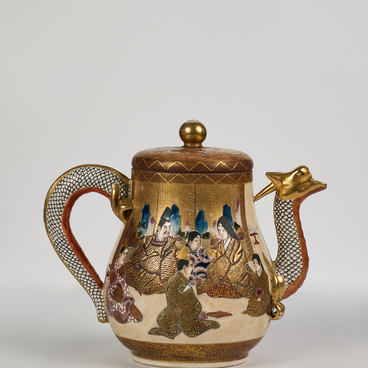
The tea caddy presented in the museum’s Collection of Foreign Art is a pear-shaped vessel for storing dry tea leaves. The item has two handles in the form of stylized dragons, and two genre paintings on the body: they depict six seated figures (three female and three male) against a mountainous landscape.
The artist who decorated the tea caddy paid great attention to the characteristic and easily recognizable details of the Chinese costume. Women and men are depicted in traditional outfits — the national Chinese Hanfu clothing, which means — “Han Dynasty clothes”. It was during this era that the national Chinese costume was born.
The clothes were made of high-quality painted silk. For sewing festive clothes, silk was dyed gold and red, richly decorated with embroidery and precious stones.