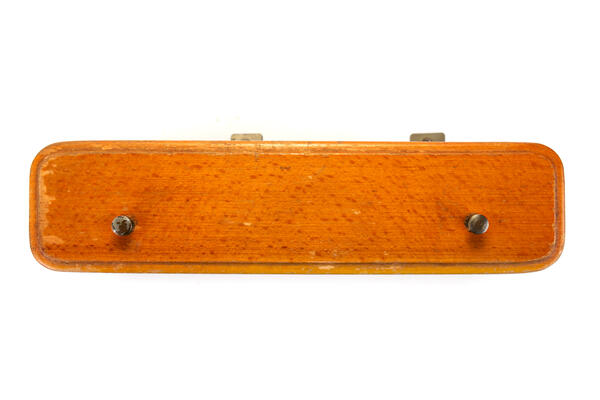
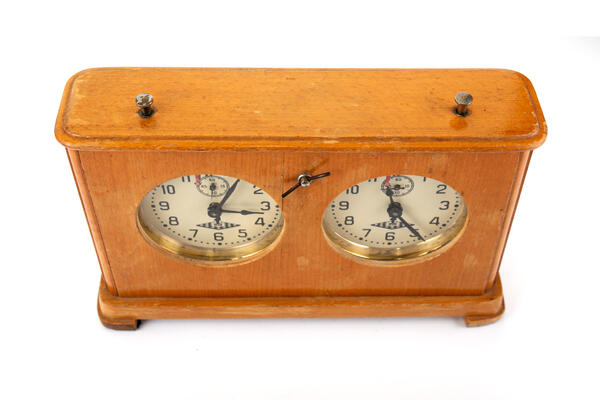
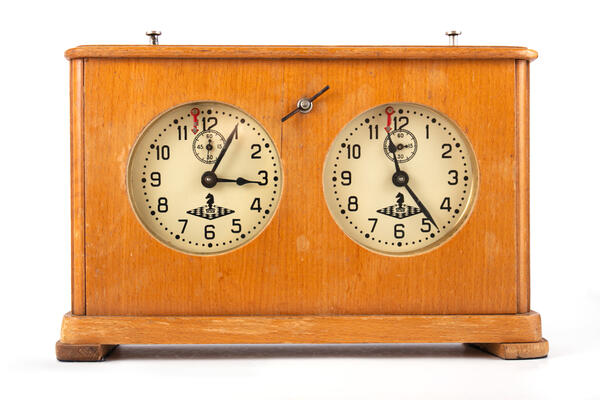
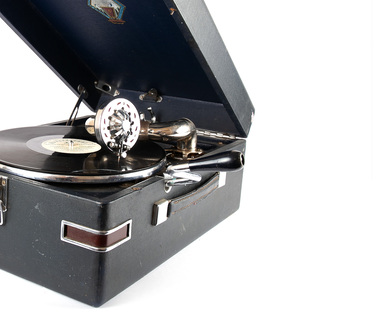
Chess clocks are used during chess competitions, reversi, checkers and similar board games, where the time for completing the move is strictly regulated.
The first chess competitions had no such restrictions, which was sometimes abused by the losing side. The matches lasted for hours and even days. This state of affairs led to a curious case. In the protocol of the 1851 international chess tournament regarding the match between Williams and Mucklowe, it was recorded that “The game was left unfinished because both opponents fell asleep”.
After this incident, the opponents completed the move within no more than 10 minutes and were charged a fine for exceeding the limit. The first tournament according to these rules was held in 1853 between Daniel Garvitz and Johann Leventhal, and both had an hourglass standing next to them. In 1866, chess players Adolf Andersen and Wilhelm Steinitz were already using mechanical clocks — ordinary ones so far.
By 1883, the grandmasters were already using a special mechanical clock invented by Thomas Bright Wilson, an engineer from Lancashire and an amateur chess player. Three years later, a new and improved model by Amandus Shearwater entered the market. He added a move counter and a bell that warned when time was running out.
In 1899, the secretary of the Dutch Chess Federation, D.B. Meyer, proposed another innovation — a “signal flag” in the form of a red arrow. It began to rise slowly two or three the time was up, and right after counting down the final second it fell down.
Finally, in 1900, Veenhoff introduced the last essential element for mechanical, or analog chess clocks — button-switches. After completing the move, the participant of the tournament had to press the button on the device, thereby stopping his clock and initiating a countdown on the opponent’s. This made it possible to accurately measure the total time each player spent on setting up their moves.
In the Soviet Union, the first chess watches were produced at the Yantar factory in the city of Oryol.