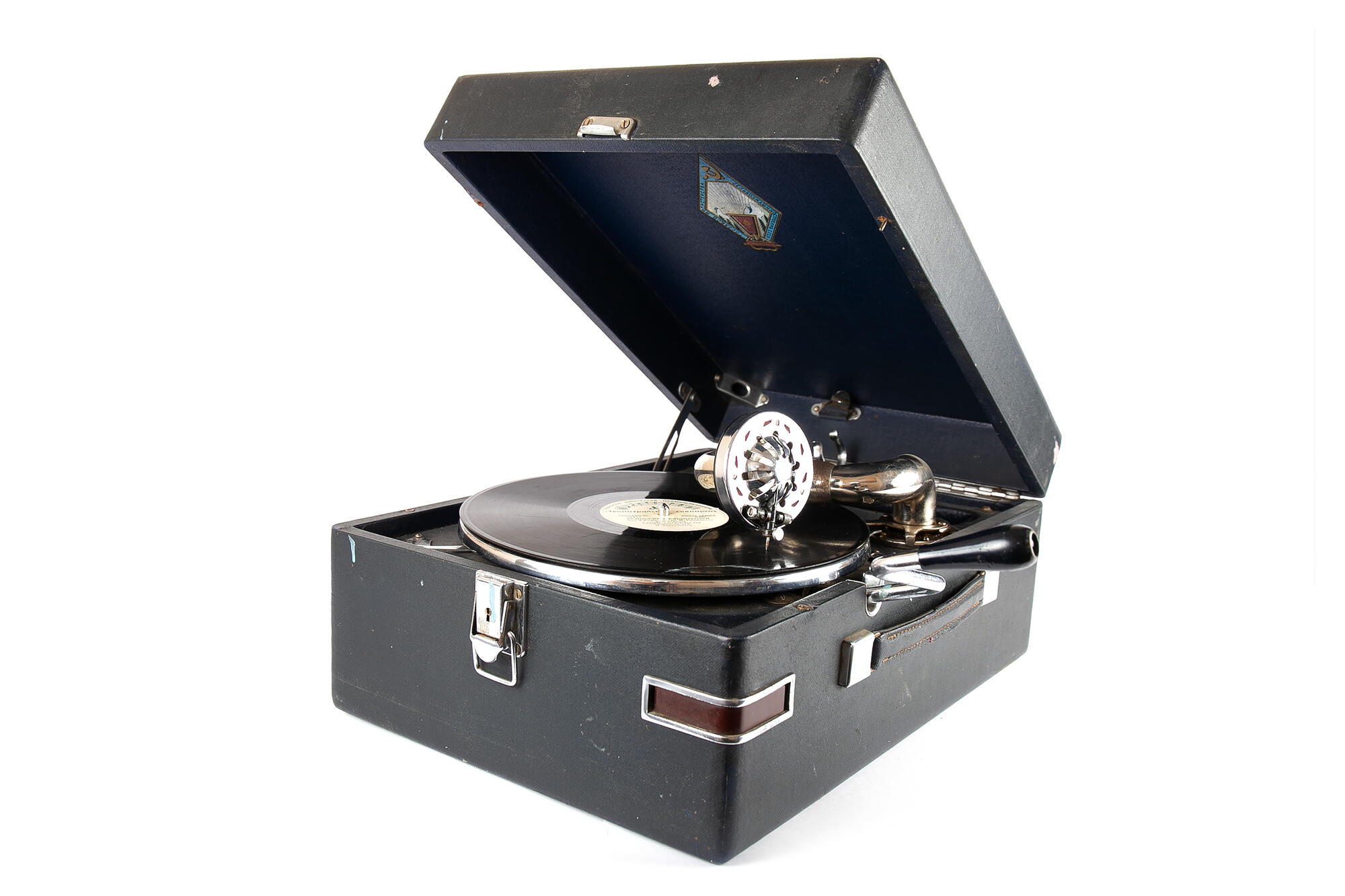


In the history of culture, there were many devices designed to play melodies: clocks with a musical mechanism, hurdy-gurdies, musical boxes… In 1877, the experiments of Thomas Alva Edison led to the creation of the phonograph — the first mechanical device for recording and reproducing sounds. The French entrepreneur Charles Pathé was one of the first to popularize this device. Having acquired the novelty item, he began with demonstrating it at fairs, and eventually opened a whole recording salon together with his brothers Emile, Jacques and Theophile.
Meanwhile, the gramophone, a device patented in 1887 by the American inventor of German descent Emil Berliner, was gaining more and more recognition. Following the example of Berliner, many manufacturers began to offer their own variations of the “music box”; among them were the Pathé brothers. In 1896, the Société Pathé Frères factory was established in Chatou and released the first “pathephone” record player, named after the owners of the company.
The pathephone owes its iconic design to Guillon Kemmler, an employee of the Société Pathé Frères, who suggested moving the bulky sound horn inside the case. The smaller size of the pathephone was its major advantage, but the sound quality was inferior to that of the regular phonograph. The reason behind this lies in the way sounds were recorded. Records for the Pathé device were made using the vertical cut process and the Berliner device used the lateral, which allowed for more clear-sounding lower frequencies. This also influenced the dimensions of the grooves, necessitating that the records were played on their intended devices.
A spring motor was used to drive the turntable of the phonograph. It had to be handled very carefully, as the spring was very fragile and hard to come by. One winding of the motor was enough to listen to one side of the record, or about five minutes. The volume level (about 80–100 dB) could not be regulated.
In the USSR, gramophones were a cult phenomenon both in the city and in the countryside, and remained in demand even during wartime, when one could trade a record for bread.
In 1933, the production of
phonographs began in Vladimir. During the war with Finland, production was
evacuated to the city of Molotov and reoriented for the needs of the front. Following the end of the Great
Patriotic War, when Vladimir specialists returned to their hometown, the Molotov
Factory started producing gramophones: in 1946 the first hundred devices were
assembled, and in 1947 — 10 thousand. However, the demand for phonographs was
already falling rapidly, and in 1956 the factory was converted into a bicycle
factory.