


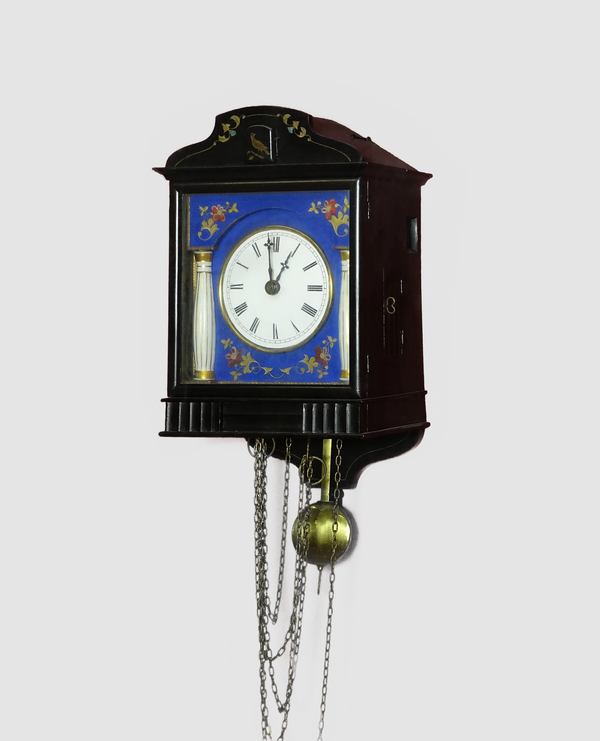
The Volgograd Regional Museum of Local Lore holds a cuckoo clock that belonged to Don Cossack Mikhail Kolesov.
A cuckoo clock is a mechanical clock with chimes imitating the voice of cuckoo at certain intervals. It usually plays every hour, counting down the current time, and is often accompanied by the sound of a bell.
The body of the clock is usually stylized as a wooden house with a gable roof mounted on the wall. Above the dial there is a small window with a door which, when opened, reveals a figure of a bird, and together with its appearance the clock plays a sound imitating cuckooing. The bird sometimes moves and tilts back and forth, opens its beak, etc.
The mechanism of the clock is weight-driven, but there are also versions that are spring-driven. The “coo-coo” sound is produced by two tiny pipes with bellows attached to their tops. The clock mechanism activates the bellows, they send an airflow to each pipe alternately.
The first mention of a cuckoo clock dates back to 1629, when an Augsburg nobleman Philipp Heinhofer presented a similar clock to Augustus, prince-elector of Saxony. In 1650, Athanasius Kircher, in his musical manual Museo Kircheriano, described a mechanical organ equipped with automated figures, including a cuckoo.
However, the birthplace of the traditional cuckoo clock is considered to be the German Black Forest. The first such clocks were made by local craftsmen between 1740 and 1750. The unusual clocks quickly gained popularity in the region, where by the middle of the 18th century there already were several watchmaking workshops producing clocks with wooden mechanisms. The familiar appearance of the clock in the form of a fantasy house decorated with leaves, cones and other decorative elements was developed by the middle of the 19th century. The sound mechanism, installed in almost every type of cuckoo clock, originated in the middle of the 18th century and since then has remained almost unchanged until now.


