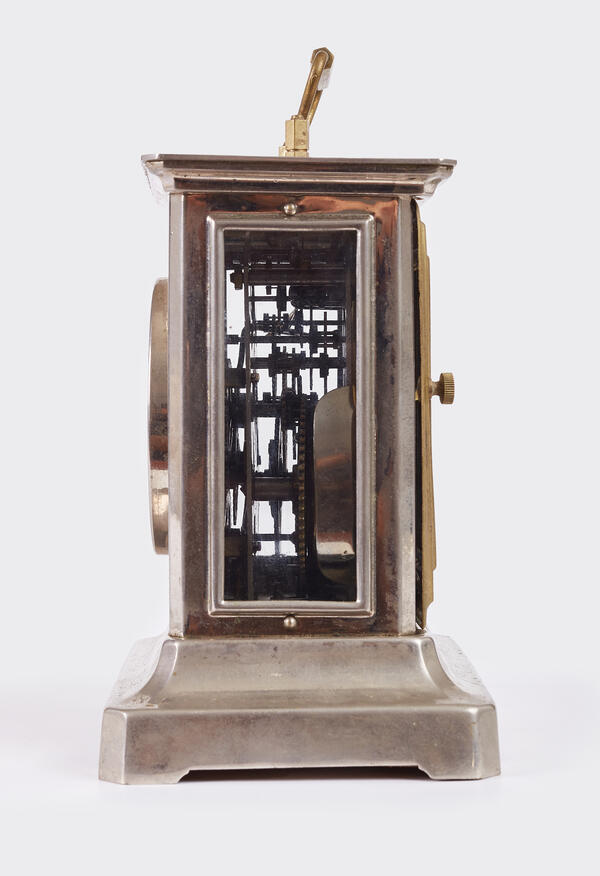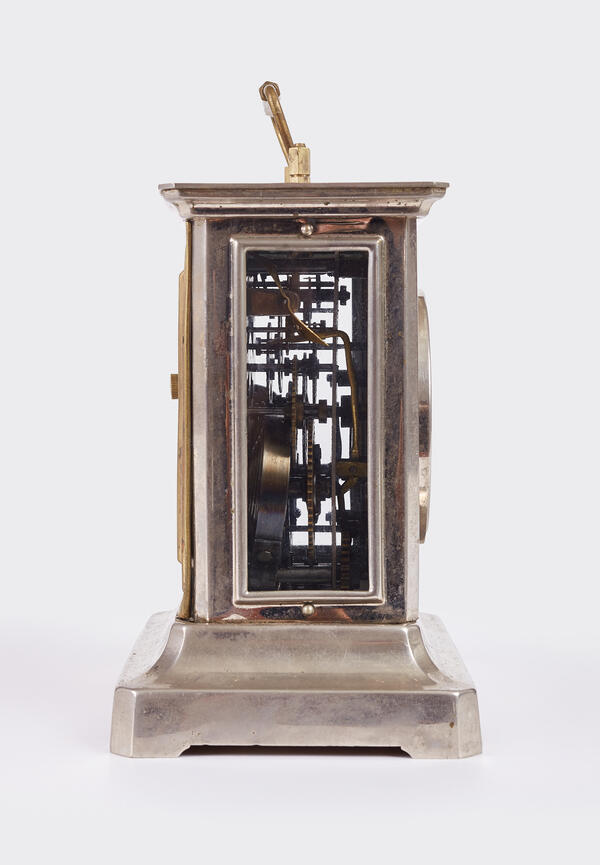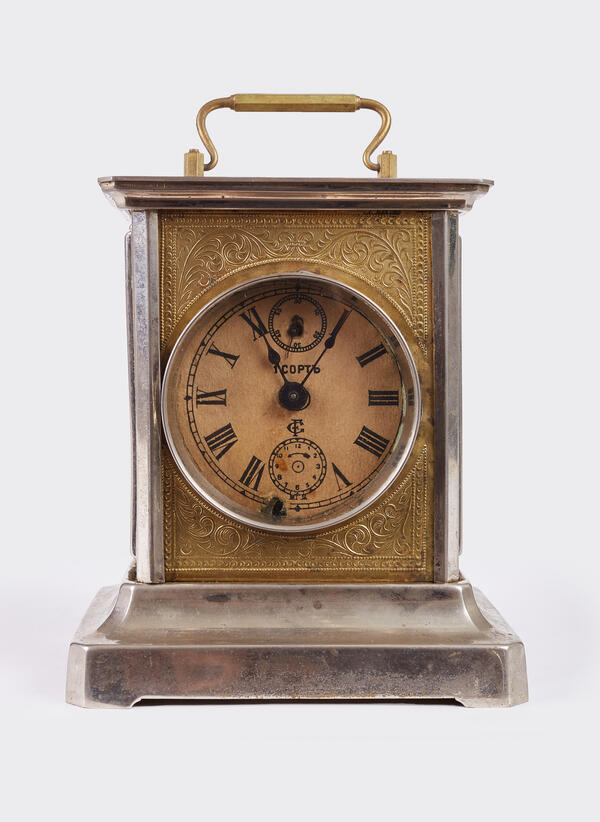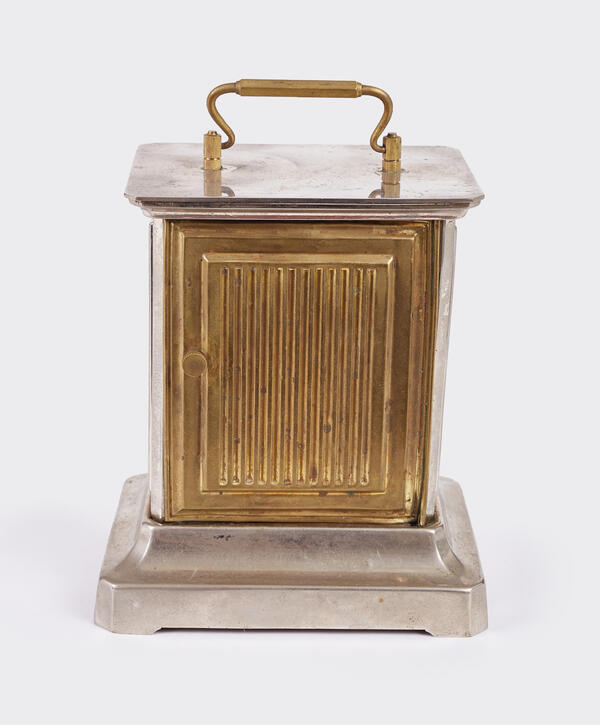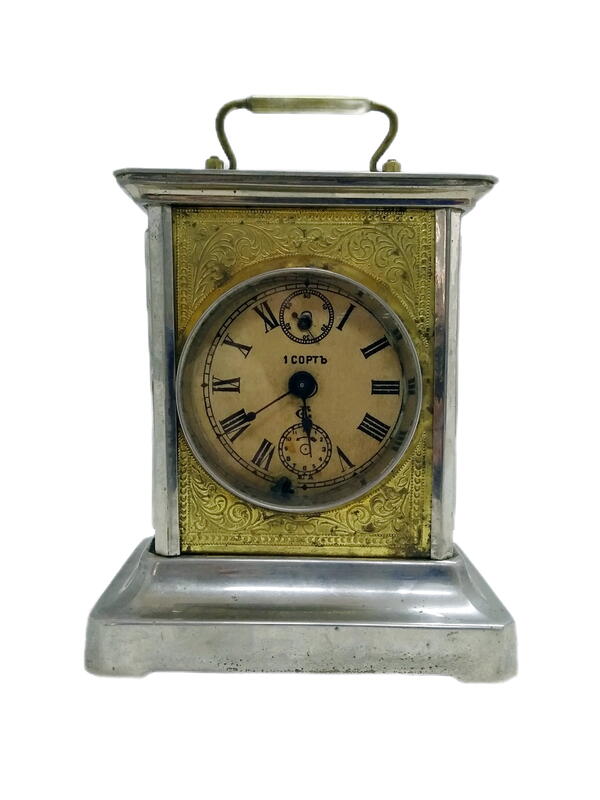
The exhibition of the Zheleznodorozhny Local Lore Museum presents a carriage clock from the German company Junghans, produced in the late 19th — early 20th centuries.
The Gebrueder Junghans watch and clock manufactory was founded in 1861 by Erhard Junghans in the town of Schramberg in the Eastern Black Forest, Germany. The company began producing its first clocks in 1866. From that time on, Junghans made everything it needed, from clock mechanisms to case designs. In 1875, after the death of Erhard Junghans, the management of the company passed to his son Arthur Junghans, a professional watchmaker, an excellent leader and businessman. Arthur focused his efforts on innovations: he patented over 300 inventions, which allowed the company to become the largest and most advanced factory in Germany. The first German wristwatch, carriage clock, German wrist chronograph, German quartz watch — all this was part of the Junghans product range. In 1877, the factory came up with the “eagle with flag” mark and registered it as a product brand, and the Jughans trademark— an eight-pointed star — was developed in 1890.
The
mechanism of the exhibited clock has the same mark, so the museum staff was
able to establish the period when such a mechanism was produced — from 1890 to
1917. Carriage clocks received such a name because they accompanied people on
the road, and therefore initially their mechanisms had to meet certain
requirements. They had to be able to withstand constant vibration, changes in
temperature and high humidity, as well as keep dust out. It was inconvenient
and unsafe to light a candle on the road in order to check what time it was, so
carriage clocks had a very loud and clear sound to let passengers know the time
at night in complete darkness. Moreover, it was necessary for travelers to be
able to hear this signal despite the clatter of hooves and wheels, the creaking
of the carriage and the noise of wind or rain. Carriage clocks have always been
known to have precise mechanisms, made by the best clockmakers, which rarely
broke down. Given that the clock mechanism itself was considered a work of art,
most often, the case for carriage clocks either was made entirely transparent
or had a glass upper part so that the owner could see the most important thing
— the clock mechanism. This element is seen in the exhibited clock as well.