The cylinder-shaped pyxis from the collection of the Astrakhan Museum Reserve was found in a burial in the BEra mound near KOsika village of EnotAevka district. This burial was opened and destroyed in 1984, when a water culvert trench was laid there.
A pyxis is a small round box with a lid. Since the Ancient Greece, such boxes were used to keep jewelry, spices, ointments or powders.
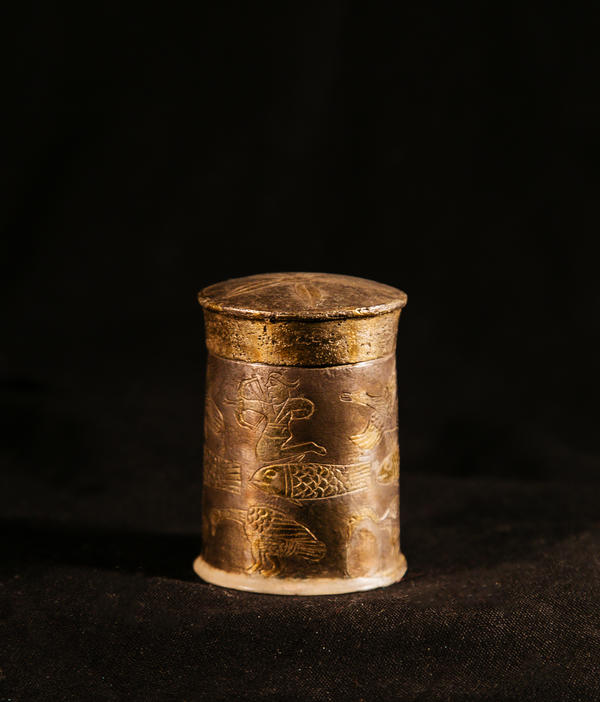
The pyxis from the collection of the Astrakhan Museum Reserve is a cylinder-shaped one; its bottom is a bit concave. Both the box itself and its lid are made of thin silver covered with hot gilded images. This decoration method was known since the antiquity times. To this end, the gold mercury mixture was applied as patterns onto the silver surfaces and then heated. Once the mercury evaporated, an item turned out to be adorned with precious ornaments.
The pattern on the pyxis lid is floral. We can see a rosette with five long open petals and a flower ovary.
The pyxis walls are decorated with three friezes (stripes) of images. The first top frieze depicts three flying birds and two knelt hunters armed with short bows and shooting at the birds; one of the birds is hit by an arrow. Some researchers believe that the pyxis depicts an epic myth scene, possibly of ethnic nature. The hunting scene in detail coincides with the plot of an ancient and principal Ossetian myth interpreting the origin of the AkhsartagAt ruling clan. According to a legend, the twin brothers AskhAr and AkhsartAg armed with their bows were chasing three magical birds. One of the birds was injured: it hid under the sea waves and turned out to be DzerAssa, a daughter of the sea god. Then DzerAssa and AkhsartAg got married, and she was the ancestress of the AkhsartagAt clan.
The middle frieze depicts fish. The Sarmatians often decorated their household and worship items with zoomorphic images, which even gave rise to naming such a phenomenon as the animal style. A legend holds that any animal had its own mystical interpretation. Most often, the ancient craftsmen depicted prey cats, deer, sheep and birds, the same as in the bottom frieze of the pyxis. However, fish is a rare occurrence in the art of the animal style.
In 2005, the pyxis and other ancient treasures of the Astrakhan Museum Reserve were exhibited at the Astrakhan Steppe Treasures show at the National Museum of the Palazzo Venezia in Rome.
A pyxis is a small round box with a lid. Since the Ancient Greece, such boxes were used to keep jewelry, spices, ointments or powders.
The pyxis from the collection of the Astrakhan Museum Reserve is a cylinder-shaped one; its bottom is a bit concave. Both the box itself and its lid are made of thin silver covered with hot gilded images. This decoration method was known since the antiquity times. To this end, the gold mercury mixture was applied as patterns onto the silver surfaces and then heated. Once the mercury evaporated, an item turned out to be adorned with precious ornaments.
The pattern on the pyxis lid is floral. We can see a rosette with five long open petals and a flower ovary.
The pyxis walls are decorated with three friezes (stripes) of images. The first top frieze depicts three flying birds and two knelt hunters armed with short bows and shooting at the birds; one of the birds is hit by an arrow. Some researchers believe that the pyxis depicts an epic myth scene, possibly of ethnic nature. The hunting scene in detail coincides with the plot of an ancient and principal Ossetian myth interpreting the origin of the AkhsartagAt ruling clan. According to a legend, the twin brothers AskhAr and AkhsartAg armed with their bows were chasing three magical birds. One of the birds was injured: it hid under the sea waves and turned out to be DzerAssa, a daughter of the sea god. Then DzerAssa and AkhsartAg got married, and she was the ancestress of the AkhsartagAt clan.
The middle frieze depicts fish. The Sarmatians often decorated their household and worship items with zoomorphic images, which even gave rise to naming such a phenomenon as the animal style. A legend holds that any animal had its own mystical interpretation. Most often, the ancient craftsmen depicted prey cats, deer, sheep and birds, the same as in the bottom frieze of the pyxis. However, fish is a rare occurrence in the art of the animal style.
In 2005, the pyxis and other ancient treasures of the Astrakhan Museum Reserve were exhibited at the Astrakhan Steppe Treasures show at the National Museum of the Palazzo Venezia in Rome.