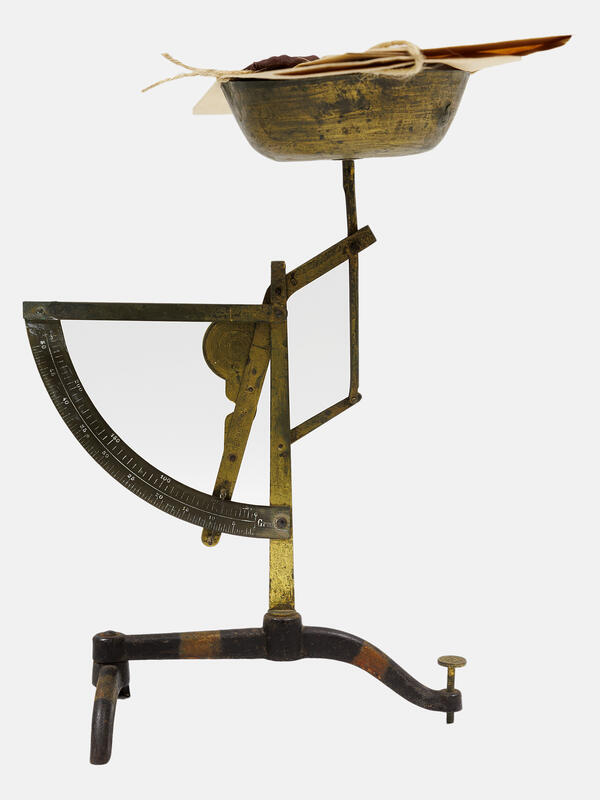
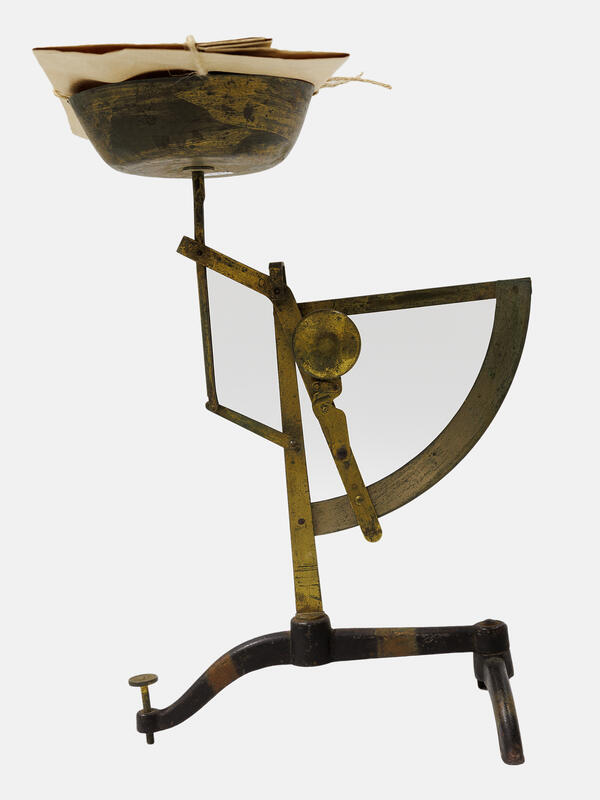
Special scales for weighing letters appeared in 19th-century England. This innovation resulted from a new method of determining the amount of postage — not by the number of sheets, but by the weight of the letter. In Russia, letter envelopes featured the inscription: “10 kopecks per lot. 1 kopeck per envelope”. A lot is a measure of weight equal to 12.8 grams that was used before the introduction of the metric system.
The first letter scales were of simple design — either a spring-based scale or a steelyard balance. These devices were affordable and reliable. Letters were also weighed using a Roberval pan balance that quickly became popular in post offices and using a beam balance. The scale from the museum’s collection is of the pendulum type.
In 1871, a patent was granted in England for a weighing scale that combined the features of a pan balance and a steelyard scale. The left part of the scale did not differ in any way from the standard Roberval balance design and consisted of a pan for placing a letter. The right part was a steelyard balance with a measuring scale and a sliding weight built into the structure of the lever. Such a scale could be used without additional weights.
In 1875, another scale was patented based on the Roberval balance design, where disc counterweights were placed on a special suspension. The weights were gradually added until they balanced the letter. Rarer models included hydraulic candlestick scales which were filled with water or mercury. The body of such scales was made of brass, and in the case of more expensive models — of silver and ivory.
Adapted letter scales were imported from Europe until the 20th century when their production was organized in Russia. In 1929, Sahakyan, an employee of a Baku post office, designed automatic postage scales for weighing registered letters and parcels. The new scales simplified the process of receiving mail and increased productivity dozens of times. The scales included postage rates and a mechanism for counting the day’s work.