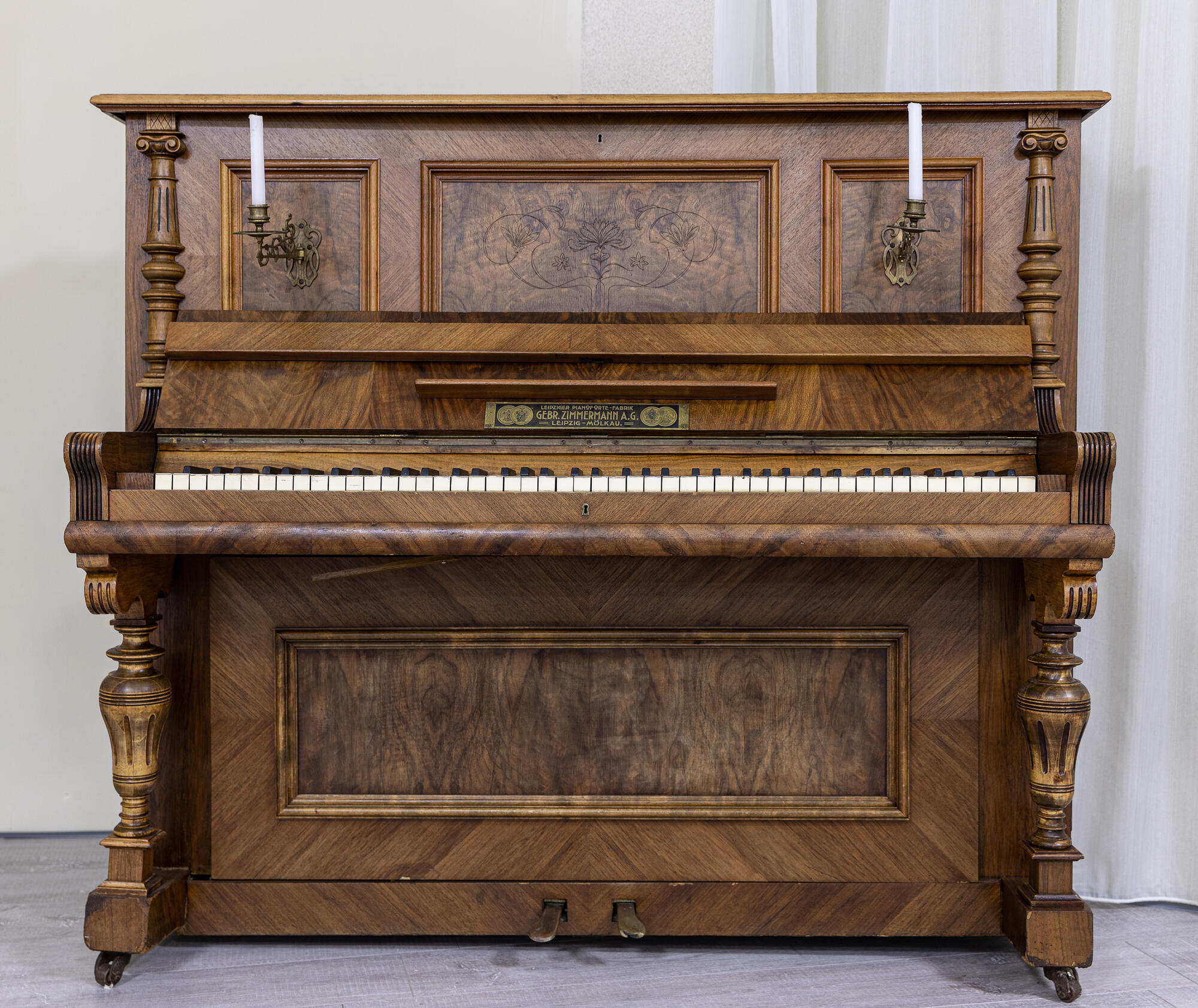


This German piano was produced at the Zimmermann factory which operated between 1884 and 1945 in Mölkau near Leipzig. The factory’s founders, brothers Max and Richard Zimmermann, came to Germany from the United States, where they had worked for the world-renowned piano manufacturer Steinway & Sons.
The Zimmermann factory enjoyed a steady increase of business, and a decade later it already employed 120 craftsmen. Soon, new production facilities were opened in the German towns of Eilenburg, Gotha, and Seifhennersdorf. By 1912, Zimmermann was producing over 10,000 pianos a year and became one of the largest piano manufacturers in Europe.
This piano is made of solid wood, with its natural grain and rich texture providing additional decoration. The instrument’s upper front board is decorated with a carved floral pattern. The legs are decorated with elegant, intricate carvings. The keys are made of ivory. The piano has four medals. Exquisite candlesticks have also been preserved, even though these decorative elements were often removed from old pianos and sold separately.
Anton Chekhov was passionate about music; it was not merely entertainment for him, but a basic need — this attitude to music was also shared by many of the characters of his plays and short stories. The Chekhovs moved frequently in Moscow but always tried to rent a piano. Anton Chekhov wrote in his letters,