Font
Color
Graphics
Изображение точки

To see AR mode in action:

1. Install ARTEFACT app for iOS or Android;

2. Find the exhibition «“Sakhalin Island”: An Open-Ended Story»

3. Push the «Augmented reality» button and point your phone's camera at the exhibit;

Скрыть точки интересаПоказать точки интереса
Показать в высоком качестве

Inkstand, a set of three

Creation period
the late 19th — early 20th century
Place of сreation
the Russian Empire
Dimensions
17,5x13 cm
Technique
glass, bronze; casting, stamping, plant production
0
Open in app
#6

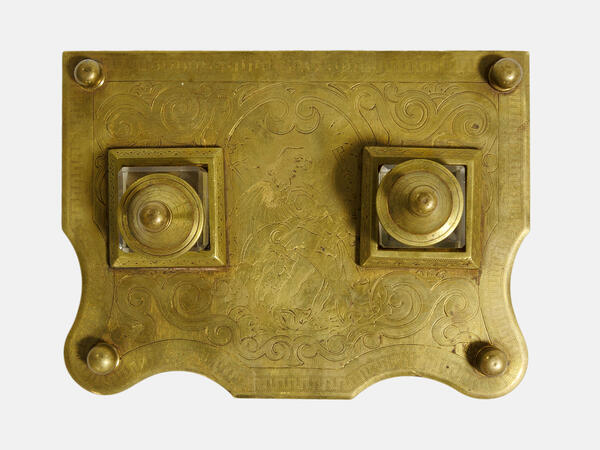
The inkstand was donated to the museum by Yuliya Smirnova, a resident of Yuzhno-Sakhalinsk, in 1998. It is decorated beautifully, although rather modestly by the standards of its time.

The lids of the inkwells and the stand are made of bronze. The stand with an ornately-shaped edge rests on four round feet. On each side, it has a square indentation with borders where the two inkwells are placed. The front side of the stand is decorated with patterns and the image of an angel created using the technique of shallow engraving without inlaying other metals or foreign materials. The lids of the inkwells are cone-shaped, resembling tower roofs.

An inkstand is a desk set of writing utensils, decorated in one style. All inkstands included a stand and an inkwell. In total, a writing set could include up to nine items, such as a glass pen and pencil holder, a pen wiper, a servant bell, a paperweight, and candlesticks.

In the 17th century, when exchanging private letters became fashionable among high society in Europe, a writing set was transformed into a piece of desk décor. Craftsmen created writing instruments for every taste: massive and elegant, minimalistic and luxurious. Often writing sets were decorated with the coat of arms or monogram of their owner. Some also featured clocks, mirrors, and small secret drawers.

Inkstands were made of white or gray marble or limestone. An inkstand usually had a rectangular base, with a groove for pens and indentations for inkwells. Often it was decorated with interesting details, such as a lyre. Most inkwells were made of marble, glass, or metal.

Anton Chekhov had an inkstand in every study. The writer sent several letters a day — and received even more. He carefully sorted all letters, classified them by sender, and stored the letters tied with a ribbon. At the age of 29, he wrote,

#7

I treasure the letters and shall bequeath them to my grandchildren: let them read the letters and know what went on in times long past…

#8

Anton Chekhov’s archives contain about 10,000 letters addressed to him. He collected almost every letter he received in his life.

#11
Inkstand, a set of three
#10
read morehide
00:00
00:00
1x

Inkstand, a set of three

Creation period
the late 19th — early 20th century
Place of сreation
the Russian Empire
Dimensions
17,5x13 cm
Technique
glass, bronze; casting, stamping, plant production
0
Point your smartphone camera to open in the app
Share
VkontakteOdnoklassnikiTelegram
Share on my website
Copy linkCopied
Copy
Open in app
To see AR mode in action:
  1. Install ARTEFACT app for 
  2. iOS or Android;
  3. Find and download the «Paintings in Details» exhibition
  4. Push the «Augmented reality» button and point your phone's camera at the painting;
  5. Watch what happens on your phone screen whilst you flip through the pictures.
 
We use Cookies
Cookies on the Artefact Website. We use cookies to ensure that we give you the best experience on our website. If you continue without changing your settings, we'll assume that you are happy to receive all cookies on the Artefact website. However, if you would like to, you can change your cookie settings at any time.
Learn more about useHide
Content is available only in Russian

X

Нашли опечатку?...

%title%%type%