#1
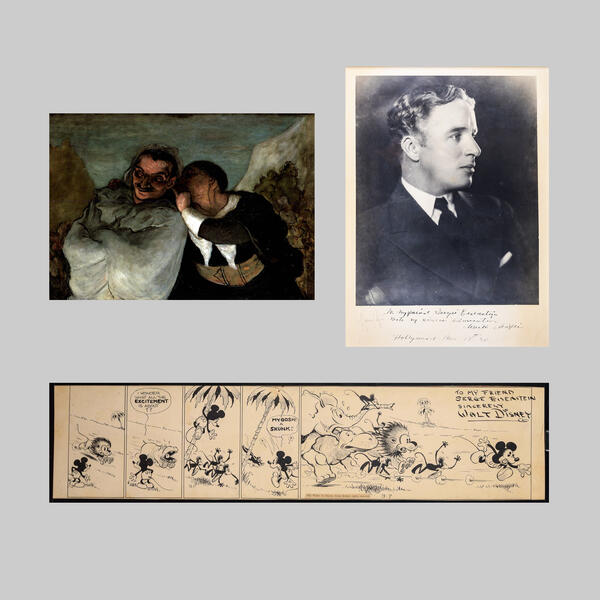
Chaplin, Comic book page, Crispin and Scapin
#2
#3
#4
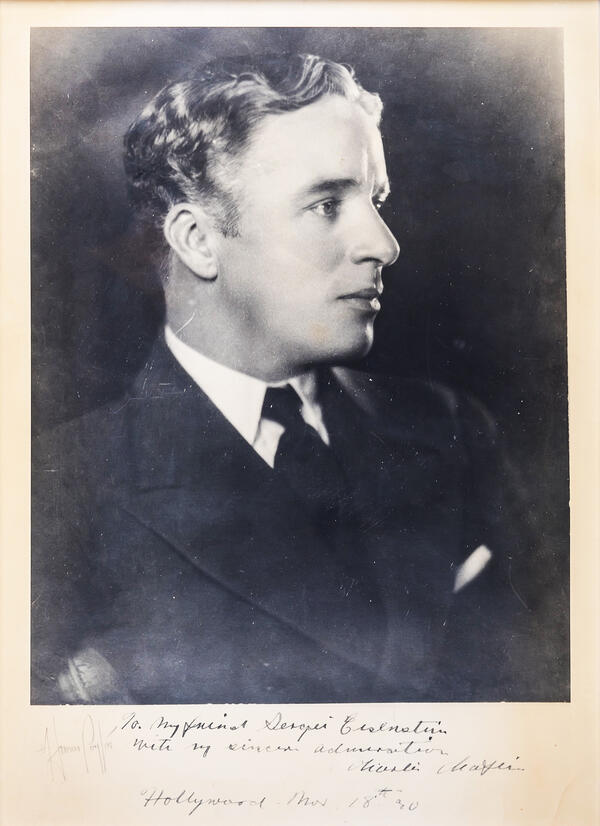
Comedian, actor, director, scriptwriter, composer, producer, and the most popular cinematographist of the first half of the 20th century is depicted on that photograph — none other than Charles Spencer Chaplin (1889–1977).
Sergei Eisenstein and Charlie Chaplin knew and appreciated each other’s work long before they met. When they met in Hollywood, there was a mutual understanding between them. Eisenstein and his associates often visited Chaplin at his villa in Hollywood. The comedian always tried to help his Russian friend: he spoke highly about his scripts, defended in Hollywood society and the press, and recommended the writer Upton Sinclair to support the project of shooting an independent movie in Mexico. Before leaving for Mexico, Eisenstein received a photo from Chaplin with an inscription that read: “To my friend Sergei Eisenstein with sincere admiration. Hollywood, November 18 [19]30.” Eisenstein hung this photo in his study. Photographer HOmer PEyton took the picture in 1929.
After returning to his homeland, Sergei Eisenstein wrote about Chaplin several times. On the 50th anniversary of his friend in April 1939, he published a salutatory article “Hello, Charlie!” in the Kino (Cinema) newspaper. At that time, the danger of Nazi Germany’s aggression and its hateful ideology was already clear. Eisenstein turned to Chaplin with remarkable words: ‘…Your path was the path of art, so beloved all over the world for the passionate proclamation of human love, which it brings from the very first of your films. For this humanism, for your aspiration to participate in the struggle of humankind, for human dignity and decent human living, for your fine art I would like to clap you on your back, as it is customary in America to express the warmth of feelings, - and from the bottom of my heart, welcome you: 'Hello, Chaplin… For many and many years ahead, hand in hand for the best ideals of mankind! '.’ At the height of World War II, in 1942, Eisenstein completed his essay on Chaplin, Charlie the Kid, where he wrote: ‘Chaplin has a distinctive feature - with his gray hair he has retained the look of a child and the ingenuousness of perception of any phenomenon’. In his essay, Eisenstein analyzed in detail how such a feature appeared in the comedian’s creative method.
Sergei Eisenstein and Charlie Chaplin knew and appreciated each other’s work long before they met. When they met in Hollywood, there was a mutual understanding between them. Eisenstein and his associates often visited Chaplin at his villa in Hollywood. The comedian always tried to help his Russian friend: he spoke highly about his scripts, defended in Hollywood society and the press, and recommended the writer Upton Sinclair to support the project of shooting an independent movie in Mexico. Before leaving for Mexico, Eisenstein received a photo from Chaplin with an inscription that read: “To my friend Sergei Eisenstein with sincere admiration. Hollywood, November 18 [19]30.” Eisenstein hung this photo in his study. Photographer HOmer PEyton took the picture in 1929.
After returning to his homeland, Sergei Eisenstein wrote about Chaplin several times. On the 50th anniversary of his friend in April 1939, he published a salutatory article “Hello, Charlie!” in the Kino (Cinema) newspaper. At that time, the danger of Nazi Germany’s aggression and its hateful ideology was already clear. Eisenstein turned to Chaplin with remarkable words: ‘…Your path was the path of art, so beloved all over the world for the passionate proclamation of human love, which it brings from the very first of your films. For this humanism, for your aspiration to participate in the struggle of humankind, for human dignity and decent human living, for your fine art I would like to clap you on your back, as it is customary in America to express the warmth of feelings, - and from the bottom of my heart, welcome you: 'Hello, Chaplin… For many and many years ahead, hand in hand for the best ideals of mankind! '.’ At the height of World War II, in 1942, Eisenstein completed his essay on Chaplin, Charlie the Kid, where he wrote: ‘Chaplin has a distinctive feature - with his gray hair he has retained the look of a child and the ingenuousness of perception of any phenomenon’. In his essay, Eisenstein analyzed in detail how such a feature appeared in the comedian’s creative method.
#5
Full name: A signed portrait photograph of Charles Chaplin
Author: Homer Peyton
Date: 1929
Technique: paper (passe-partout), photographic paper, photo printing
Place: USA, Hollywood
Dimensions: 34.5×26.5 cm (photo); 44×33.5 cm (signed passe-partout)
Collection: Study
Copyright: Cinema museum
Author: Homer Peyton
Date: 1929
Technique: paper (passe-partout), photographic paper, photo printing
Place: USA, Hollywood
Dimensions: 34.5×26.5 cm (photo); 44×33.5 cm (signed passe-partout)
Collection: Study
Copyright: Cinema museum
#6
Mickey Mouse comic book page
#7
#8
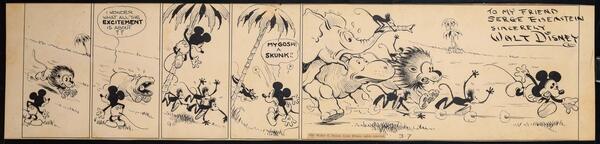
A renowned director, artist, and producer Walt Disney gave this comic book page as a gift when Sergei Eisenstein visited his studio in Los Angeles in September 1930. Following the first success on the screen, Mickey Mouse appeared in a comic book that Disney printed in American newspapers. This page depicts Mickey asking first: ‘I wonder what all the excitement is about? ’, and then exclaiming: ‘My Gosh! A Skunk! ’ On the right side of the page, an inscription reads: ‘To my friend Sergei Eisenstein. Sincerely, Walt Disney.’
Eisenstein first saw Disney’s talking short films in London in 1929 and admired the mastery of their creators, their sense of humor, and the skill of aligning graphics with music. In his first interviews in the United States in June 1930, he said:
Eisenstein first saw Disney’s talking short films in London in 1929 and admired the mastery of their creators, their sense of humor, and the skill of aligning graphics with music. In his first interviews in the United States in June 1930, he said:
“The work of this master is the greatest contribution of the American people to art.”
Ten years later, Eisenstein wrote a large essay on Disney, explaining the global success of Disney movies by the fact that the selection of animal-type characters that parodied human weaknesses, the funny gags, and the perfection of sound and images held a certain perception of the world, important in any country and in any era: “This man seems to know not only the magic of all technical means but also the most secret strands of human thought, images, feelings, ideas. Such was probably the effect of Saint Francis of Assisi”s sermons. Fra Angelico”s paintings bewitch in this way. He creates somewhere in the realm of the very purest and most primal depths. There, where we all are children of nature. He creates on the conceptual level of man not yet shackled by logic, reason, or experience. (…) Disney is a marvelous lullaby for the suffering and unfortunate, the oppressed and deprived. For those who are shackled by hours of work and regulated moments of rest, by a mathematical precision of time, whose lives are graphed by the cent and dollar. (…) This triumph over all fetters, over everything that binds, resounds throughout, from the plastic trick to the hymn of The Three Little Pigs: “We”re not afraid of the big gray wolf…”’
During the First Moscow International Film Festival in 1935, the jury chairman Eisenstein awarded Disney’s Three Little Pigs the Golden Medal for Best Cartoon to the applause of those in attendance. Eisenstein himself successfully applied the reimagined experience of audiovisual montage in the movies Alexander NEvsky and Ivan the Terrible, taught his students at VGIK (the Russian State University of Cinematography Named After Sergei. GerAsimov) how to align motion on the screen and music on a phonogram in a harmonious way.
During the First Moscow International Film Festival in 1935, the jury chairman Eisenstein awarded Disney’s Three Little Pigs the Golden Medal for Best Cartoon to the applause of those in attendance. Eisenstein himself successfully applied the reimagined experience of audiovisual montage in the movies Alexander NEvsky and Ivan the Terrible, taught his students at VGIK (the Russian State University of Cinematography Named After Sergei. GerAsimov) how to align motion on the screen and music on a phonogram in a harmonious way.
#9
Full name: Mickey Mouse comic book page
Author: Walt Disney
Date: 1930
Technique: paper, pen-and-ink drawing
Place: USA
Dimensions: 16×64.8 cm (including edges)
Collection: Study
Copyright: Cinema museum
Author: Walt Disney
Date: 1930
Technique: paper, pen-and-ink drawing
Place: USA
Dimensions: 16×64.8 cm (including edges)
Collection: Study
Copyright: Cinema museum
#10
Crispin and Scapin
#11
#12
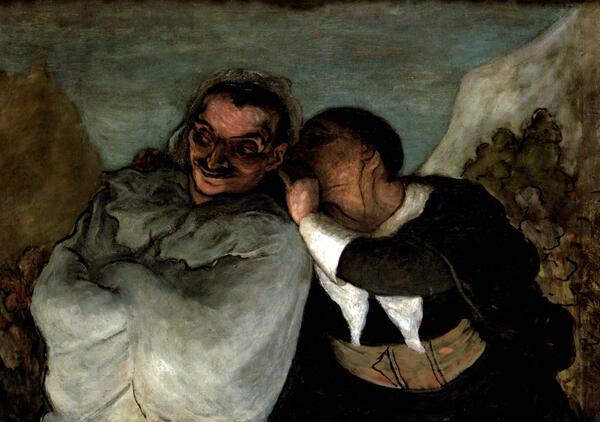
One of the two large-size facsimile (the most accurate) reproductions of paintings by the French artist Honoré /onorE/ Daumier /domjE/. The director bought them for his new apartment on PotYlikha Street in 1935. Both paintings are dedicated to the theater but could be a bridge to the cinema. Crispin and Scapin are the characters from A Comedy of Masks which he loved from his youth and which became the prototype of Eisenstein’s archetype films.
Daumier worked on this painting in 1858-1860, but it was only after his death that the painting was recognized as a masterpiece of art and exhibited in the Louvre. Today, it is on display at the Paris D’Orsay Museum.
The two characters in the painting are theatrical. Crispin /krispEn/ is a cunning, though clumsy servant from the play The Student of SalamAnca, or Noble Enemies (1654) by the French comedy dramatist Paul ScarrOn. Many other play writers took this character and made it a household name. He is always played in his distinctive costume – a black short caftan with large white collar, belt and lace cuffs. Scapin /skapEn/ is the character of Moliere’s comedy The Tricks of Scapin. The great French playwright based the character of Scapin – who he was the first to play at the Palais Royal Theater in 1671 – on the trickster Brighella from the Italian folk comedy.
The Italian commedia dell’arte, which Eisenstein loved from childhood, has permanent characters (masks) with a certain set of traits: the mischievous Harlequin, the charming Colombine, the fictitious scientist Bologna Doctor, the scrappy Captain and other embodiments of human traits and weaknesses. The mask of the simpleton Pedrolino transformed in the French theater into the image of Pierrot, sad and eternally in love. The audience always knows what social and psychological type the characters represent on stage. However, the actors always improvise, invent unexpected actions and jokes, make fun of current events, enter into communication with the audience and refresh the old known stories.
Back in his youth, while engaged in the theater, Sergei Eisenstein developed different takes on the themes of Italian folk comedy and its masks. When he came to the cinema, he used the same principles and traditions in the theory and practice of the archetype. It wasn’t just a “guy next door, ” non-professional role performer that Eisenstein called an archetype, but a person whose appearance can instantly reveal the character, belonging to a certain social or ethnic group. From Daumier”s paintings and graphics, he learned how to choose the expressive appearance of characters for his films. The double portrait of Crispin and Scapin is also an example of expressive light accents on faces. Eisenstein called them “light masks” and masterfully applied them in the movie Ivan the Terrible.
Daumier worked on this painting in 1858-1860, but it was only after his death that the painting was recognized as a masterpiece of art and exhibited in the Louvre. Today, it is on display at the Paris D’Orsay Museum.
The two characters in the painting are theatrical. Crispin /krispEn/ is a cunning, though clumsy servant from the play The Student of SalamAnca, or Noble Enemies (1654) by the French comedy dramatist Paul ScarrOn. Many other play writers took this character and made it a household name. He is always played in his distinctive costume – a black short caftan with large white collar, belt and lace cuffs. Scapin /skapEn/ is the character of Moliere’s comedy The Tricks of Scapin. The great French playwright based the character of Scapin – who he was the first to play at the Palais Royal Theater in 1671 – on the trickster Brighella from the Italian folk comedy.
The Italian commedia dell’arte, which Eisenstein loved from childhood, has permanent characters (masks) with a certain set of traits: the mischievous Harlequin, the charming Colombine, the fictitious scientist Bologna Doctor, the scrappy Captain and other embodiments of human traits and weaknesses. The mask of the simpleton Pedrolino transformed in the French theater into the image of Pierrot, sad and eternally in love. The audience always knows what social and psychological type the characters represent on stage. However, the actors always improvise, invent unexpected actions and jokes, make fun of current events, enter into communication with the audience and refresh the old known stories.
Back in his youth, while engaged in the theater, Sergei Eisenstein developed different takes on the themes of Italian folk comedy and its masks. When he came to the cinema, he used the same principles and traditions in the theory and practice of the archetype. It wasn’t just a “guy next door, ” non-professional role performer that Eisenstein called an archetype, but a person whose appearance can instantly reveal the character, belonging to a certain social or ethnic group. From Daumier”s paintings and graphics, he learned how to choose the expressive appearance of characters for his films. The double portrait of Crispin and Scapin is also an example of expressive light accents on faces. Eisenstein called them “light masks” and masterfully applied them in the movie Ivan the Terrible.
#13
Full name: Crispin and Scapin
Author: Honoré Daumier
Date: 1935 or earlier
Technique: paper, colored lithograph
Place: France
Dimensions: 58.4×80 cm (sheet size); 54.4×75.9 cm (image)
Collection: Study
Copyright: Cinema museum
Author: Honoré Daumier
Date: 1935 or earlier
Technique: paper, colored lithograph
Place: France
Dimensions: 58.4×80 cm (sheet size); 54.4×75.9 cm (image)
Collection: Study
Copyright: Cinema museum
read morehide
00:00
00:00
1x
Chaplin, Comic book page, Crispin and Scapin
Collection
Exhibition
0
 Point your smartphone camera to open in the app
Open in app
Share