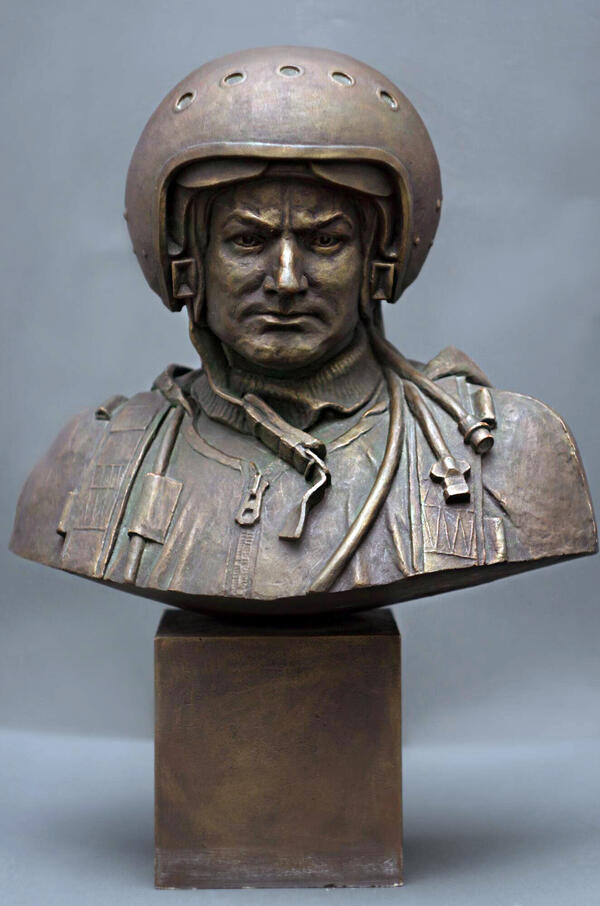
Timur Avtandilovich Apakidze was the first Russian naval pilot who landed a Su-27K carrier-based fighter aircraft on the deck of the heavy aircraft carrier Admiral Kuznetsov of the Soviet Fleet. Apakidze was a hero of the Russian Federation, Aviation Major General, Deputy Commander of Russian Naval Aviation, Honored Military Pilot of the Russian Federation, and pilot-sniper.
Apakidze was born in 1954 in Tbilisi, but at the age of one moved with his mother to the Hero City of Leningrad, where he grew up and studied. In 1983, he entered the Grechko Naval Academy. Subsequently, he was sent to the town of Nikolaev and assumed the position of commander of the 100th Naval Fighter Aviation Regiment of the Centre for Combat Application and Crew Training for Naval Aviation. Then he served in the same position in the town of Saki in the Crimea. For landing a fighter jet on the deck of the aircraft carrier “Admiral of the Fleet of the Soviet Union Kuznetsov”, pilot Apakidze was presented with the title of Hero of the Soviet Union.
The pilot mastered 13 types of aircraft, had a flight time of 3850 hours, and performed 283 landings on the decks of ships. He completed many landings on deck in daytime, at night, as well as in difficult weather conditions of the Arctic. He de facto became the founder of modern naval aviation in Russia.
Apakidze was one of the five pilots who mastered the world-famous “Pugachev’s cobra”. This is a maneuver in which an airplane abruptly raises its nose momentarily to a vertical attitude, causing an extremely high angle of attack and momentarily stalling the plane, making a full-body air brake before dropping back to normal position. It is an example of supermaneuverability of a jet aircraft.
Apakidze died on July 17, 2001 during an airshow in honor of the 85th anniversary of Naval Aviation at the Center for Combat Training and Retraining of Naval Aviation Personnel near Pskov. The pilot, having completed all aerobatic maneuvers, was landing when his Su-33 aircraft began “behaving erratically”. According to a report issued after the incident was investigated, the pilot received a command to eject from the flight control center. But Apakidze remained in the cockpit until the plane hit the ground and exploded, trying to save the plane.