


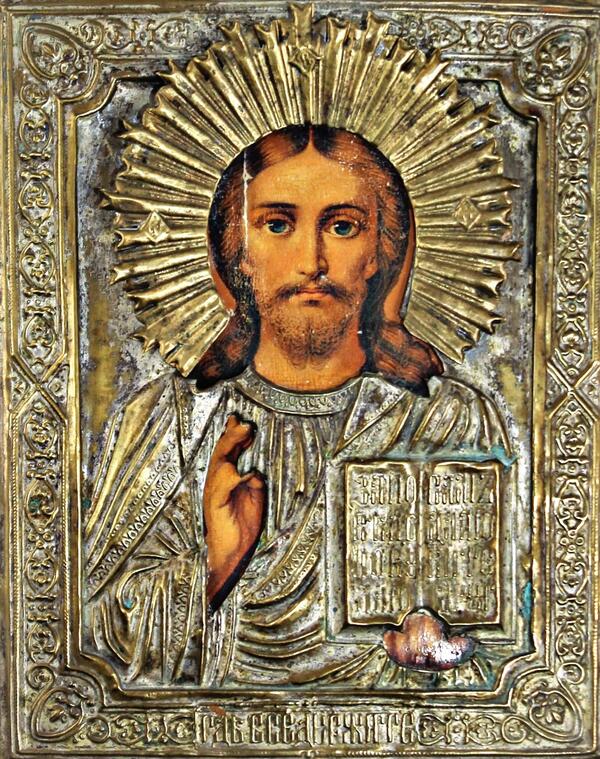
The museum’s collection features an icon of Christ Almighty (or Christ Pantocrator). This is the central image in the iconography of Christ, representing Him as the Heavenly King and Judge. The epithet “Almighty” expresses, among other things, the doctrine of Incarnation, that is, God assuming human nature and becoming a man in the form of Jesus Christ. The title of “Almighty” refers fully to both the Divine and human nature of the Savior.
In Byzantium, the iconographic image of Christ Almighty appeared approximately in the 4th–6th centuries. The oldest known image is the icon of Christ Pantocrator from the Sinai Monastery. One of the most common and early depictions of the Almighty is “Christ Enthroned”. In such icons, He is depicted facing forward, sitting on a throne with a cushion, a mandatory element. These images are found even in Roman catacombs.
The Savior can be depicted standing or sitting on a throne. It can be a half-length or chest-length image. He usually holds a scroll or Gospel in the left hand and makes the gesture of blessing with His right. The image of the Almighty can be used for single icons, as part of Deisis compositions, in iconostases, and also in wall paintings. This image traditionally occupies the space of the central dome of an Orthodox church. There is also a rare variant of this image, in which instead of a book, Christ holds an orb and a scepter in His hands.
The icon “Christ Pantocrator” reminds parishioners of the importance of good deeds and that the heavenly judgment awaits everyone, when all will be held accountable for their deeds.
A special feature of this icon is its bronze cover. A riza (or oklad) is a decorative element that covers the entire painted image, except for the face and hands of the saint. Covers can be made of metal or embroidered, decorated with pearls and precious stones. Sometimes, in order not to damage the painted image, velvet fabric is attached to the back of the cover. Sometimes, covers for icons were made at the same time as the image was painted, and sometimes the cover was made later.
The icon on display was donated to the museum in 2003 by a resident of Severomorsk.


