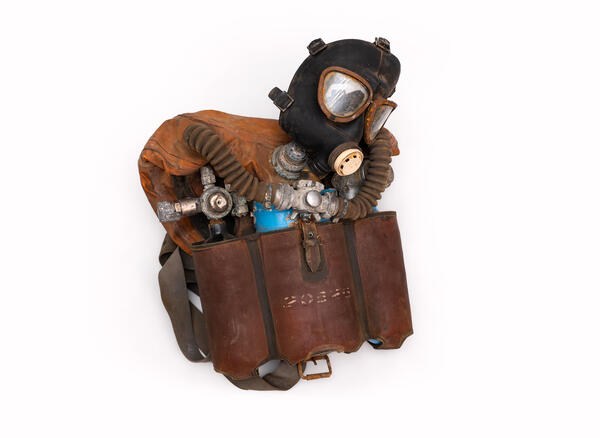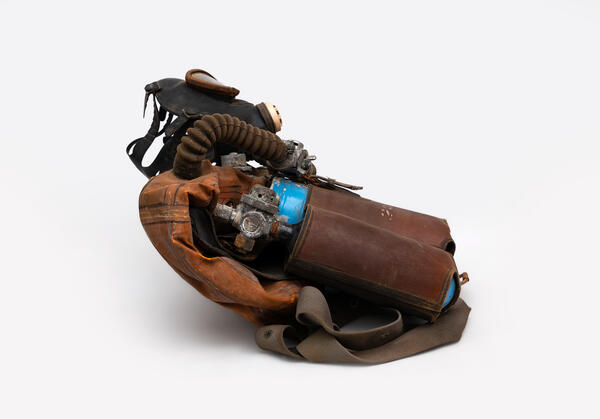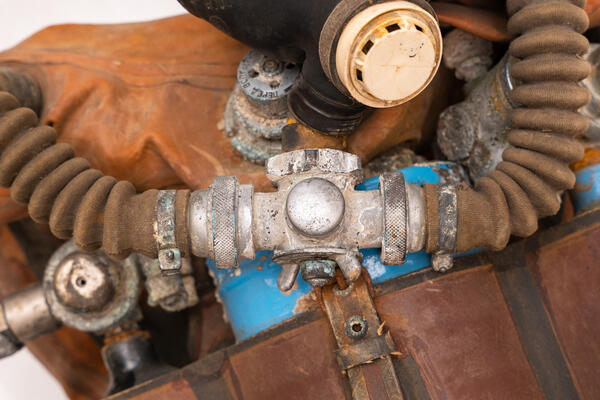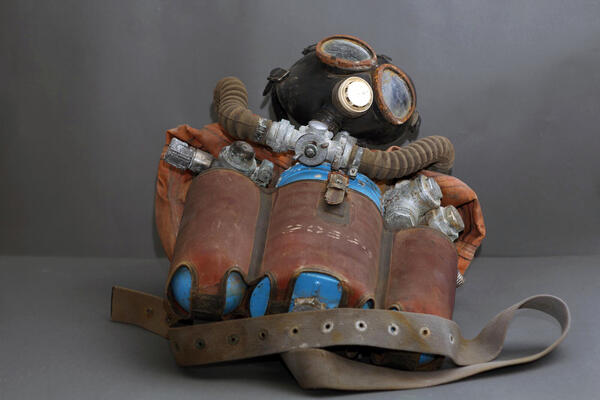
The breathing apparatus on display at the museum is part of the rescue equipment lifted from the hull of the Kursk nuclear submarine after the disaster in the Barents Sea. On August 12, 2000, the submarine K-141 Kursk sank during an exercise. All 118 personnel on board were killed. This incident was the largest tragedy in the modern history of the Russian Navy.
The Kursk submarine was raised from the seabed in a large-scale operation, which took a year to carry out. The salvage operation involved several stages, with 120 companies from 20 countries involved in it. Potentially dangerous weaponry and two nuclear reactors were safely removed from the bottom of the Barents Sea. Experts and engineers analyzed the wreckage and managed to reconstruct with a high degree of accuracy the sequence of tragic events in the final hours of the vessel and its crew. They also determined what likely caused the disaster.
The submarine escape and immersion suit (or SEIS) is a means of ensuring the safety and survival of the crew, which has been used on Russian submarines for several decades. The SEIS allows the submariner to abandon the vessel and safely resurface. Depending on the equipment used, rescues can be conducted from depths of up to 200–220 meters. The SEIS is available in two versions: set No. 1 includes an SGP-K-1 wetsuit, a rebreather (IDA), a carabiner belt and a PP-2 parachute system, while set No. 2 has an SGP-K-2 wetsuit and an IDA-59M rebreather.
The composition of the SEIS depends on the available onboard rescue equipment. The breathing apparatus is used as part of a submarine’s rescue equipment and is designed to provide air when exiting the submarine.
The mask included in the kit allows the wearer to
use the breathing apparatus in dry and partially flooded compartments without a
wetsuit. To get into the wetsuit, the submariner puts his legs inside through
an opening on the chest. When he is done, the fabric around the hole is tightly
twisted and tucked into the belt. An IDA rebreather is put on top of the suit
and connected to the headgear. The time required for putting on a diving suit
with an IDA apparatus is four to five minutes, but experienced submariners can
do it in one minute.