This small, elegant vase from the museum’s collection is a boutonnière with three pea pods. It entered the collection from the Kaluga Governorate History Museum in the 1920s. It was created in the last quarter of the 18th century at one of the oldest porcelain factories in Thuringia — the Volkstedt Porcelain Manufactory, known since 1760.
Thuringia is a forested region in eastern Germany that is rich in natural resources. It has long been famous for its pottery. Legend has it that Thuringian craftsmen mastered porcelain production independently of the already existing Meissen manufactory.
However, like most porcelain factories of that time, Thuringian factories strove to imitate the products of the famous and successful Meissen manufactory. In addition to tableware, they also produced vases and elegant porcelain figurines.
Despite some similarities, however, Thuringian products can easily be distinguished from Meissen porcelain. They are characterized by a special charm and their own unique style.
Thuringian porcelain manufactories mainly targeted middle-class customers. At the same time, their products were distinguished by high quality and unique style. Being beautiful and affordable, Thuringian porcelain quickly caught the fancy of customers and became popular not only in Germany but also abroad, including in the Russian Empire.
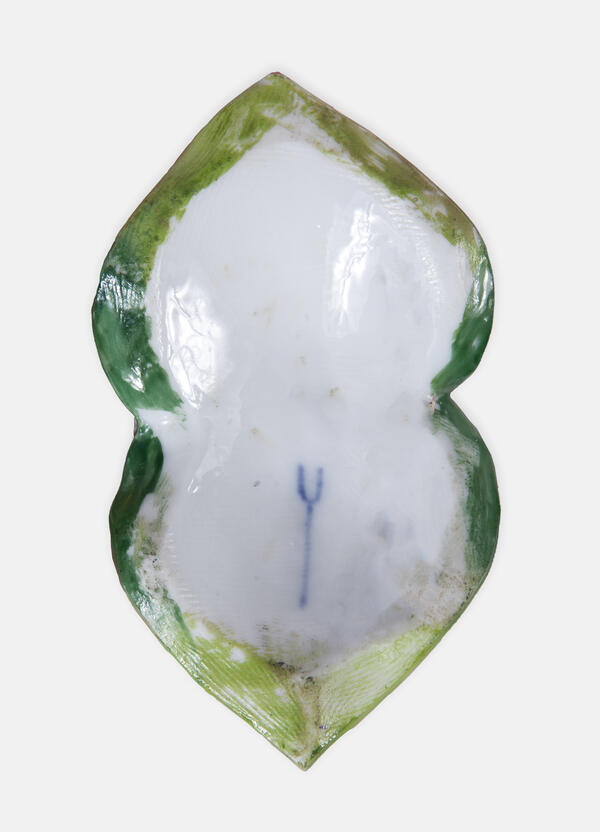
The boutonnière is elaborately detailed. Its base is shaped like a pea leaf. Between three vertical pods painted in different shades of green, there are three delicately molded pink and purple flowers.
Such elegant figurines could complement a richly decorated table or be placed in the women’s quarters of the house, for example, in the boudoir. The most famous mark of the Volkstedt Porcelain Manufactory was the blue crossed pitchforks — a reference to the famous crossed swords of the Meissen manufactory.
Thuringia is a forested region in eastern Germany that is rich in natural resources. It has long been famous for its pottery. Legend has it that Thuringian craftsmen mastered porcelain production independently of the already existing Meissen manufactory.
However, like most porcelain factories of that time, Thuringian factories strove to imitate the products of the famous and successful Meissen manufactory. In addition to tableware, they also produced vases and elegant porcelain figurines.
Despite some similarities, however, Thuringian products can easily be distinguished from Meissen porcelain. They are characterized by a special charm and their own unique style.
Thuringian porcelain manufactories mainly targeted middle-class customers. At the same time, their products were distinguished by high quality and unique style. Being beautiful and affordable, Thuringian porcelain quickly caught the fancy of customers and became popular not only in Germany but also abroad, including in the Russian Empire.
The boutonnière is elaborately detailed. Its base is shaped like a pea leaf. Between three vertical pods painted in different shades of green, there are three delicately molded pink and purple flowers.
Such elegant figurines could complement a richly decorated table or be placed in the women’s quarters of the house, for example, in the boudoir. The most famous mark of the Volkstedt Porcelain Manufactory was the blue crossed pitchforks — a reference to the famous crossed swords of the Meissen manufactory.