The primer became the first textbook for a Soviet pupil. Its main task was not only to teach literacy, but also to educate the younger generation in the spirit of the state ideology.
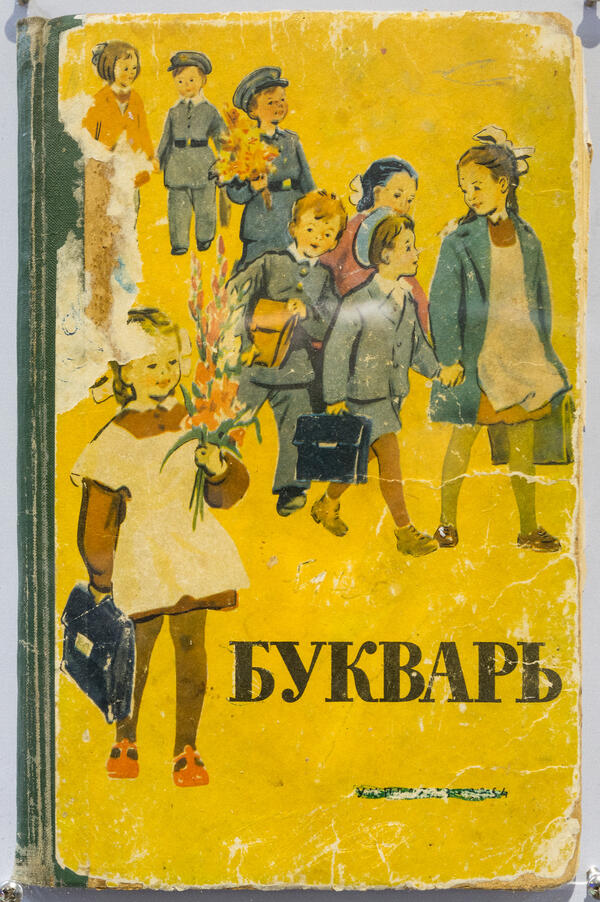
In primary school, children learned to read the ABC book as a rule, in the first semester and finished it with the celebration ‘Farewell to the ABC book.’ The training was based on a certain method: first-graders studied basic letters and sounds and immediately learned their identification. Primer books were well illustrated: children’s peers became the main characters of the plot pictures. They gathered mushrooms, flew a kite, made a snowman, skated and sledged, and did other common activities. Vivid pictures and examples made the literacy process easy and understandable.
This primer, authored by the Soviet teacher Sergei Redozubov, was developed for city schools and was subsequently reprinted several times. Serious topics were also raised on the pages of the primer: help around the house and garden, the main responsibilities of children. “Ma-ma my-la ra-mu” is one of the first sentences written in the primer. And next to it in the picture is not only a mother who washes the frame, but also a girl who helps by carrying a basin of water. An important place was also occupied by topics of national importance: labor in agriculture, new factories and plants, family welfare, sports. “Octobrists” appeared on the pages of the primer — helpers of adults that were an example of behavior for many schoolchildren. In the early 1960s, a portrait of the first man in space, Yuri Gagarin, was placed on the last pages of the book.
The exposition of the museum presents a copy of the primer from the stereotyped 12th edition, published by the State Educational and Pedagogical Publishing House of the Ministry of Education of the RSFSR in 1964. Since the primer was used in every Soviet family raising a first grader, it was one of the most common books. Therefore, as a rule, they did not take care of the primer: each child in the family had a new one. Paradoxically, the most extensively used Soviet book has become one of the rarest in the 21st century. There were very few primers published in the 1960s; this is a bibliographic rarity.
In primary school, children learned to read the ABC book as a rule, in the first semester and finished it with the celebration ‘Farewell to the ABC book.’ The training was based on a certain method: first-graders studied basic letters and sounds and immediately learned their identification. Primer books were well illustrated: children’s peers became the main characters of the plot pictures. They gathered mushrooms, flew a kite, made a snowman, skated and sledged, and did other common activities. Vivid pictures and examples made the literacy process easy and understandable.
This primer, authored by the Soviet teacher Sergei Redozubov, was developed for city schools and was subsequently reprinted several times. Serious topics were also raised on the pages of the primer: help around the house and garden, the main responsibilities of children. “Ma-ma my-la ra-mu” is one of the first sentences written in the primer. And next to it in the picture is not only a mother who washes the frame, but also a girl who helps by carrying a basin of water. An important place was also occupied by topics of national importance: labor in agriculture, new factories and plants, family welfare, sports. “Octobrists” appeared on the pages of the primer — helpers of adults that were an example of behavior for many schoolchildren. In the early 1960s, a portrait of the first man in space, Yuri Gagarin, was placed on the last pages of the book.
The exposition of the museum presents a copy of the primer from the stereotyped 12th edition, published by the State Educational and Pedagogical Publishing House of the Ministry of Education of the RSFSR in 1964. Since the primer was used in every Soviet family raising a first grader, it was one of the most common books. Therefore, as a rule, they did not take care of the primer: each child in the family had a new one. Paradoxically, the most extensively used Soviet book has become one of the rarest in the 21st century. There were very few primers published in the 1960s; this is a bibliographic rarity.