Font
Color
Graphics
Изображение точки

To see AR mode in action:

1. Install ARTEFACT app for iOS or Android;

2. Find the exhibition «Yugan River Khanty and Their Daily Life»

3. Push the «Augmented reality» button and point your phone's camera at the exhibit;

Скрыть точки интересаПоказать точки интереса
Показать в высоком качестве

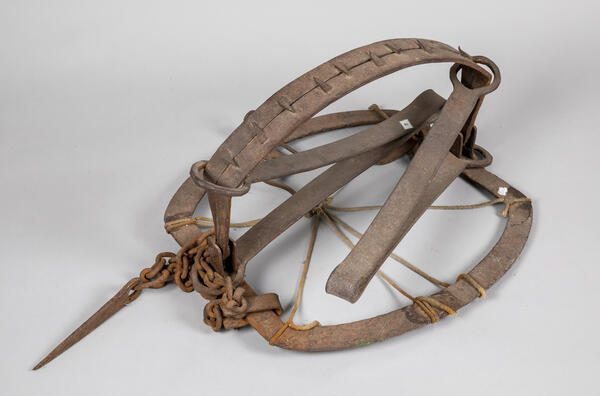
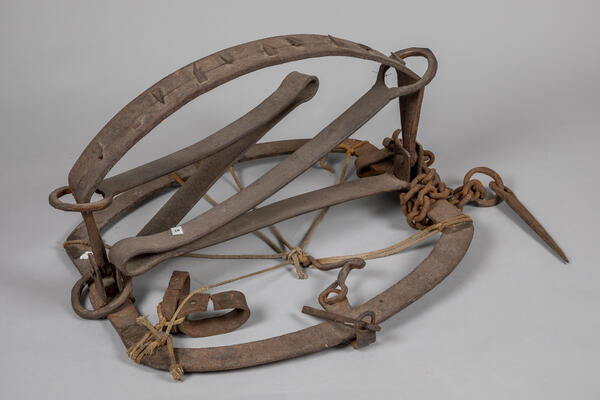
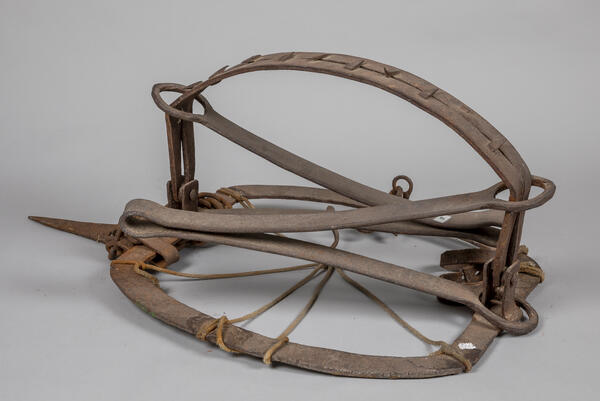
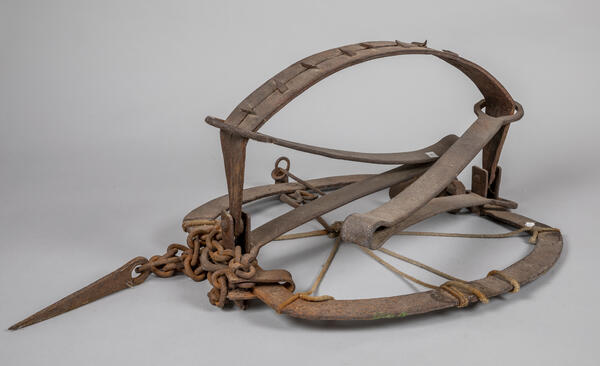
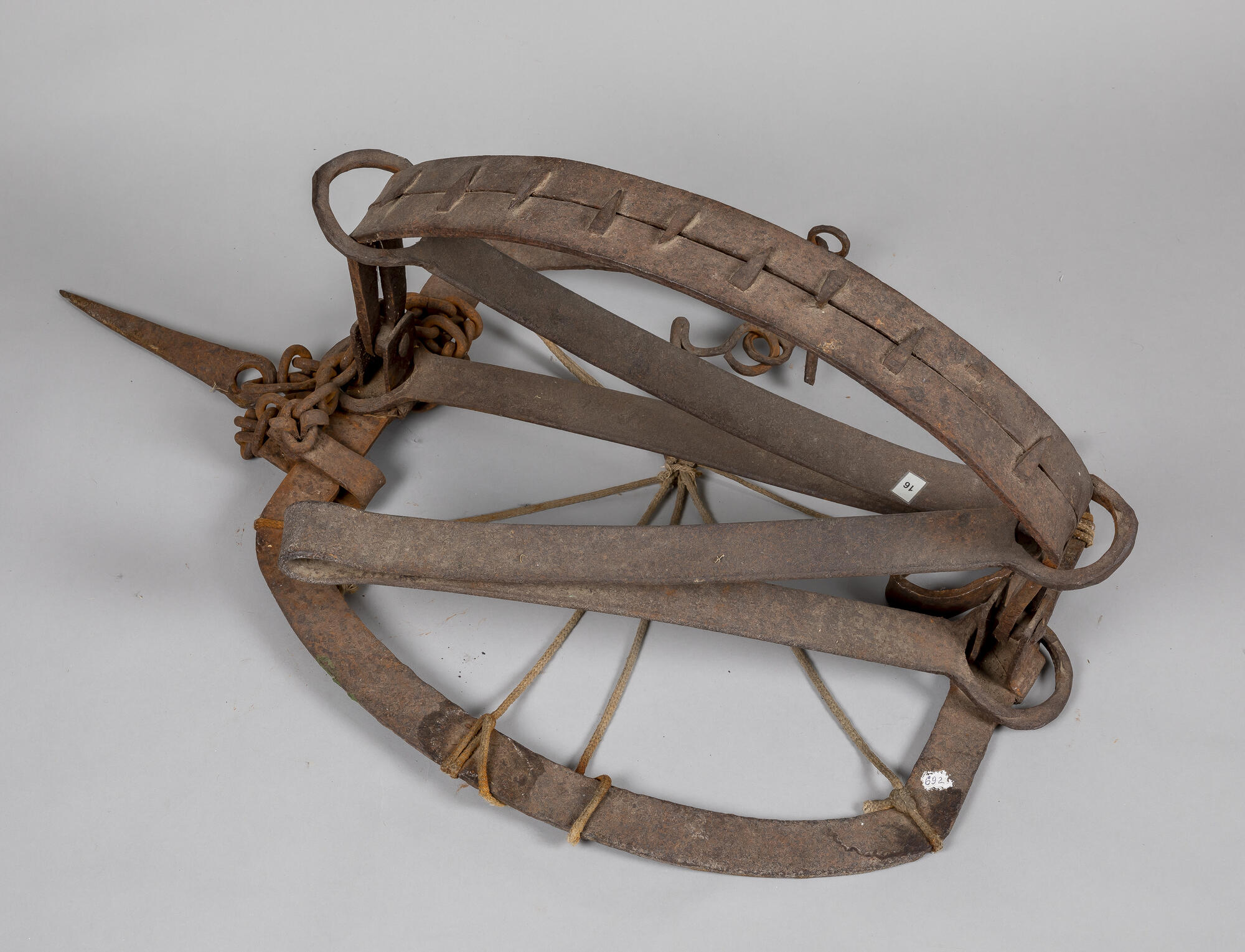
Bear trap. Chapkas kapkan

Creation period
the late 19th — the first half of the 20th century
Place of сreation
The Russian Empire
Dimensions
52,5x55x32,5 cm
Technique
factory production, stamping; metal, rope
0
Open in app
#1

The bear has been revered by the indigenous peoples of the North since times immemorial. It is believed that the bear is the son of the god Torum, who was sent by his father to keep justice on earth. An ancient Mansi legend states that a bear presented people with fire, arrows and bows.

The bear festival is an important element of the general phenomena of the bear cult. In her book “Khanty and Mansi: a Look from the 21st Century”, Zoya Sokolova explains it thusly: 

#2

The cult of the bear is a broad concept that covers beliefs regarding the bear, rituals associated with hunting it, eating its meat, and storing its bones; whereas the bear festival is a more narrow concept that covers only the rites associated with the consumption of bear meat, namely those of an apologetic and propitiatory character. The latter encompasses the entertainment of the bear in activities like songs, dances, games, pantomimes, competitions, etc. This is an entire system of rituals with various functions.

#3

The Khanty and Mansi were allowed to hunt bears, but after that the hunter was obliged to perform a certain ritual. Most often, catching the bear involved the use of traps. They were hunted only during autumn, since during spring and summer the animals bear and feed their offspring. A trap could also be set in winter for catching bears who continue roaming the forest during hibernation season.

A bear is a large animal, so the trap has to be strong and heavy. Such traps feature powerful springs weighing more than ten kilograms. The edges of the iron arcs called jaws have a sharp jagged edge. Such jaws are very practical because they grip the paw of the captured bear twice as hard as those with blunt and smooth edges.

The way it works is simple. The jaws of the trap are pushed apart, and one of them is clamped to the base with a hook, to which a piece of rotten meat is tied with a rope. The bear grabs the bait, the hook releases the jaw, which then slams on the animal’s paw.

Leaves, pine needles, and moss are used to cover up the trap.

The two jaws with nine teeth of a flattened oval shape are the main part of this trap.

Such traps were most likely made at Ural factories and bought or exchanged by Khanty hunters at local fairs. The trap on display was purchased at the Surgut or Yugansk fair. Traps like this have not been used since the 19th century.
#5
Bear trap. Chapkas kapkan
#4
View in the State Catalogue
read morehide
00:00
00:00
1x

Bear trap. Chapkas kapkan

Creation period
the late 19th — the first half of the 20th century
Place of сreation
The Russian Empire
Dimensions
52,5x55x32,5 cm
Technique
factory production, stamping; metal, rope
0
Point your smartphone camera to open in the app
Share
VkontakteOdnoklassnikiTelegram
Share on my website
Copy linkCopied
Copy
Open in app
To see AR mode in action:
  1. Install ARTEFACT app for 
  2. iOS or Android;
  3. Find and download the «Paintings in Details» exhibition
  4. Push the «Augmented reality» button and point your phone's camera at the painting;
  5. Watch what happens on your phone screen whilst you flip through the pictures.
 
We use Cookies
Cookies on the Artefact Website. We use cookies to ensure that we give you the best experience on our website. If you continue without changing your settings, we'll assume that you are happy to receive all cookies on the Artefact website. However, if you would like to, you can change your cookie settings at any time.
Learn more about useHide
Content is available only in Russian

X

Нашли опечатку?...

%title%%type%