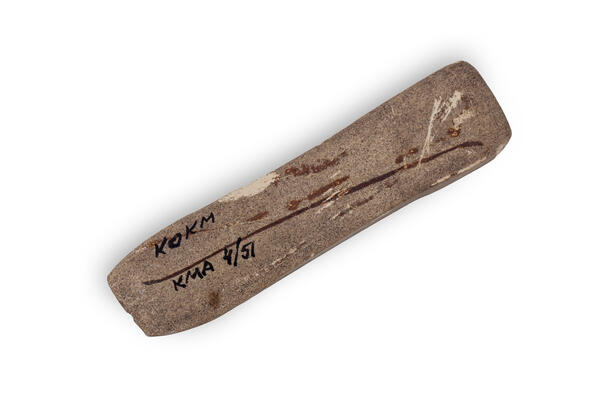
The Kursk Museum of Archaeology houses a whetstone — an abrasive tool in the form of a rectangular fine-grained bar, used for manually finishing the surfaces and cutting edges of chisels, saws, scissors, razors, knives, scythes, and other similar tools after sharpening. This artifact was made of sandstone. It was found by the famous Kursk archaeologist Nikolai Alekseevich Tikhomirov during the excavations at the Gochevo-1 settlement in the Belovo district of the Kursk region in 1986–1987. The object is dated to the 3rd century and belongs to the Kyiv archaeological culture, whose representatives are considered by scholars to be ancestors of the Slavs.
Whetstones have been actively used by people since ancient times. Archaeological finds indicate that whetstones were widespread in various cultures. From the Bronze Age to the present day, they have continued to be used for their intended purpose. Initially, any stones that were somewhat suitable in shape were used as whetstones. Subsequently, people discovered that some stones were better suited for sharpening.
Each locality had its own source of abrasive materials. Most whetstones were made of fine-grained rocks: sandstone, shale, and basalt. The principle of operation of all whetstones is the same. Fragments of abrasives have very high hardness. When the bar is rubbed against the surface of a metal blade, the abrasive grains scrape off small particles of metal. Layer by layer, people removed material from metal objects, leveling the blade surface and achieving the required sharpening angle and sharpness. During use, the stone had to be periodically moistened with water or oil, otherwise the bar would become clogged with metal particles, begin to “shine” and lose its abrasive properties.
In archaeological research, whetstones are often
found in burials of males and warriors from antiquity and the Middle Ages. As a
rule, such whetstones have through holes on one side for a cord or leather
strap so they could be worn on a belt. Sometimes, whetstones made from
valuable, variegated stones, such as jasper, serpentine, or porphyry, are
found. They usually show no signs of wear. According to scholars, such stones
had a ritual purpose.