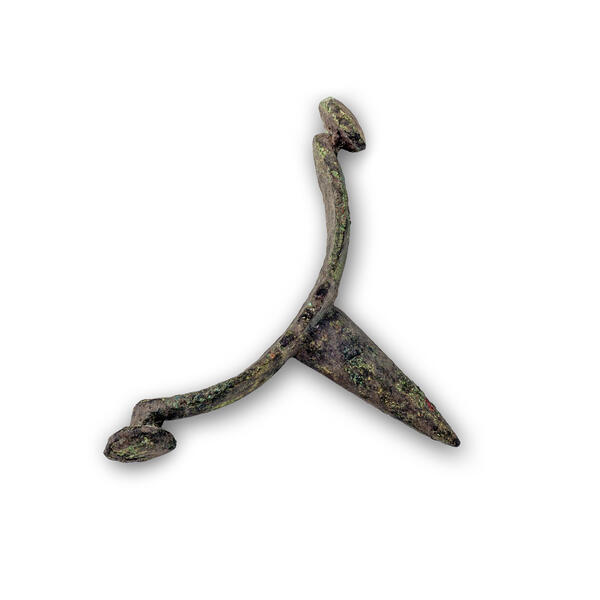
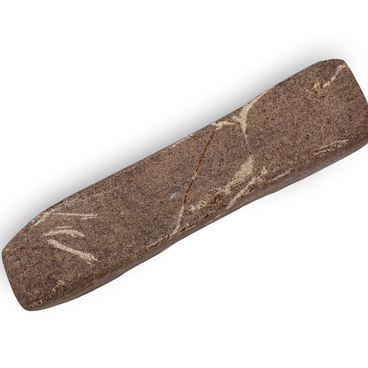
The spur was found in the village of Komarovka, in the Korenevsky district of the Kursk region, in 2009. The artifact was transferred to the collections of the Kursk Museum of Archaeology by the well-known Moscow archaeologist Oleg Alexandrovich Radyush. The spur belongs to the Kyiv archaeological culture, the bearers of which are considered by scholars to be ancestors of the Slavs. In ancient chronicles, these tribes are mentioned under the name “Veneti” or “Venedi.”
Stylistically, the item belongs to the circle of so-called Eastern European barbarian champlevé enamels, although it is not inlaid with enamel, which is not uncommon for items of this type. The enamel style spread over vast areas of Eastern Europe in the 2nd–4th centuries. Such decorations are most characteristic of the Dnieper and Desna regions in the 3rd–5th centuries. This manner originated in these areas based on local late Zarubintsy style and the influence of provincial Roman craftsmanship. Enamel-inlaid items often formed part of the rich and colorful sets found in hoards such as the Bryansk hoard, discovered in 2010 near the village of Usukh in the Bryansk region. This indicates the presence of well-established aristocratic traditions and a culture of prestige among the Proto-Slavic population.
The widespread use of spurs, the use of whips, and the presence of drinking horns in local hoards clearly indicate the formation of warrior culture by the late 2nd–3rd centuries, associated with the local military equestrian elite. Spurs with buttons display a significant variety of design, details, sizes, and manufacturing techniques. Different elements are used in various combinations, both with and without enamel.
A distinctive feature of the Eastern European
tradition of equipment is the predominance of bronze objects over iron ones,
which is a marked difference from Western Germanic cultures. Its another
distinctive feature is the extensive use of composite bimetallic technology,
enameled spurs, and spurs with diamond-shaped buttons. The decor features
numerous identical elements characteristic of the Eastern European champlevé
enamel object complex as a whole: branches, crossbars, rosettes, geometrically
shaped buttons, as well as openwork ornamentation techniques.