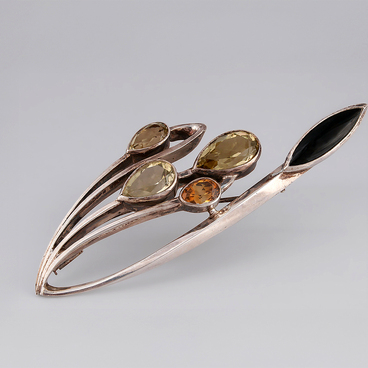
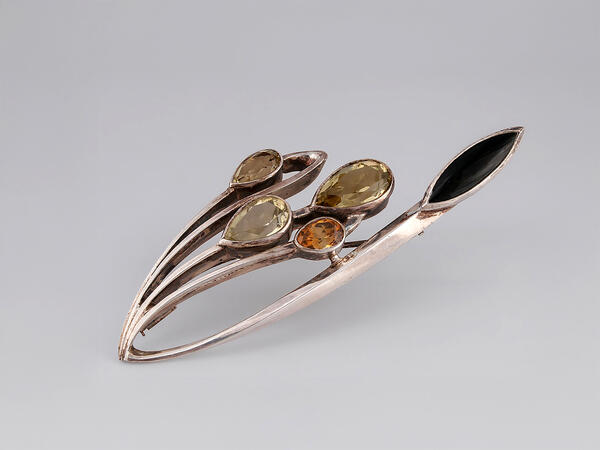
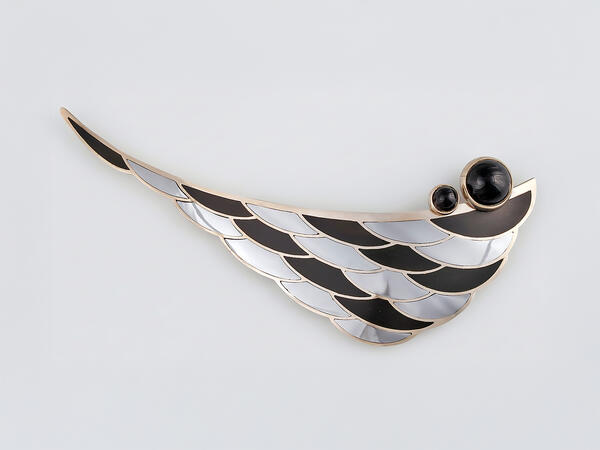
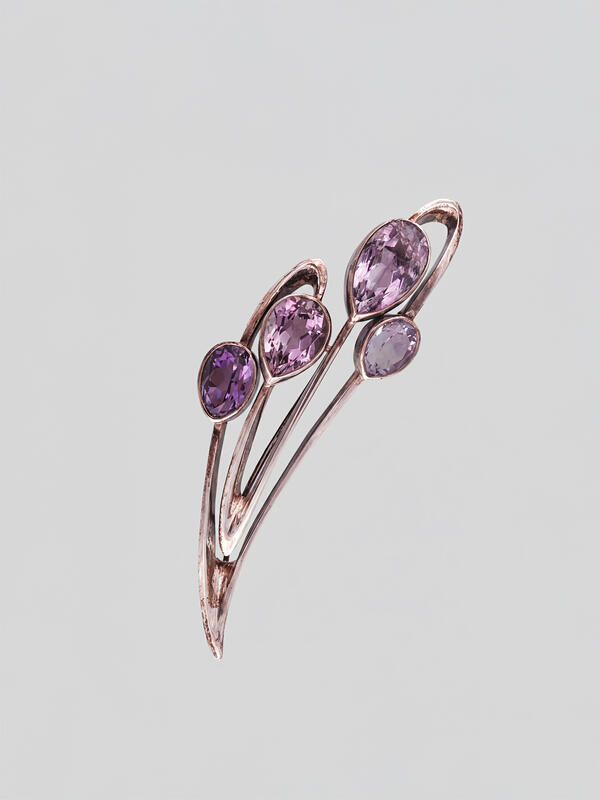
Crafted in 1984 by the Yekaterinburg jeweler Vladimir Nikolayevich Ustyuzhanin, the brooch from the “Birth of Stars” collection is made from damburite and obsidian, set in silver. Its dynamic composition is built around a central metal rod from which two silver loops of different lengths gracefully diverge. Suspended between these arcs are three round, black obsidian cabochons, each secured in a bezel setting. The loops culminate in a third, opposing arc that holds a large, oval, transparent faceted stone.
The reverse is engraved with the artist’s monogram — “UVN” — and the year of creation, 1984. The “Birth of Stars” collection of brooches embodies the hallmark features of Ustyuzhanin’s style: dynamic, flying lines, elongated silhouettes, and a sense of purposeful motion that evokes the flight of bright, distant stars. The artist masterfully contrasts the sleek metal loops with the sparkle of faceted stones.
For this brooch, Ustyuzhanin opted for damburite. It is a synthetic corundum with a pale yellow hue. This lab-created stone imitates precious stone. Such an alternative looks like citrine or topaz, often surpassing them in color saturation and clarity. Its use allows for unique, consistent shades that are not typically found in nature.
The black cabochons are crafted from obsidian, a volcanic glass occasionally used in jewelry due to its fragility. Obsidian requires careful handling and a secure setting. Here, the stones are protected by their secure metal settings, which accentuate the material’s signature mirror-like luster and depth.
The cosmic theme is organic to Ustyuzhanin’s work. The brooch’s silver loops, with their smooth, rounded arcs, create a linear composition that seems to soar upward toward unknown stellar worlds. The jeweler’s oeuvre is often divided into three fundamental themes: nature, states of mind, and movement. The brooch from the “Birth of Stars” collection is a quintessential example of his cosmic theme.
Vladimir Ustyuzhanin is a brilliant stylist deeply sensitive to the plasticity of the line. His works from the 1980s retain their artistic freshness and relevance to this day.