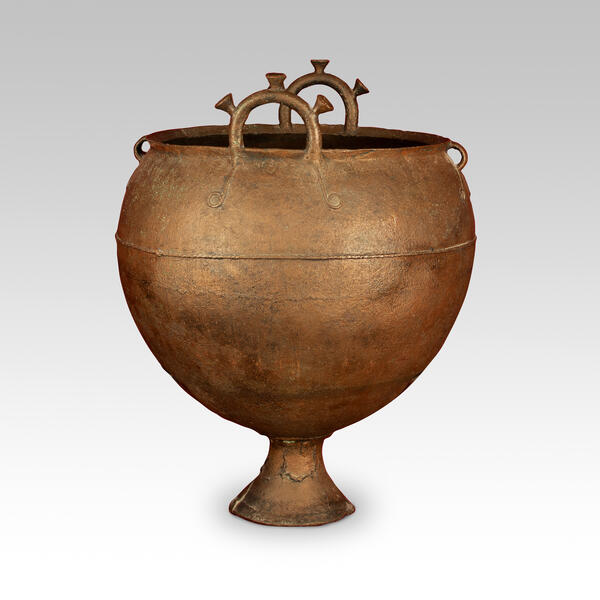
The kurgan “Sadovy” was discovered in 1962. During excavations, a burial was discovered beneath the mound that had been looted a very long time ago. The cauldron on display was found in that burial.
There were traces of footprints and grass impressions on the ground surrounding the burial mound, indicating that the burial was looted in rainy weather in the early spring, when the grass had not yet grown tall. A looter’s pit has also been preserved under the mound, leading directly to the tomb. However, the thieves did not manage to find the gifts for the deceased’s soul that were stored in a hidden place.
The cauldron has a spherical body resting on a bell-shaped base. It has two arched vertical handles and two handles in the shape of small loops. A “rope” with a knot runs along the convex part of the body. Relief stripes continue the vertical arched handles further down on the body, ending in rings. Similar decorative elements are also featured under the looped handles. Two cast rivets reinforce the vessel’s leg. There is a hole on the body that was intentionally punched back in ancient times.
Cauldrons played an important role in the culture of the nomadic people. They were used for cooking meat, as evidenced by the presence of bone remains inside and around the vessels. Researchers have also identified another purpose for these pots, which may have been the primary one: these artifacts were used for religious ceremonies. Cauldrons were associated with the ruling class and performed the function of uniting the clan of a nomadic group.
The nomads would eat food that was cooked in the cauldron of the leader. This practice symbolized unity and solidarity, and the process of cooking meat became a sacred ritual. Many scholars have written about the significance of cauldrons as sacred objects, used in various ceremonies and sacrifices. Often, they reference the works of the ancient Greek historian and geographer, Herodotus. He wrote about the Scythian king Ariantas who ordered the casting of a large cauldron made from arrowheads that had been presented to him by the Scythians under his rule.
Smaller cauldrons, such as the one from the museum collection, were not suitable for cooking meat due to their size and shape. Such vessels were likely used for mixing drinks. It is also possible that the cauldron was made specifically for use in the burial of its owner and was subsequently “killed” by creating a hole in it.