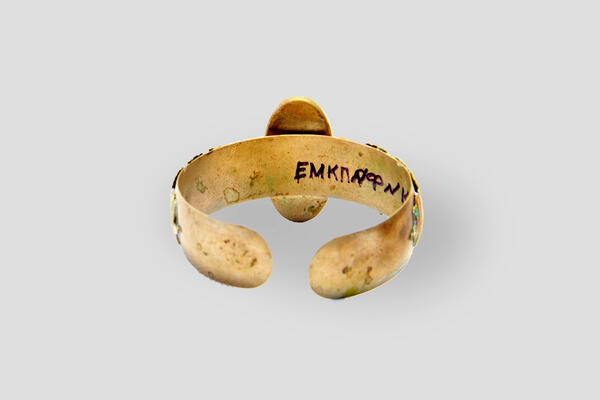
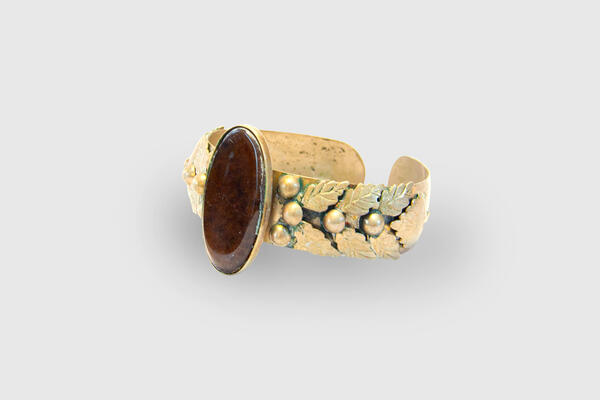
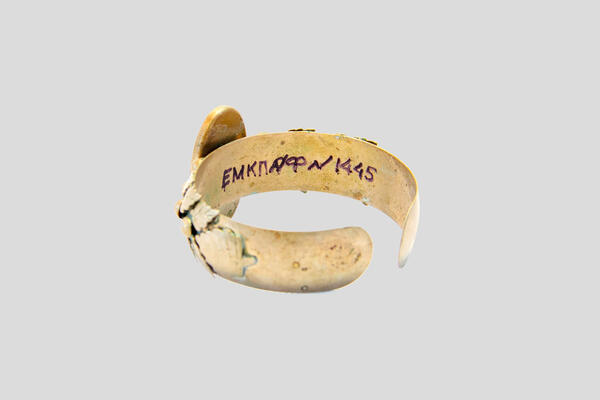
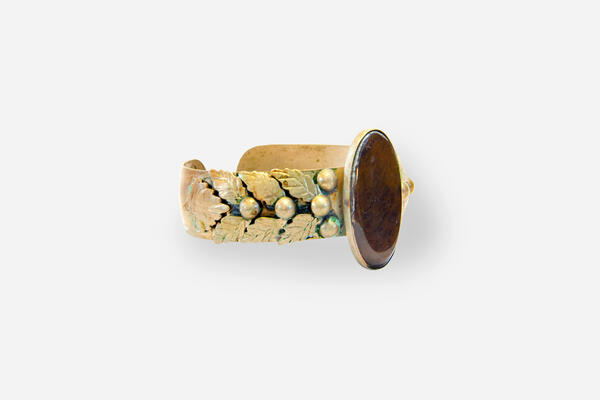
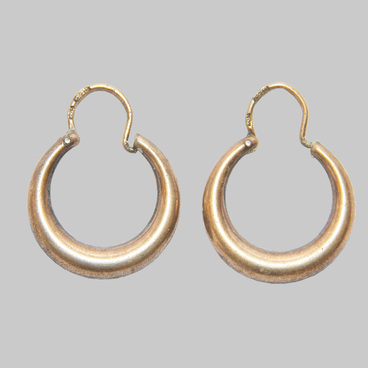
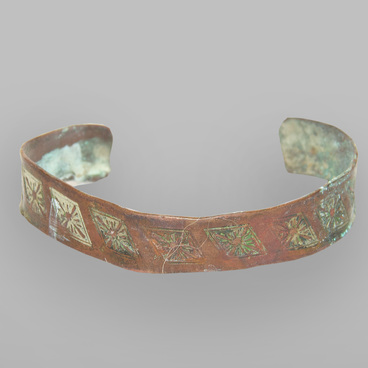
This piece of jewelry from the exhibition was donated to the museum by Khalida Sadykova, a resident of the Embaevo village in the Tyumen region. The open-ended metal bracelet with rounded edges is decorated with a black stone, false granulation and metal leaves.
Local artisans often made cheap products, taking into account the national character, from tin, copper, bronze, brass, nickel silver (cupronickel), and combinations with silver. They could be silver-coated, that is, they looked like silver jewelry. Gold was used as a material for jewelry much less frequently; it was part of jewelry sets belonging to rich Tatar women.
Turquoise, corals, mother-of-pearl, malachite, carnelian, amethyst, aquamarine, and ruby were used for inserts. However, most often, natural materials were imitated. Amethyst, aquamarine and ruby were replaced by transparent faceted glass, carnelian — by frosted glass of the corresponding color. By the way, it is very difficult to distinguish a carnelian piece from an imitated one by their appearance, since one needs to see a chip, which is not always possible. Turquoise, malachite and corals were substituted with glass paste (smalt), and mother-of-pearl was often replaced by a fragment of a mirror.
Tatar jewelers have achieved great results in mastering the most complex and unique techniques. There are several technologies for making jewelry: casting, rolling, stamping and drawing. Tatar artisans used casting, while chasing, stamping and engraving were the main decoration methods — this allowed the craftsmen to create jewelry of varying complexity. The work of a jeweler is extremely important: if it was of poor quality, then the jewelry could fall apart or lose its elegance.
There is a Tatar proverb that because of the ringing produced by numerous heavy pendants, rings and earrings, khasites, wide bracelets, one can rather hear a Tatar woman than see her. Jewelry also played the role of a talisman, so, according to the Tatars, turquoise protected from the evil eye, and an equal number of bracelets worn on both hands helped to keep the love of the spouses in the family. Decorations were passed down in Tatar families from one generation to the other, and new pieces were gradually accumulated.
Local artisans often made cheap products, taking into account the national character, from tin, copper, bronze, brass, nickel silver (cupronickel), and combinations with silver. They could be silver-coated, that is, they looked like silver jewelry. Gold was used as a material for jewelry much less frequently; it was part of jewelry sets belonging to rich Tatar women.
Turquoise, corals, mother-of-pearl, malachite, carnelian, amethyst, aquamarine, and ruby were used for inserts. However, most often, natural materials were imitated. Amethyst, aquamarine and ruby were replaced by transparent faceted glass, carnelian — by frosted glass of the corresponding color. By the way, it is very difficult to distinguish a carnelian piece from an imitated one by their appearance, since one needs to see a chip, which is not always possible. Turquoise, malachite and corals were substituted with glass paste (smalt), and mother-of-pearl was often replaced by a fragment of a mirror.
Tatar jewelers have achieved great results in mastering the most complex and unique techniques. There are several technologies for making jewelry: casting, rolling, stamping and drawing. Tatar artisans used casting, while chasing, stamping and engraving were the main decoration methods — this allowed the craftsmen to create jewelry of varying complexity. The work of a jeweler is extremely important: if it was of poor quality, then the jewelry could fall apart or lose its elegance.
There is a Tatar proverb that because of the ringing produced by numerous heavy pendants, rings and earrings, khasites, wide bracelets, one can rather hear a Tatar woman than see her. Jewelry also played the role of a talisman, so, according to the Tatars, turquoise protected from the evil eye, and an equal number of bracelets worn on both hands helped to keep the love of the spouses in the family. Decorations were passed down in Tatar families from one generation to the other, and new pieces were gradually accumulated.