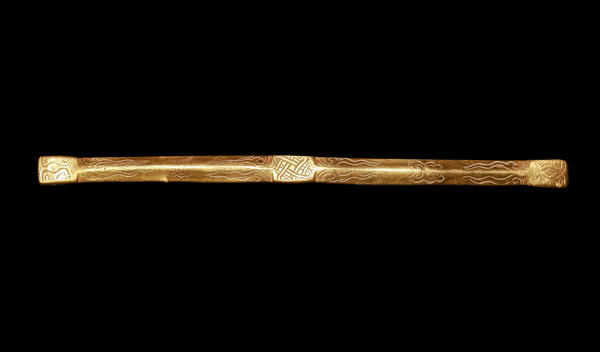
The bracelet from the Astrakhan Museum Reserve collection was found by archaeologists in 1980 at the site of SelItrennoye ancient settlement in the KharabalInsky District of Astrakhan Region. According to scientists, it was crafted in the XIV century AD.
The exhibit is a straightened bracelet engraved with an ornament. There is a ‘knot of happiness’ in the middle. This pattern came to Eastern Europe and Central Asia together with the Mongols in the XII-XIII centuries, and then spread over a vast area. It survived as a decorative detail in the folk art of the Mongols, the peoples of the Volga region and Central Asia till the present day.
The ‘knot of happiness’ is a symbol of the Tibetan mythology, which means infinite wisdom. Since the knot has no beginning or end, it also represents the fluidity of time, the impermanence and interconnection of all things, and also the unity of compassion and wisdom.
The ‘knots of infinity’ that appeared on the objects of the material culture of the Golden Horde is primarily associated with the religious preferences of the first Mongol rulers.
The ends of the piece are decorated with engraved images of ‘lion masks’. The so-called ‘lion-headed bracelets’ were widespread in the region of the medieval East. Researchers attribute such bracelets to the range of items crafted by the Golden Horde jewelers, while some scholars believe that the ornaments have oriental (Asia Minor-Iranian) origins. The lion image may be interpreted as a symbol of prosperity, fertility, nobility and wishing every happiness to a woman wearing such an ornament.
The third image on the bracelet is the image of fleecy clouds with long long ‘tails’. They are engraved on the inclined surfaces of the bracelet. The motif of the image of such clouds is found in the medieval antiquities in variations over a vast area stretching from the Far East to Eastern Europe. This motif was found on a variety of items. The range of such items includes bone linings for the quiver, ceramics and others.
In 2005, the bracelet and other valuable items from the Astrakhan Museum Reserve collection were exhibited at the Golden Horde: History and Culture show in KazAn (arranged under the scientific supervision by the State Hermitage).
The exhibit is a straightened bracelet engraved with an ornament. There is a ‘knot of happiness’ in the middle. This pattern came to Eastern Europe and Central Asia together with the Mongols in the XII-XIII centuries, and then spread over a vast area. It survived as a decorative detail in the folk art of the Mongols, the peoples of the Volga region and Central Asia till the present day.
The ‘knot of happiness’ is a symbol of the Tibetan mythology, which means infinite wisdom. Since the knot has no beginning or end, it also represents the fluidity of time, the impermanence and interconnection of all things, and also the unity of compassion and wisdom.
The ‘knots of infinity’ that appeared on the objects of the material culture of the Golden Horde is primarily associated with the religious preferences of the first Mongol rulers.
The ends of the piece are decorated with engraved images of ‘lion masks’. The so-called ‘lion-headed bracelets’ were widespread in the region of the medieval East. Researchers attribute such bracelets to the range of items crafted by the Golden Horde jewelers, while some scholars believe that the ornaments have oriental (Asia Minor-Iranian) origins. The lion image may be interpreted as a symbol of prosperity, fertility, nobility and wishing every happiness to a woman wearing such an ornament.
The third image on the bracelet is the image of fleecy clouds with long long ‘tails’. They are engraved on the inclined surfaces of the bracelet. The motif of the image of such clouds is found in the medieval antiquities in variations over a vast area stretching from the Far East to Eastern Europe. This motif was found on a variety of items. The range of such items includes bone linings for the quiver, ceramics and others.
In 2005, the bracelet and other valuable items from the Astrakhan Museum Reserve collection were exhibited at the Golden Horde: History and Culture show in KazAn (arranged under the scientific supervision by the State Hermitage).