#7
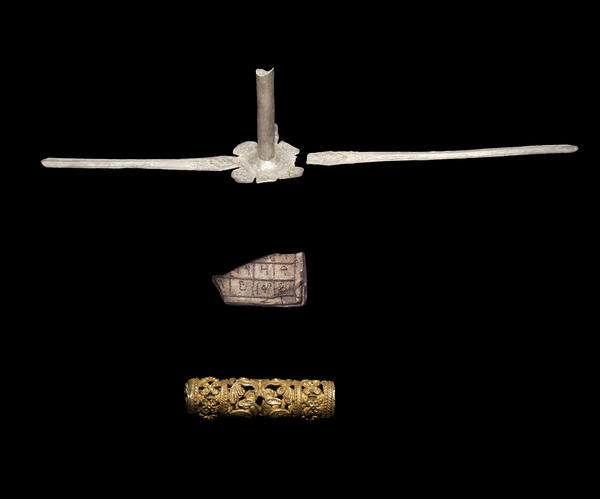
Boktag, Silver plate fragment, TumAr (phylactery)
#8
#11
#12
BoktAgs (bOccas) are traditional headdresses of the nomads of the Golden Horde era. They stemmed from China: Empresses of the Yuan Dynasty in China were also depicted in such headdresses.
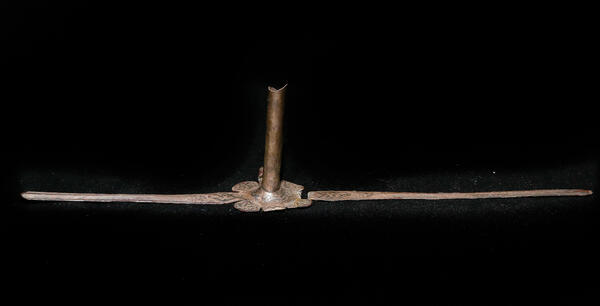
The boktag looked like a round hat on a frame made of branches, birch bark, bamboo strips or wire. A cylinder rose from the top of the head and then re-shaped into a cone with a flat top. The entire headdress was lined with a piece of fabric that covered the back of the head; and finally a larger piece of fabric underneath rippled over the shoulders. The headdress was fastened to the head with a black ribbon.
The Astrakhan Museum Reserve keeps a frame of such a headdress. It has a socket to insert peacock feathers in. This suggests that the mistress of the boktag was noble and, probably, was a part of the Mongol elite. The message by the Spanish ambassador Ruy González de Clavijo describes Timur’s (Tamerlane) senior wife as follows: “… And her head was covered with a sort of helmet made of red fabric, similar to those in which [the knights] fight in tournaments, and this fabric fell slightly over her shoulders. And this helmet was very high, and there were many large, light and round pearls, many rubies, turquoise and other neatly held misc stones. The veil [falling over her shoulders] was embroidered with gold, and at the top of [the whole set] there was a very beautiful gold wreath adorned with many [precious] stones and large pearls. The very top was crowned with a structure of three rubies, about two fingers in size, bright, extremely beautiful, and lustrous. The top of [the whole set] was decorated with a large plume, one cubit high, and [some] feathers hung down, while others reached the face and [sometimes] the eyes. These feathers were tied together with a golden string that [had] a white tassel made of bird feathers with stones and pearls at the end; and while she was walking, the plume was tremulous in every direction.”
The archaeological collections keep gold, gilt silver, bronze and amber appliqués that used to be tops of such headdresses. Noble women wore boktags with tops made of precious stones, while those who were ranked not so high had tops decorated with bronze.
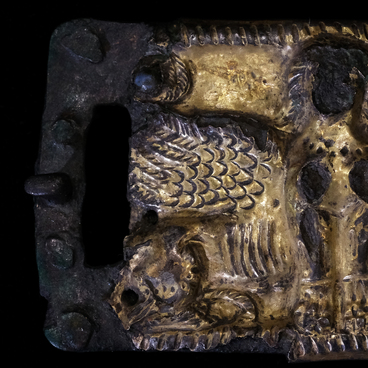
The components of the headdress from the collection of the Astrakhan Museum Reserve were found in 1969, when the Aksenovsky burial at the distance of 5 kilometers from the NOvy AksAi in the Volgograd region was being examined.
The boktag looked like a round hat on a frame made of branches, birch bark, bamboo strips or wire. A cylinder rose from the top of the head and then re-shaped into a cone with a flat top. The entire headdress was lined with a piece of fabric that covered the back of the head; and finally a larger piece of fabric underneath rippled over the shoulders. The headdress was fastened to the head with a black ribbon.
The Astrakhan Museum Reserve keeps a frame of such a headdress. It has a socket to insert peacock feathers in. This suggests that the mistress of the boktag was noble and, probably, was a part of the Mongol elite. The message by the Spanish ambassador Ruy González de Clavijo describes Timur’s (Tamerlane) senior wife as follows: “… And her head was covered with a sort of helmet made of red fabric, similar to those in which [the knights] fight in tournaments, and this fabric fell slightly over her shoulders. And this helmet was very high, and there were many large, light and round pearls, many rubies, turquoise and other neatly held misc stones. The veil [falling over her shoulders] was embroidered with gold, and at the top of [the whole set] there was a very beautiful gold wreath adorned with many [precious] stones and large pearls. The very top was crowned with a structure of three rubies, about two fingers in size, bright, extremely beautiful, and lustrous. The top of [the whole set] was decorated with a large plume, one cubit high, and [some] feathers hung down, while others reached the face and [sometimes] the eyes. These feathers were tied together with a golden string that [had] a white tassel made of bird feathers with stones and pearls at the end; and while she was walking, the plume was tremulous in every direction.”
The archaeological collections keep gold, gilt silver, bronze and amber appliqués that used to be tops of such headdresses. Noble women wore boktags with tops made of precious stones, while those who were ranked not so high had tops decorated with bronze.
The components of the headdress from the collection of the Astrakhan Museum Reserve were found in 1969, when the Aksenovsky burial at the distance of 5 kilometers from the NOvy AksAi in the Volgograd region was being examined.
#13
Date: XIII–XIV centuries
Technique: embossing, engraving
Dimensions: 6,7×4,6×13,1 cm
Collection: Precious metals
Copyright: State budgetary institution of culture of the Astrakhan region “Astrakhan Museum-Reserve”
Goskatalog Number: 17112912
Technique: embossing, engraving
Dimensions: 6,7×4,6×13,1 cm
Collection: Precious metals
Copyright: State budgetary institution of culture of the Astrakhan region “Astrakhan Museum-Reserve”
Goskatalog Number: 17112912
#10
Silver plate fragment
#17
#18
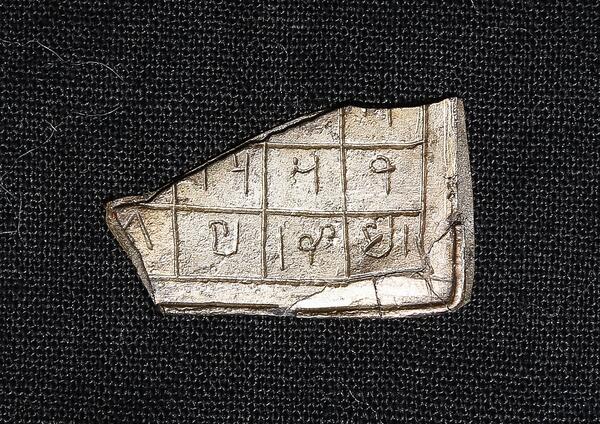
The silver plate from the Astrakhan Museum Reserve collection was discovered in 2000 at the SamosdElka archeological site, among the remains of the medieval fortified town. The cultural layers of the SamosdElka archeological site contain the remains of three towns that replaced one another. They are a Khazar town located on the spot in the 9th–10th centuries, a town of the pre-Mongolian time of the 11th–12th centuries and a Golden Horde settlement of the 13th–14th centuries.
The plate, as the researchers believe, was crafted between the XII and XVI centuries. It is decorated with engravings: there is a square on one side, and an Arabic inscription on the other one.
The magic square is a table filled with natural numbers. They are arranged in such a way that the sum of the numbers in each row, each column and on both diagonals is the same. The first magic square sized 3 × 3 and inscribed on the shell of a turtle was found in China and dates back to 2200 BC.
In the era of the Golden Horde, such magic squares were used in religious and magical rituals. During that period, they were usually filled with figures of Eastern Arabic content. The figures were inscribed by people who studied magic: medicine men, shamans, and bakshy folk singers from among the Turkic peoples.
Scientists have studied medieval written sources and found out how the population of the Golden Horde used such magic squares. For example, they depicted such images on the walls of vessels to protect the contents from deterioration. Also, medieval magic treatises advised to use such squares to survive childbirths, bake good bread, or make it rain during a drought. They recommended to have the squares on hand as amulets, sew them into clothes, and even swallow some as medicine.
Also, other items induing with special qualities were used together with the mystical squares for rituals. There are cowrie shells, ornaments with sympathetic inscriptions, and tumArs (amulets cases). And also it were ongOns that were figurines or images considered to be containers for the souls of deceased ancestors.
The traditions to use the magic squares in the everyday magic were preserved in Central Asia within the areas that used to be parts of the Golden Horde.
The plate, as the researchers believe, was crafted between the XII and XVI centuries. It is decorated with engravings: there is a square on one side, and an Arabic inscription on the other one.
The magic square is a table filled with natural numbers. They are arranged in such a way that the sum of the numbers in each row, each column and on both diagonals is the same. The first magic square sized 3 × 3 and inscribed on the shell of a turtle was found in China and dates back to 2200 BC.
In the era of the Golden Horde, such magic squares were used in religious and magical rituals. During that period, they were usually filled with figures of Eastern Arabic content. The figures were inscribed by people who studied magic: medicine men, shamans, and bakshy folk singers from among the Turkic peoples.
Scientists have studied medieval written sources and found out how the population of the Golden Horde used such magic squares. For example, they depicted such images on the walls of vessels to protect the contents from deterioration. Also, medieval magic treatises advised to use such squares to survive childbirths, bake good bread, or make it rain during a drought. They recommended to have the squares on hand as amulets, sew them into clothes, and even swallow some as medicine.
Also, other items induing with special qualities were used together with the mystical squares for rituals. There are cowrie shells, ornaments with sympathetic inscriptions, and tumArs (amulets cases). And also it were ongOns that were figurines or images considered to be containers for the souls of deceased ancestors.
The traditions to use the magic squares in the everyday magic were preserved in Central Asia within the areas that used to be parts of the Golden Horde.
#19
Date: XII–XVI centuries AD
Technique: repoussé work, embossing
Dimensions: 3,0×1,8 cm
Collection: State budgetary institution of culture of the Astrakhan region ‘Astrakhan Museum-Reserve’
Copyright: State budgetary institution of culture of the Astrakhan region ‘Astrakhan Museum-Reserve’
Goskatalog Number: 17112940
Technique: repoussé work, embossing
Dimensions: 3,0×1,8 cm
Collection: State budgetary institution of culture of the Astrakhan region ‘Astrakhan Museum-Reserve’
Copyright: State budgetary institution of culture of the Astrakhan region ‘Astrakhan Museum-Reserve’
Goskatalog Number: 17112940
#20
TumAr (phylactery)
#21
#22
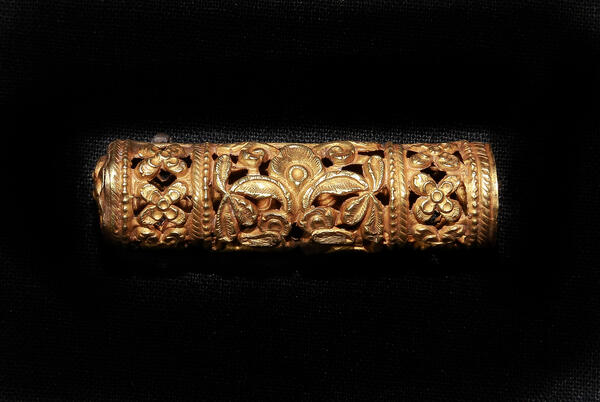
Tumar is a small case in which the talisman was put. The amulet, which was kept in the case, was supposed to protect its owner from diseases, the evil eye, infertility and evil spirits.
The cylindrical tumAr with slitted ornaments from the Astrakhan Museum Reserve collection was found in 1996 at the KrAsny Yar archeological site in the Astrakhan Region. Archaeologists determined that it was crafted in the XIII century AD. The amulet case is made of gold, while the eyes are of silver. It depicts two fallow deer near the flower that blooms so magnificently that it resembles a tree. Tumar was attached to a headdress — boktAg.
The headdress (bOcca, boktAg or googUn) distinguished women who belonged to the Mongol elite of the Chingisid states. The boktAg was made in the form of a round cap. The fabric base was attached to a frame made of branches, birch bark, bamboo strips or wire. A cylinder rose from the top of the head and then re-shaped into a cone with a flat top. The whole headdress was covered with a cloth that covered the back of the head; and finally a larger piece of fabric underneath rippled over the shoulders. The boktAg was richly decorated: embroidered with pearls and precious gems, sewn on appliques made of precious metals and feathers of rare birds.
The costume, the appearance of the nomads was complemented by a whole complex of decorations: earrings, neck-chest ornamentals, for example, beads and necklaces, and sometimes bracelets and rings. They additionally decorated clothes, headdress, shoes. For this purpose, they used beads, amulets, appliques or bells, belt appliques and buckles, decorative buttons. The nomads used bags, cases, mirrors and other items as accessories.
Giovanni da Pian del Carpine, an Italian Franciscan, the first European to visit the Mongol Empire, left the memories of the appearance of the nomads. In his Ystoria Mongalorum, he wrote: ‘Girls and young women were very difficult to be distinguished from men, since they dress like men in everything.’ It is subject not only to the style of clothing (nomads often wore palls resembling a vest), but also meant that men also often decorated their outfits with decorative elements.
In 2005, the amulet case and other valuable archaeological finds from the Astrakhan Museum Reserve collection were exhibited at the Golden Horde: History and Culture show in Kazan (under the scientific supervision of the State Hermitage Museum).
The cylindrical tumAr with slitted ornaments from the Astrakhan Museum Reserve collection was found in 1996 at the KrAsny Yar archeological site in the Astrakhan Region. Archaeologists determined that it was crafted in the XIII century AD. The amulet case is made of gold, while the eyes are of silver. It depicts two fallow deer near the flower that blooms so magnificently that it resembles a tree. Tumar was attached to a headdress — boktAg.
The headdress (bOcca, boktAg or googUn) distinguished women who belonged to the Mongol elite of the Chingisid states. The boktAg was made in the form of a round cap. The fabric base was attached to a frame made of branches, birch bark, bamboo strips or wire. A cylinder rose from the top of the head and then re-shaped into a cone with a flat top. The whole headdress was covered with a cloth that covered the back of the head; and finally a larger piece of fabric underneath rippled over the shoulders. The boktAg was richly decorated: embroidered with pearls and precious gems, sewn on appliques made of precious metals and feathers of rare birds.
The costume, the appearance of the nomads was complemented by a whole complex of decorations: earrings, neck-chest ornamentals, for example, beads and necklaces, and sometimes bracelets and rings. They additionally decorated clothes, headdress, shoes. For this purpose, they used beads, amulets, appliques or bells, belt appliques and buckles, decorative buttons. The nomads used bags, cases, mirrors and other items as accessories.
Giovanni da Pian del Carpine, an Italian Franciscan, the first European to visit the Mongol Empire, left the memories of the appearance of the nomads. In his Ystoria Mongalorum, he wrote: ‘Girls and young women were very difficult to be distinguished from men, since they dress like men in everything.’ It is subject not only to the style of clothing (nomads often wore palls resembling a vest), but also meant that men also often decorated their outfits with decorative elements.
In 2005, the amulet case and other valuable archaeological finds from the Astrakhan Museum Reserve collection were exhibited at the Golden Horde: History and Culture show in Kazan (under the scientific supervision of the State Hermitage Museum).
#23
Date: XIII century AD
Technique: forming, engraving
Dimensions: Length — 6 cm, diameter — 1,6 cm
Collection: Precious metals
Copyright: State budgetary institution of culture of the Astrakhan region ‘Astrakhan Museum-Reserve’
Goskatalog Number: 17112936
Technique: forming, engraving
Dimensions: Length — 6 cm, diameter — 1,6 cm
Collection: Precious metals
Copyright: State budgetary institution of culture of the Astrakhan region ‘Astrakhan Museum-Reserve’
Goskatalog Number: 17112936
read morehide
00:00
00:00
1x
Boktag, Silver plate fragment, TumAr
Collection
Exhibition
1
 Point your smartphone camera to open in the app
Open in app
Share