BoktAgs (bOccas) are traditional headdresses of the nomads of the Golden Horde era. They stemmed from China: Empresses of the Yuan Dynasty in China were also depicted in such headdresses.
The boktag looked like a round hat on a frame made of branches, birch bark, bamboo strips or wire. A cylinder rose from the top of the head and then re-shaped into a cone with a flat top. The entire headdress was lined with a piece of fabric that covered the back of the head; and finally a larger piece of fabric underneath rippled over the shoulders. The headdress was fastened to the head with a black ribbon.
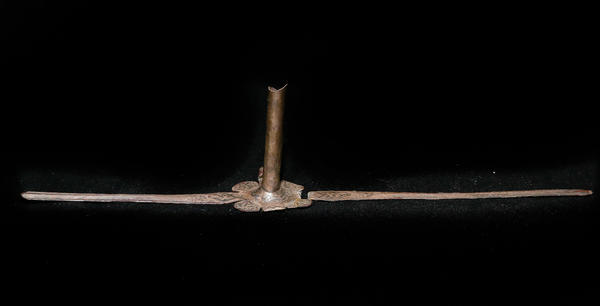
The Astrakhan Museum Reserve keeps a frame of such a headdress. It has a socket to insert peacock feathers in. This suggests that the mistress of the boktag was noble and, probably, was a part of the Mongol elite. The message by the Spanish ambassador Ruy González de Clavijo describes Timur’s (Tamerlane) senior wife as follows: “… And her head was covered with a sort of helmet made of red fabric, similar to those in which [the knights] fight in tournaments, and this fabric fell slightly over her shoulders. And this helmet was very high, and there were many large, light and round pearls, many rubies, turquoise and other neatly held misc stones. The veil [falling over her shoulders] was embroidered with gold, and at the top of [the whole set] there was a very beautiful gold wreath adorned with many [precious] stones and large pearls. The very top was crowned with a structure of three rubies, about two fingers in size, bright, extremely beautiful, and lustrous. The top of [the whole set] was decorated with a large plume, one cubit high, and [some] feathers hung down, while others reached the face and [sometimes] the eyes. These feathers were tied together with a golden string that [had] a white tassel made of bird feathers with stones and pearls at the end; and while she was walking, the plume was tremulous in every direction.”
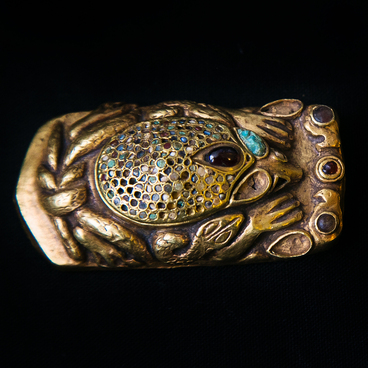
The archaeological collections keep gold, gilt silver, bronze and amber appliqués that used to be tops of such headdresses. Noble women wore boktags with tops made of precious stones, while those who were ranked not so high had tops decorated with bronze.
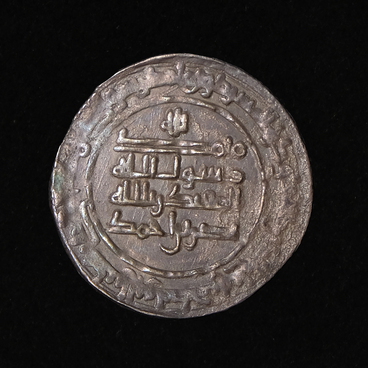
The components of the headdress from the collection of the Astrakhan Museum Reserve were found in 1969, when the Aksenovsky burial at the distance of 5 kilometers from the NOvy AksAi in the Volgograd region was being examined.
The boktag looked like a round hat on a frame made of branches, birch bark, bamboo strips or wire. A cylinder rose from the top of the head and then re-shaped into a cone with a flat top. The entire headdress was lined with a piece of fabric that covered the back of the head; and finally a larger piece of fabric underneath rippled over the shoulders. The headdress was fastened to the head with a black ribbon.
The Astrakhan Museum Reserve keeps a frame of such a headdress. It has a socket to insert peacock feathers in. This suggests that the mistress of the boktag was noble and, probably, was a part of the Mongol elite. The message by the Spanish ambassador Ruy González de Clavijo describes Timur’s (Tamerlane) senior wife as follows: “… And her head was covered with a sort of helmet made of red fabric, similar to those in which [the knights] fight in tournaments, and this fabric fell slightly over her shoulders. And this helmet was very high, and there were many large, light and round pearls, many rubies, turquoise and other neatly held misc stones. The veil [falling over her shoulders] was embroidered with gold, and at the top of [the whole set] there was a very beautiful gold wreath adorned with many [precious] stones and large pearls. The very top was crowned with a structure of three rubies, about two fingers in size, bright, extremely beautiful, and lustrous. The top of [the whole set] was decorated with a large plume, one cubit high, and [some] feathers hung down, while others reached the face and [sometimes] the eyes. These feathers were tied together with a golden string that [had] a white tassel made of bird feathers with stones and pearls at the end; and while she was walking, the plume was tremulous in every direction.”
The archaeological collections keep gold, gilt silver, bronze and amber appliqués that used to be tops of such headdresses. Noble women wore boktags with tops made of precious stones, while those who were ranked not so high had tops decorated with bronze.
The components of the headdress from the collection of the Astrakhan Museum Reserve were found in 1969, when the Aksenovsky burial at the distance of 5 kilometers from the NOvy AksAi in the Volgograd region was being examined.